
Why Are Ajwa Dates So Expensive?
One region, 800,000 palms, hand pollination and pilgrim demand: the supply and labour facts behind the Ajwa premium, and when paying it makes sense.
◷ Figures and price anchors last checked 30 October 2026Ajwa is expensive because supply is fixed and demand is not. The commercial crop comes from roughly 800,000 palms in one Saudi province, a date palm takes years to fruit, and pollination, thinning, harvesting and sorting are still done by hand. Religious and gifting demand from Hajj, Umrah and Ramadan arrives on a predictable schedule and barely responds to price.
The short version before the detail
Five separate costs stack onto the same kilogram of fruit, and no single one of them explains the price on its own.
- A growing region that cannot be widened quickly, and a palm population that is counted in hundreds of thousands rather than millions.
- A tree that takes years to produce anything and more years to produce well.
- Labour that has resisted mechanisation, from pollination through to final sorting.
- Demand attached to religious practice and gift giving, which is seasonal, predictable and largely indifferent to price.
- Cost added after the farm: grading, cold storage, packaging, freight and retail margin.
Most pages that answer this question stop at “it is rare and it is from Madinah.” That is true and incomplete. The useful question is why the rarity persists even when the price signal is strong enough that somebody should have fixed it by now.
A growing region that cannot simply be expanded
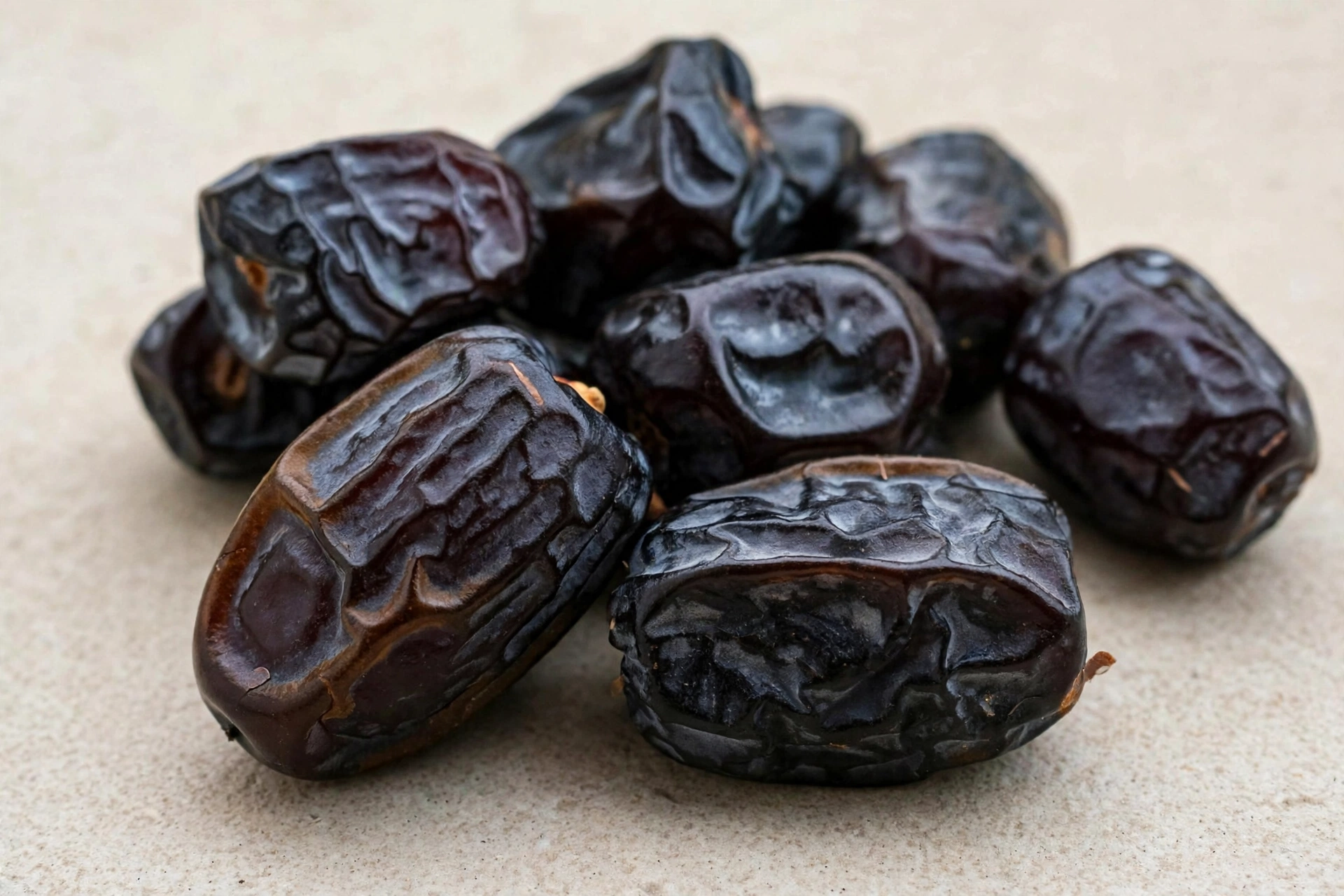
Ajwa is a named cultivar of Phoenix dactylifera grown in the Al Madinah Al Munawwarah province of Saudi Arabia. The scale is unusually easy to picture, because the Saudi reference encyclopaedia Saudipedia puts a number on it: the province holds roughly 4.5 million date palms across about seventy varieties, and about 800,000 of those palms are Ajwa.
Set that against the national picture. Saudi Arabia has around 37.1 million date palms, of which roughly 31.8 million bear fruit, and produced more than 1.9 million tonnes of dates in 2023. Madinah province contributed about 343,000 tonnes of that total, and Ajwa is only one of its seventy varieties. The cultivar that carries the highest premium of the lot is a small slice of a single province’s output.
Why nobody has simply planted more
This is the part that explains the persistence of the premium. Ajwa plantings have been attempted at scale and have failed for an ordinary reason: water.
Arab News reported on the launch of a company intended to help the Ajwa sector, and the same report describes an investor who planted 15,000 Ajwa palms in the Khaybar valley and other areas, lost all of them, and closed the farm because he could not supply enough water. Industry sources in that report call a lack of water in Madinah one of the biggest obstacles to expanding the crop.
The irrigation requirement is not a small one. FAO’s EcoCrop database puts date palm water demand at roughly 10,000 to 50,000 cubic metres per hectare per year, or about 1.5 cubic metres per palm per week on average, with irrigation needed about every fourteen days in summer. In an arid province where water is the binding constraint, a high price for the fruit does not create more water.

What about Ajwa grown outside Madinah?
It exists, but at trial scale. FreshPlaza reported an Egyptian company completing a first Ajwa trial of five tonnes and planning five export containers the following season, describing itself as the only Egyptian grower of the variety. Five tonnes is a rounding error against a province that produces hundreds of thousands of tonnes of dates.
There is also a reputational ceiling. A large part of the demand for Ajwa is specifically demand for Ajwa from Madinah, because the association that drives the purchase is geographic. A chemically identical fruit grown elsewhere does not satisfy a buyer who is purchasing it as a gift from Madinah. That is unusual: for most agricultural products, successful cultivation elsewhere eventually caps the price. For Ajwa, it only partly does.
The palm’s own timetable
Even where water and land are available, a date palm sets the pace, and the pace is slow.
| Stage | Typical timing | Source basis |
|---|---|---|
| Fruiting begins | 2 to 4 years after planting | FAO EcoCrop |
| Full production reached | 5 to 8 years, with one cited source giving 8 to 10 | FAO EcoCrop |
| Productivity may still be rising | up to about 9 to 15 years | FAO EcoCrop |
| Yield of a well managed palm | about 60 to 70 kg of fresh dates per year | FAO EcoCrop |
| Yield begins to decline | after 40 to 50 years | FAO EcoCrop |
| Productive life ends | around 75 years | FAO EcoCrop |
A University of California horticultural publication gives a slower figure still for commercial conditions, with harvestable fruit after about three to five years and full production at about fifteen to twenty years. The ranges differ because climate, water and management differ. The direction is the same either way.
Three consequences follow from that table.
- A price rise cannot pull in supply this season or next. If demand jumps today, the planting decision it triggers produces its first meaningful crop years later and its full crop years after that. Annual crops correct within a season. Tree crops cannot.
- The yield per palm is modest. At 60 to 70 kg per year for a well managed palm, a tonne of fruit needs roughly fifteen mature palms working for a full year. Scale in dates is built out of a lot of trees and a lot of time, not out of productivity jumps.
- Named cultivars are propagated vegetatively. Date palm is grown from offshoots taken from the base of a mother palm rather than from seed, because a seed grown palm does not reliably reproduce the parent’s fruit and has a roughly even chance of being male. Each mother palm supplies a limited number of offshoots in its life, which puts a physical cap on how fast a specific cultivar can be multiplied regardless of how much capital is available.
The work that is still done by hand
Date growing has mechanised less than almost any other commercial fruit crop, and the reasons are structural rather than a matter of tradition.
Pollination is a manual operation by necessity
The date palm is dioecious, meaning male and female flowers grow on separate trees. FAO’s date palm cultivation manual states plainly that commercial date production necessitates artificial pollination. Left alone, female flowers set fruit without commercial value.
So a worker has to bring pollen to each female inflorescence. Modern plantations keep roughly one male palm per fifty females, and the pollen is applied as fresh male strands tied between the female strands, as dry pollen with a puffer or duster, or as a pollen suspension.
The timing is unforgiving. FAO advises pollinating within two to four days of the female spathe opening, with a second pass three or four days later, and notes that yields drop sharply if pollination is delayed beyond a week. That is a narrow window, repeated for every flowering palm, in a short season, which means peak labour demand concentrated into days.
The same palm is climbed again and again
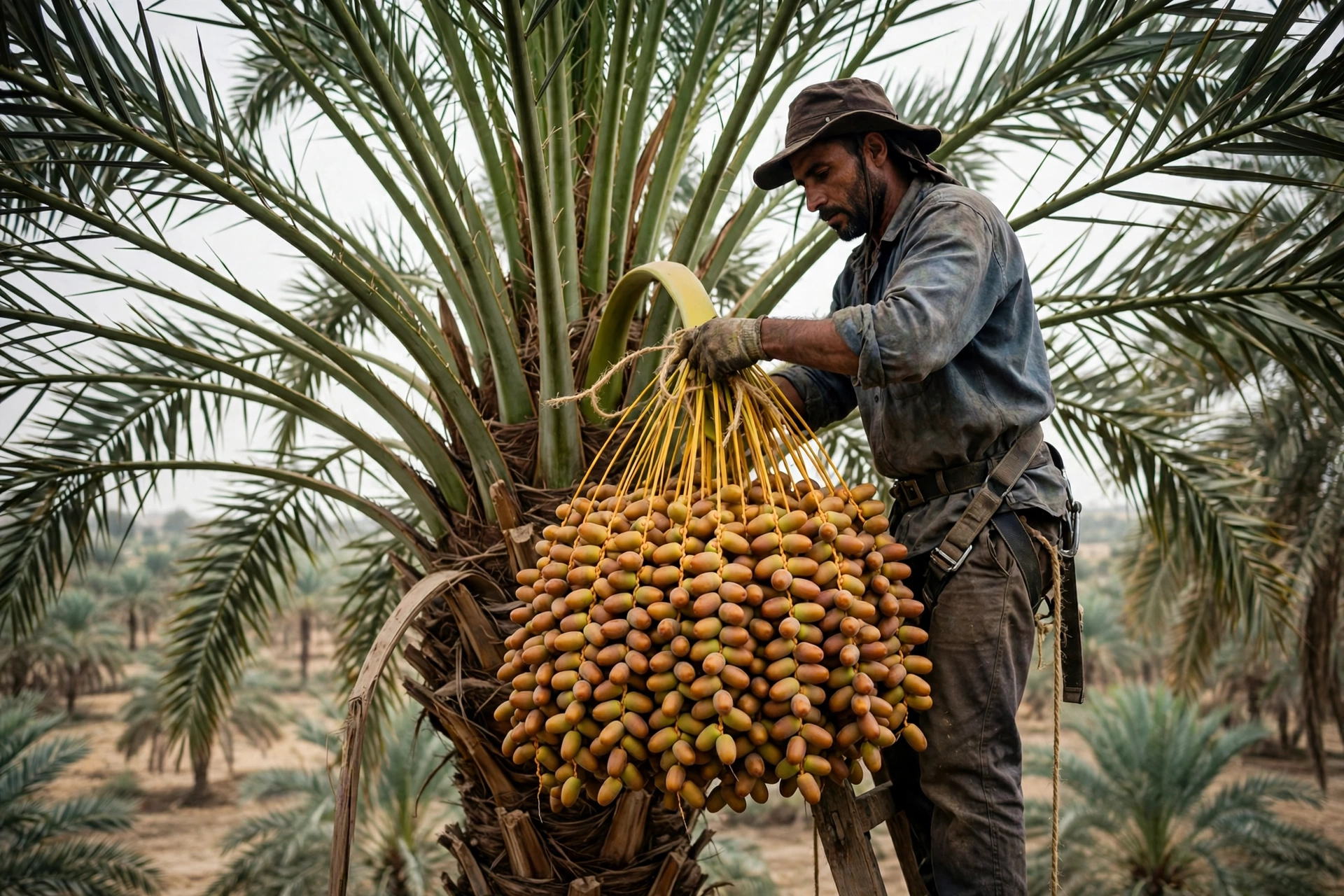
The single most revealing figure in the FAO manual is this: a worker must climb a date palm eight to ten times from pollination through to harvest. Mechanical pollination can reduce that labour by fifty to seventy percent and removes the climbing risk, but the full set of operations still requires access to the crown.
Those operations include thinning, which FAO describes as highly desirable at roughly fifty to sixty percent of flowers or fruits per bunch, and often removing between one half and three quarters of the fruits. Thinning is deliberate yield destruction in exchange for larger, more uniform fruit. For a cultivar sold on appearance and size, that trade is not optional, and it means the fruit that reaches a gift box is paid for partly by the fruit that was removed.
Bunches are then tied for support, because a ripe bunch can weigh thirty five kilograms or more, and may be covered with paper, netting or shade net bags against rain, birds and insects. A mature palm typically carries about ten bunches, with a recommended ratio of eight to nine leaves per bunch.
Harvesting and sorting cannot be done in one pass
Dates do not ripen simultaneously on a bunch, and Ajwa is sold at the fully ripe tamr stage. Fruit is picked as it reaches the right stage, which means repeat visits rather than a single mechanical harvest, and it is handled gently because a soft date bruises and skin separation is a cosmetic defect that drops the grade.
Sorting is then a human judgement exercise. The fruit is graded on size, uniformity, skin condition and colour. This is not a step that adds nutrition. It adds the consistency that a premium pack is sold on, and it is paid for in labour hours per kilogram.

Demand that does not respond to price
Supply explains why Ajwa cannot get cheap quickly. Demand explains why it does not need to.
Ajwa carries a specific religious association. It is named in the hadith collections, including Sahih al-Bukhari, where a narration from Sa’d ibn Abi Waqqas records the Prophet Muhammad as saying: “If somebody takes seven ‘Ajwa dates in the morning, neither magic nor poison will hurt him that day” (Sahih al-Bukhari 5769, Book 76 on Medicine). Scholars discuss the scope and application of this narration, and it is a religious text rather than a clinical finding. It is recorded here only to explain why the demand exists, and it should not be read as a health claim.
This hadith is cited solely to explain the commercial and cultural demand for Ajwa. It is not evidence of a medical effect and is kept separate from the nutrition and evidence discussion later on this page.
The commercial effect of that association is substantial and it arrives on a calendar.
- Umrah runs year round, so a baseline of visitors to Madinah is continuously in the market.
- Hajj concentrates millions of pilgrims into a few weeks, most of whom buy dates to take home.
- Ramadan lifts demand across every market at once, domestic and export, and importers stock up weeks ahead of it.
The scale of the pilgrim buying shows in official market data. Al Riyadh Daily, citing the Madinah branch of the Ministry of Environment, Water and Agriculture, reported that the Madinah Central Dates Market sold 724,381 kg of dates worth nearly SAR 12 million over a twenty day period around Hajj in 2026, through twenty auction lanes, with Ajwa named among the top selling varieties.
Two features of this demand matter for price.
- It is gift demand, not grocery demand. An earlier Arab News report on Saudi date exports noted that around thirty percent of exports were gifts and charity. A buyer choosing a gift is not comparing cost per hundred grams. They are choosing something presentable, named and associated with a place. That buyer tolerates a price a self consumer would refuse.
- It is time boxed. A pilgrim buys during their trip. They cannot wait for the price to fall after the Hajj season, because they will be home. Demand with a deadline is demand that pays.
What grading adds, and what it does not
A large part of the price gap between two packs of genuine Ajwa is grade rather than origin or authenticity. Saudi sellers use grade names such as Alia, first class, Quba and numbered lower classes, and Saudipedia notes that local usage also distinguishes a larger type, Ajwat Abi Dhira’a, from a smaller one, al Madradimah.
Grading is a cosmetic and size based sort. It reflects how much labour went into selecting the fruit and how much fruit was rejected to produce a uniform pack. It does not describe a different variety and it does not meaningfully change nutrition.
It is worth knowing how loose grade language can be even in regulated markets. The United States Standards for Grades of Dates do not define size by weight per date or count per pound at all. Uniformity is judged relative to the average size of the dates in that container, with Grade A allowing not more than ten percent by weight conspicuously larger or smaller than that average. In other words, “uniform” is defined against the pack, not against an absolute standard. Grade names from any market should be read as a seller’s description, not a measurement.
For a full breakdown of what each Saudi grade name signals and what the grades cost, see the full price guides below.
Cost added after the farm
A kilogram of Ajwa on a shelf in Manchester or Toronto has paid for several things that have nothing to do with growing it.
Temperature controlled storage and transport. Ajwa is a soft to semi soft date, and soft fruit is perishable. Guidance in the Global Cold Chain Alliance commodity storage manual gives semi soft dates at twenty to thirty percent moisture a storage life of about one month at 21C, three months at 15C, eight months at 4.4C and about a year at 0C, with soft dates above thirty percent moisture held at 0C for up to six months. It recommends storage and shipping at or below 7C, and 2C to 4.4C in hot weather. Every one of those degrees is a refrigeration bill carried from Madinah to the shelf.
Packaging that is part of the product. Because so much Ajwa is bought as a gift, it is sold in tins, wooden boxes and printed cartons in 200 g to 500 g formats. Packaging and the smaller format together are a real share of the shelf price, which is why a plain one kilogram pouch is almost always cheaper per hundred grams than two gift boxes.

Freight, duty and margin. Saudi date exports reached SAR 1.695 billion, about USD 451.7 million, in 2024 across 133 destination countries according to the National Center for Palms and Dates, which tells you the export channel is well established, not that it is free. Air freight for a perishable, cold chain handling at both ends, import duty, local repacking and two layers of margin all land on the final price.
Counterfeiting is a symptom of the premium, not a cause
Where a premium is large and verification is hard, substitution follows. That is worth understanding as evidence about the price rather than as a separate problem.
The mechanics are simple. Ajwa is a small, dark, wrinkled date, and it is not the only one. Kalmi and Safawi are both dark dates that trade well below Ajwa and are commonly presented as Ajwa outside Saudi Arabia. The visual difference is subtle enough that most buyers cannot judge it, and the price difference is large enough to be worth the deception.
Enforcement activity gives a sense of the scale of mislabelling in this category.
- A Ministry of Commerce raid in Riyadh in March 2024, carried out with the Ministry of Human Resources and the Saudi Food and Drug Authority, seized 400 kg of substandard dates, 3,000 empty plastic packets, 5,000 cardboard crates and 100,000 stickers bearing several date brand names and fake expiry labels (Gulf News). The stickers are the detail that matters: the business model was relabelling.
- An Arab News report from 2014 described agricultural researchers proposing that Madinah dates be stamped with a logo, because distributors were selling ordinary dates at international events while claiming Madinah origin.
The practical lesson for a buyer is that a suspiciously low price is a stronger signal than a high one. If a seller offers “Ajwa” at close to ordinary dark date prices, variety substitution is the most likely explanation.
The specific identification points are set out in Ajwa vs Kalmi dates.
Is the premium worth paying?
This depends entirely on what you are buying it for, and the honest answer in some cases is no.
| Your purpose | Is top grade Ajwa worth it? | Better choice |
|---|---|---|
| A gift from Madinah, or an Umrah or Hajj gift | Yes. Presentation, naming and origin are the product | First class or Alia grade in retail packaging |
| Eating a few at a time, deliberately, during Ramadan | Usually yes at mid grade | Quba or standard retail grade in a 1 kg pouch |
| Everyday dates for the family fruit bowl | Rarely | Khudri, Safawi or Medjool at a fraction of the price |
| Blending into smoothies, paste, bars or baking | No | Lowest grade Ajwa or a cheaper soft variety |
| Making Ajwa seed powder | No | Low grade fruit, since the seed is the target |
| Buying for a specific health outcome | No basis for the premium | See the evidence caveat below |
Research on Ajwa and on date seeds exists, but much of it is preliminary, conducted in animals or in vitro, or on extracts rather than on the fruit as eaten. Evidence in humans remains insufficient to recommend Ajwa over other dates for any health outcome, and no date treats, prevents or cures disease. Paying a premium over Khudri or Safawi for a nutritional advantage is not supported by the current evidence base.
Where the premium is genuinely avoidable
If you want Ajwa and not the markup, four things reliably cut the per kilogram cost without changing the variety.
- Drop the grade, not the variety. A lower grade is smaller or less uniform fruit. It is the same cultivar.
- Buy the pouch, not the box. Gift packaging in small formats is the single biggest avoidable cost in Western retail.
- Buy a larger unit. Bulk cartons are priced close to wholesale and the per kilogram difference is substantial.
- Buy outside the demand peaks. Prices firm ahead of Ramadan and during Hajj. The window after the main Saudi harvest, which runs roughly August to September, is usually the best combination of price and freshness.
For the numbers behind each of those levers, see the Ajwa dates price guide. For what a kilogram actually contains before you compare two packs, see how many Ajwa dates are in 1 kg.
Two reference points for scale
This page avoids a price table on purpose, because listed prices change and belong on the dedicated pages. Two figures are useful here as anchors only.
Arab News, reporting on the Ajwa sector, cited an average of about SAR 40 per kilogram, roughly USD 11, for the fruit. Saudi listed retail prices for graded Ajwa checked on 30 October 2026 ran from about SAR 56 per kilogram at the lowest grade to about SAR 130 per kilogram at first class.
The gap between those two numbers is the whole story of this page in miniature. Most of it is grading, packing, storage and retail, applied to a fruit whose supply was already fixed before any of that began.
Current prices by market and grade: see the links below.
Frequently asked questions
Why is Ajwa more expensive than Medjool when both are premium dates?
Medjool is produced commercially in several countries, including Morocco, Israel, the United States and Jordan, so a price rise in one origin can be answered by supply from another. Commercial Ajwa stays concentrated in one Saudi province where water, not demand, is the limiting factor. Medjool also has no equivalent religious and gifting demand attached to a specific city. The variety comparison is in Ajwa vs Medjool.
Will Ajwa get cheaper as more farms plant it?
Not quickly, and possibly not much. A new planting takes several years to first fruit and longer to reach full production, the Madinah water constraint limits expansion inside the traditional area, and plantings outside Madinah do not fully substitute because a large share of demand is specifically for Madinah origin.
Is expensive Ajwa better for you than cheap Ajwa?
No. Grade is a cosmetic and size sort, not a nutritional one. A lower grade is smaller or less uniform fruit of the same cultivar. If the dates are being blended, baked or made into paste, the premium buys appearance you are about to destroy.
Does Ajwa cost more during Ramadan and Hajj?
Yes, and the rise typically begins before those periods as retailers and importers build stock. Buying a few weeks after the main Saudi harvest, which runs roughly August to September, usually avoids both peaks.
If Ajwa is so constrained, how is it available everywhere?
Partly genuine export, which reached SAR 1.695 billion across 133 countries for Saudi dates overall in 2024, and partly substitution. Other dark varieties are frequently sold under the Ajwa name in markets where buyers cannot verify origin, which is why enforcement cases centre on relabelling.
Is there an official way to verify Madinah origin?
Not a universal consumer facing one. A proposal to stamp Madinah dates with an identifying logo was reported as far back as 2014, specifically to address false origin claims. In practice a buyer is relying on the seller’s origin statement, the packing information and the fruit itself.
Why is Ajwa so expensive?
For the same reasons this article sets out: commercial Ajwa stays concentrated in one Saudi province where water, not demand, limits supply; the palms take years to bear and much of the work is still done by hand; and religious and gifting demand attached to Madinah does not fall when prices rise. The full breakdown is above, and current listed prices are in the Ajwa dates price guide.
Sources
Citations below are listed as supplied; none carry a publicly resolvable article URL and are kept as plain text references.
- Saudipedia, Ajwa Dates article (National Center for Palms and Dates, Taibah University and Saudi Press Agency cited), for the figure of about 4.5 million date palms and about 800,000 Ajwa palms in Al Madinah province, seventy varieties, ripening timeline and local type names
- Saudipedia, How Many Ajwa Date Palms Are There in Saudi Arabia, citing the Madinah branch of the Ministry of Environment, Water and Agriculture
- Argaam, Saudi Arabia produces 1.9M tons of dates in 2023, for national and regional palm counts and regional production tonnages
- FAO EcoCrop database, Phoenix dactylifera, for years to fruiting and full production, yield per palm, productive life and water requirement
- FAO, Date Palm Cultivation (Y4360E), pollination and bunch management chapter, for dioecy, the necessity of artificial pollination, male to female ratios, the pollination window, the eight to ten climbs per palm figure, thinning rates, bunch weight and bunch covers
- University of California Division of Agriculture and Natural Resources, date palm offshoot publication, for years to harvestable fruit and full bearing under commercial conditions
- FAO, Date Palm Products (T0681E), for ripening stage definitions and moisture content at the khalal, rutab and tamr stages
- Sahih al-Bukhari 5769, Book 76 (Medicine), narrated by Sa’d ibn Abi Waqqas, via sunnah.com
- Al Riyadh Daily, Madinah Dates Market Records Sales of Nearly SAR12 Million Amid Increased Pilgrim Demand, 31 May 2026, citing the Madinah branch of the Ministry of Environment, Water and Agriculture
- Arab News, New company will help Madinah’s Ajwa dates reach new heights, industry experts say, for the 800,000 palm figure, the average SAR 40 per kg figure, and the Khaybar valley planting failure and water constraint
- Arab News, Logo urged for Madinah dates to check fraud, 22 October 2014, for false origin claims and the gift and charity share of exports
- Gulf News, Saudi Arabia: Crackdown on substandard dates in Riyadh, 16 March 2024, for the Ministry of Commerce raid and seizure figures
- FreshPlaza, Ajwa dates now grown in Egypt, for the Egyptian trial scale
- Global Cold Chain Alliance, WFLO Commodity Storage Manual, Dates, for storage temperatures, humidity and storage life by moisture class
- Arab News Japan, Saudi Arabia’s date exports rise 15.9% in 2024, citing the National Center for Palms and Dates, for export value and destination count
- United States Department of Agriculture, Agricultural Marketing Service, United States Standards for Grades of Dates, for size uniformity definitions
- Al-Khayri, Jain and Johnson (eds.), Date Palm Genetic Resources and Utilization, for variety background
Amira Noor

Amira Noor writes about Ajwa dates, their origin in Madinah, nutrition and heritage, with clear, practical guides for readers.