
Date Varieties
Khudri Dates: A Practical Buying, Grading and Storage Guide
Khudri is one of Saudi Arabia’s most widely grown date varieties – affordable, chewy, and frequently confused with cultivars that only sound similar. This guide covers identity, grading, storage, price context and the substitution traps worth knowing before you buy.
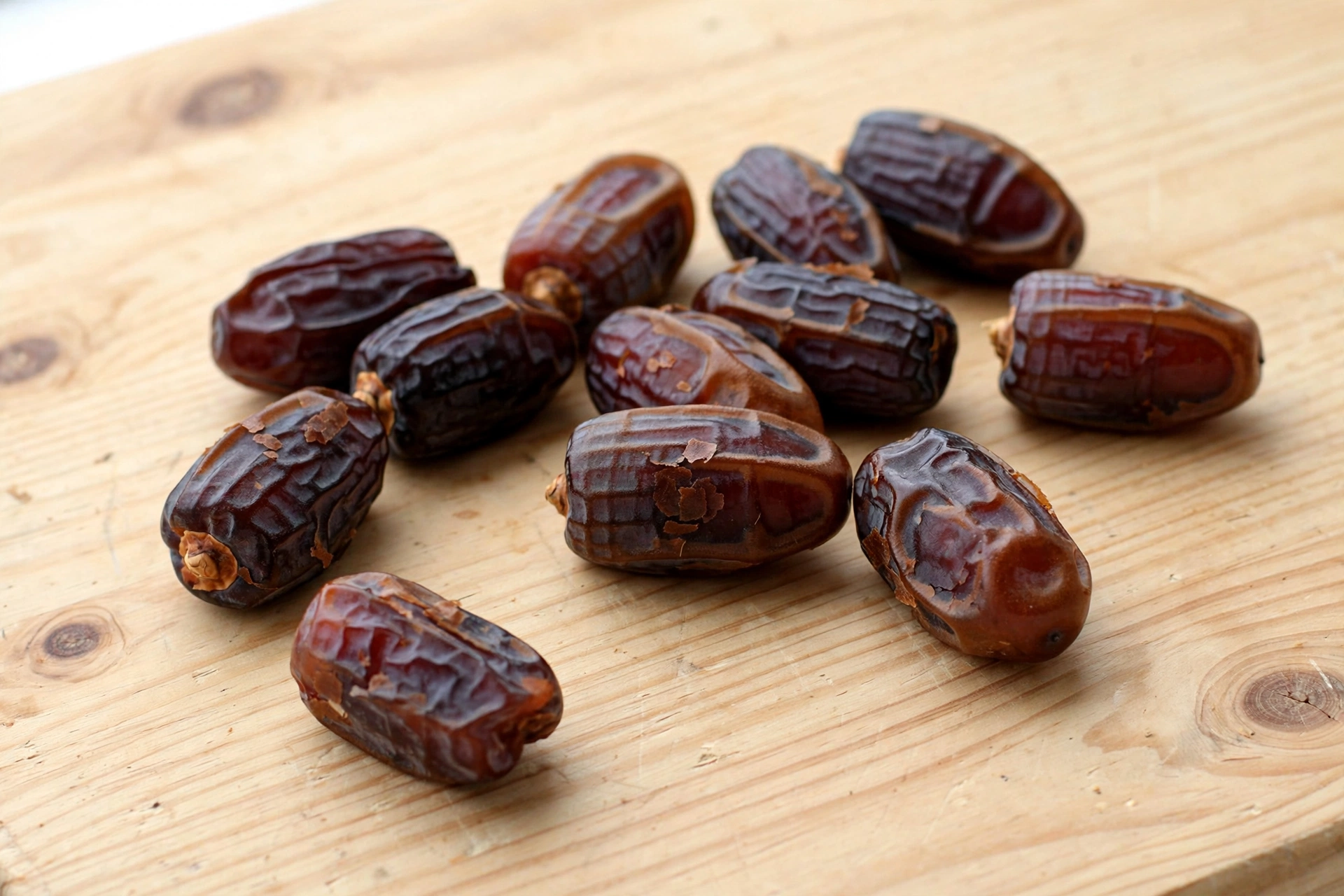
Khudri is a Saudi date cultivar grown across several regions of the Kingdom, including al-Jawf, Hail and the central governorates, where it is one of the leading varieties. It is sold at the fully ripe tamr stage as a medium to large, dark brown, lightly wrinkled date with a chewy bite. It is graded by size and appearance rather than by sub-variety, and it sits in the affordable half of the Saudi date market.
Which Cultivar You Are Actually Buying
Before any discussion of grade or price, settle the identity question, because this is where most money gets wasted on Khudri.
The Saudi cultivar is written as Khudri, Khudari, Khudry, Khodari and Khodry by different packers, and the Arabic is الخضري. Saudipedia, the national encyclopedia published under the Saudi Ministry of Media, lists Khudri among the Kingdom’s principal commercial varieties and places it in several provinces rather than a single oasis. Its regional survey of palm areas puts Khudri in al-Jawf, Hail and the southwestern oases, and records it as the first ranked variety in the central governorates of al-Zulfi, Sudair and al-Aarid.
That spread matters commercially. Ajwa is a single region cultivar and its price reflects a fixed number of mature palms around Madinah. Khudri is planted widely, supply responds to demand, and the price behaves like an ordinary agricultural commodity. Anyone marketing Khudri as rare is selling you a story.
The Name That Causes the Real Confusion
Khudri is not Khadrawi. Khadrawi, also written Khudrawi and Khadrawy, is a separate cultivar of Iraqi origin now grown in Pakistan, Iran and the United States. The FAO date products handbook lists Khadrawy as a soft date at 24.4 percent moisture, and a 2016 physicochemical survey of 32 varieties at the Date Palm Research Station in Jhang, Pakistan, measured Khudrawi at 22.31 percent moisture at the tamr stage, with 52.93 percent total sugars.
Two practical consequences:
- A pack labelled Khidri or Khudri from an Iranian or Pakistani trader may be a different cultivar from the Saudi Khudri, even when both names appear on the same website.
- Trade pages that claim Khudri originates in Bushehr Province in Iran are describing the Iranian naming convention, not the Saudi cultivar that Saudi government sources document.
If provenance matters to you, buy from a pack that states Saudi Arabia as the country of origin and names a region. If it does not matter, you are free to ignore the whole question, but then do not pay a Saudi premium for it.
Harvest Stage and Moisture Class, and Why That Decides Everything Else
Khudri reaches the retail shelf at the tamr stage, the fourth and final stage of date maturity. The FAO handbook on date palm products sets out the sequence and the moisture that goes with it: kimri at around 85 percent moisture, khalal at roughly 50 to 60 percent, rutab at 30 to 45 percent, and tamr below about 25 percent and sometimes as low as 10 percent.
The threshold that matters for a buyer sits at roughly 24 to 25 percent moisture. Below that figure a date becomes self preserving, because the sugar concentration in the remaining water is high enough to stop most microbial spoilage. Above it, the fruit is perishable and needs cold storage.
Khudri is normally handled as a semi-dry to soft tamr date, firm enough to travel and store without refrigeration but still pliable. We could not locate a published moisture measurement for the Saudi Khudri cultivar specifically, so treat any precise percentage you see quoted for it as unverified.
The practical reading of that moisture class:
| What you notice | What it means | What to do |
|---|---|---|
| Firm, chewy, skin slightly flaky | Normal Khudri at tamr | Nothing, this is the variety |
| Sticky surface, very soft flesh | Higher moisture batch or warm storage | Refrigerate and eat sooner |
| Hard, brittle, sugar crust visible | Moisture loss in storage | Steam or soak before use, fine for cooking |
| Fermented or alcoholic smell | Spoiled | Discard |
Grades and Sizes
Khudri is graded on appearance and calibre, not on sub-variety. The same palm, the same orchard and the same harvest produce several grades, and the difference between the top and bottom grade in one shop is usually wider than the difference between two shops at the same grade.
| Grade signal on the pack | What it describes | Where it sits |
|---|---|---|
| Large, jumbo, malaki, premium | Biggest calibre, uniform, intact skin, hand sorted | Top of the range |
| Medium, standard, class one | Even size, minor skin flaking accepted | The usual retail grade |
| Small, economy, class two or three | Mixed calibre, more flaking, occasional blemish | Lower priced |
| Loose or bulk carton | Mixed calibre, often last of the crop year | Lowest per kilogram |
| Pitted or seedless | Any calibre, machine or hand pitted | Priced by convenience, not quality |

Two cautions on grade language.
Malaki is a marketing word, not a standard. It appears on Khudri packs from several GCC retailers and simply signals the packer’s own top selection. There is no published grading scheme behind it.
Pitted is not a grade. Pitting removes roughly 8 to 10 percent of the fruit weight as seed. A pitted kilogram and a seed-in kilogram at the same price are not the same purchase, so compare them only after you decide which you actually want.
Does Grade Change the Eating?
For eating out of hand, yes. A large uniform Khudri with intact skin is a more pleasant date than a small flaky one. For anything blended, chopped, stuffed, baked or turned into paste, grade buys you appearance that the recipe destroys. Buying the lowest grade you can tolerate is the single easiest saving available on this variety.
Price Context
Khudri is one of the cheaper named Saudi varieties, which is most of its appeal. Full price tables for the Ajwa Hub price silo live on the Ajwa dates price guide, and the Saudi market detail sits on Ajwa dates price in Saudi Arabia. What follows is context, not a price list.
Four Khudri listings read directly on 30 October 2026 show the spread:
| Seller and market | Listing | Per kg as listed |
|---|---|---|
| Sainsbury’s, United Kingdom | Tahira Khudri Dates 450 g at £3.50 | about £7.78 |
| Darussalam UK | Khudry Dates 400 g at £8.00 | about £20.00 |
| Mecca Books, United States | Khudri Dates 400 g at USD 14.95 | about USD 37 |
| Dattelbaer, Austria and Germany | Khidri organic 600 g at €12.95 | about €21.58 |
Listed figures are examples of market pricing on the date shown, not fixed or current rates.
That range is a fourfold spread on the same variety name, and it is not explained by quality alone. The supermarket pack is a mainstream grocery line sold in volume. The specialist and organic packs carry smaller print runs, retail gift presentation and in one case an organic certification. Treat the supermarket figure as the floor for ordinary eating Khudri in a Western market and the specialist figure as what presentation and certification cost on top.
Against Ajwa the gap is the point. A kilogram of Ajwa from a Madinah seller sat between SAR 56 and SAR 130 on the same date. Khudri does not carry the single region supply limit or the religious demand that keeps a floor under Ajwa, so it is structurally cheaper and will stay that way.
Storage and Shelf Life
Because Khudri arrives below the self preserving moisture threshold, it does not need refrigeration to be safe. Refrigeration changes how long it stays pleasant rather than whether it stays edible.
| Storage | Effect | Reasonable window |
|---|---|---|
| Sealed, cool pantry, below 20°C | Gradual moisture loss, slow sugar crystallisation | Several months |
| Refrigerated, 4 to 5°C, airtight | Texture held, surface sugaring slowed | Up to around a year |
| Frozen, airtight, minus 18°C | Texture and colour largely held | Longer still, thaw sealed |
| Warm kitchen, open packet | Drying, hardening, insect risk | Weeks |
Three points worth knowing.
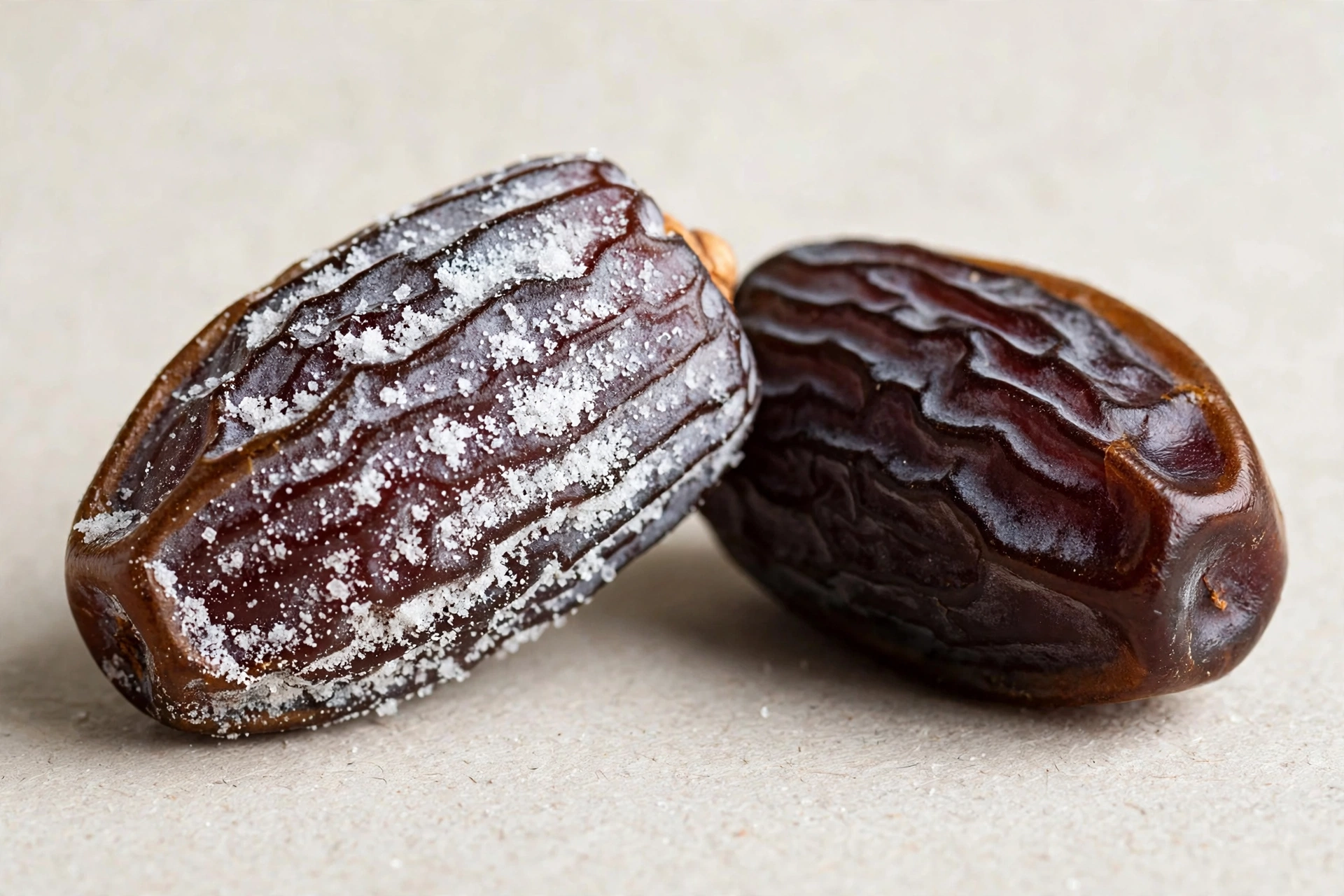
White bloom is not mould. A fine white crust on a stored date is crystallised sugar. It wipes off, and steaming or a short soak reverses it. Mould is fuzzy, localised and smells wrong.
Insects are the real storage threat, not bacteria. The FAO handbook notes that tamr dates keep for long periods without special precautions provided they are protected from insects. An airtight container does more for a bag of Khudri than a cold shelf does.
Shelf life claims of 12 to 18 months are common on trade sites and are plausible for a sealed, cool stored pack, but they are supplier statements rather than measured data. Judge your own pack by smell and texture.
Culinary and Practical Uses
Khudri suits cooking better than it suits ceremony, which is the opposite of Ajwa. Its firmer bite means it holds shape when chopped and does not collapse into the batter, and its moderate sweetness leaves room for other flavours.
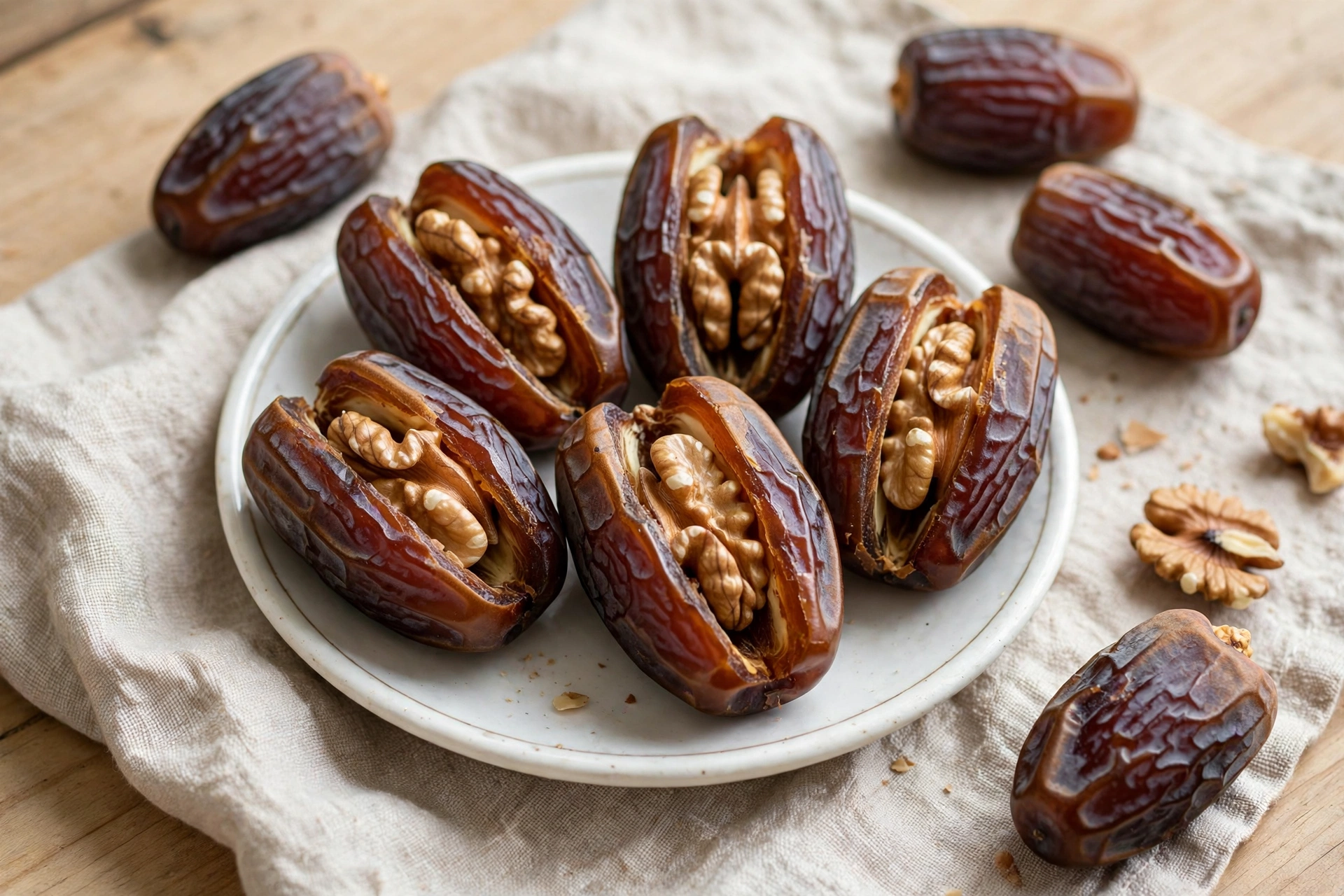
The firm flesh takes a filling without tearing. Split lengthways, remove the seed, press in a walnut half, an almond, a pistachio paste or a spoonful of cream cheese. Mecca Books lists exactly this use on its Khudri product page, and it is the standard GCC serving style for the variety.
Large Khudri holds its shape in oat bars, cakes and biscuit doughs where a softer date would smear. Flour the chopped pieces lightly to keep them separated.
Soak in hot water for 20 to 30 minutes, blend with a little of the soaking water, and you have a paste that replaces refined sugar by volume in most bakes. Lower grades are the correct choice here. See date recipes for method detail.
The sugar profile in Saudi cultivars is dominated by glucose and fructose rather than sucrose, which is why dates are absorbed quickly. Khudri is a practical choice for this because it is cheap enough to eat in quantity.
Khudri seeds are large and hard and can be roasted and ground the same way as any other date seed. The method is on how to make Ajwa seed powder, and it works identically for Khudri.
What Khudri does less well: a dessert where the date is the whole point, a gift box, or anything calling for the dense caramel softness of a Medjool.
Buying Guidance
What to Check on the Pack
- Country of origin stated, ideally with a region
- Variety name spelled out, not just “Saudi dates”
- Net weight, and whether seed-in or pitted
- Grade or calibre word, or fruit visible through the pack
- Packing or best before date
- Ingredients listed as dates only, with no glucose syrup, oil or preservative
- Price recalculated per 100 g before comparing
Substitution Risks
Khudri is more often the substitute than the victim. Because it is a cheap, dark, medium to large date, it is a convenient stand-in for pricier varieties.
Khudri sold as something else. Dark Saudi dates of similar size are regularly presented under better known names in markets outside Saudi Arabia. If a dark date is priced like Khudri and sold as a premium variety, the price is telling you the truth.
Khudri that is not Saudi Khudri. Covered above. The Khadrawi and Khidri naming overlap is the main trap.
Coated or glazed fruit. Some dates are finished with a thin oil or syrup glaze to improve shine. It is not harmful, but it adds weight and masks dryness. Rub one between finger and thumb. A glazed date leaves a slick film, a natural one does not.
A nutrition panel that cannot be right. One European Khudri listing we checked on 30 October 2026 declared 430 kcal, 10 g fat and 6 g saturated fat per 100 g. Dates contain well under 1 g of fat per 100 g in every reference database. A panel like that is a data entry error, and it is a reasonable signal to doubt the rest of the listing.
Khudri Against Ajwa and Medjool, as a Buying Decision
| Practical question | Khudri | Ajwa | Medjool |
|---|---|---|---|
| Size | Medium to large | Small to medium, measured at 9.75 g average fruit weight in a Madinah cultivar study | Largest, 13.07 g in the same study |
| Bite | Chewy, firmer | Soft with slight chew | Soft, dense, fudge-like |
| Sweetness | Moderate | Moderate, less sweet than Medjool | Pronounced, caramel |
| Price position | Low | High | Mid to high |
| Best for | Cooking, stuffing, everyday eating, paste | Gifting, religious observance, eating slowly | Dessert, cheese boards, eating out of hand |
| Supply | Several Saudi regions | Madinah region only | Multi-country, industrial scale |

The honest summary: Khudri wins on cost per kilogram and on structural integrity in cooking. Medjool wins on pure eating pleasure. Ajwa wins on provenance and on meaning, and neither Khudri nor Medjool competes there. For the Ajwa and Medjool comparison in full, see Ajwa vs Medjool. For the Ajwa cultivar itself, start at Ajwa dates. Other named varieties are covered on other date varieties.
A note for anyone cross shopping: do not buy Khudri expecting a cheap Ajwa. They are different eating experiences and the saving is not a discount on the same thing.
Frequently Asked Questions
Is Khudri the same as Khudari?
Yes. Khudri, Khudari, Khudry, Khodari and Khodry are transliterations of the same Arabic name, الخضري. Pack spelling varies by importer and tells you nothing about quality.
Are Khudri and Khadrawi the same cultivar?
No. Khadrawi, also written Khudrawi, is a separate cultivar of Iraqi origin grown commercially in Pakistan, Iran and the United States. The names sound close and some traders use Khidri for both, which is why country of origin on the pack is worth reading.
Do Khudri dates need to be refrigerated?
Not for safety. They are sold at the tamr stage, below the roughly 24 to 25 percent moisture level at which dates become self preserving. Refrigeration extends the period in which they stay soft and keeps sugar crystallisation at bay, so it is a quality choice rather than a food safety one.
Why is my Khudri covered in white crystals?
That is crystallised sugar drawn out as the fruit lost moisture, not mould. Steam the dates for a minute or soak them in warm water and the texture comes back.
Is Khudri a good date for baking?
It is one of the better choices. The firmer flesh survives chopping and holds its shape in a batter, and the moderate sweetness means the bake does not taste only of date.
How many Khudri dates are in a kilogram?
We have not found a published average fruit weight for Khudri, so any count would be a guess. The method for working it out from a weighed sample of your own pack is set out in how many Ajwa dates are in 1 kg and applies to any variety.
Is Khudri cheaper because it is lower quality?
No. It is cheaper because it is planted across several Saudi regions, so supply can expand, and because it carries none of the religious demand attached to Ajwa. Quality within the variety is a question of grade, not of the variety itself.
Sources
Prices and product details were read directly from seller listings on 30 October 2026 and are examples of market pricing, not fixed rates.
- Saudipedia, List of Date Varieties in Saudi Arabia (Khudri recorded as cultivated in several provinces)
- Saudipedia, Palm Areas in Saudi Arabia (Khudri in al-Jawf, Hail and the southwestern oases, first ranked in the central governorates of al-Zulfi, Sudair and al-Aarid)
- FAO, Date Palm Products, Chapter 1: Whole Dates (maturity stages, moisture at each stage, the self preserving threshold, insect protection in storage, Khadrawy classed as soft at 24.4 percent moisture)
- Qadri, R. W. K., Waheed, S., Haider, M. S., Khan, I., Naqvi, S. A., Bashir, M. and Khan, M. M. (2016), “Physicochemical characterization of fruit of different date palm (Phoenix dactylifera L.) varieties grown in Pakistan”, The Journal of Animal and Plant Sciences, 26(5), 1268-1277 (Khudrawi moisture and total sugars at the tamr stage)
- Alaida, M. F. and Aldhebiani, A. Y. (2022), “Comparative study of the morphological characteristics of Phoenix dactylifera L. cultivars in Al-Madinah Al-Munawarah, Saudi Arabia”, BMC Plant Biology, 22, 461 (Ajwah and Majdool fruit weights used in the comparison table)
- Hamad, I., AbdElgawad, H., Al Jaouni, S., Zinta, G., Asard, H., Hassan, S., Hegab, M., Hagagy, N. and Selim, S. (2015), “Metabolic analysis of various date palm fruit (Phoenix dactylifera L.) cultivars from Saudi Arabia to assess their nutritional quality”, Molecules, 20(8), 13620-13641 (sugar profile dominated by glucose and fructose in the Khodry sample)
- Sainsbury’s product listing, Tahira Khudri Dates 450 g
- Darussalam UK product listing, Khudry Dates 400 g
- Mecca Books product listing, Khudri Dates 400 g
- Dattelbaer product listing, Khidri organic dates 600 g (also the source of the implausible nutrition panel discussed above)