
Kimia Dates: A Buyer’s Guide to Grades, Storage and Use
Kimia is the Indian subcontinent’s market name for a well known Iranian cultivar. Here is what that means for buying, storing and cooking with it.
Last checked / verified: 30 October 2026
Kimia dates are soft, almost black, high moisture dates sold mainly in India, Pakistan and the Gulf. They are not a separate botanical variety. Kimia is the commercial name that the Indian subcontinent market uses for the Iranian Mazafati cultivar grown around Bam in Kerman province. Because the fruit holds a lot of water, Kimia needs chilled storage and sells in smaller packs than firmer dates.

What you are actually buying
Three facts explain almost every practical decision you will make about Kimia dates.
It is one cultivar under two names. The fruit is Phoenix dactylifera cultivar Mazafati, also spelled Mozafati and known in Iran as the Bam date. Botanical and agronomic literature uses the Mazafati name. “Kimia” does not appear in cultivar lists or in peer reviewed work on Iranian dates. It is a trade name that took hold in the Indian subcontinent and stayed. For the full origin story and the naming evidence, see what are Kimia dates.
It is harvested soft and stays soft. Mazafati is picked at or close to the rutab stage, the point at which the fruit has softened and darkened but has not dried down. A date at that stage carries roughly 30 to 35 percent moisture, against about 20 to 25 percent for a fully dried tamr-stage date. That single difference drives the texture people buy Kimia for, and also the storage problem that comes with it.
It is not a Saudi date. A large number of blog pages describe Kimia as a Madinah or Saudi variety, sometimes in the same breath as Ajwa. The commercial crop is Iranian, concentrated in Kerman province, with secondary production in Sistan and Baluchestan and across the border in Pakistani Balochistan. If a pack claims Saudi origin for Kimia, treat the label as unreliable rather than the fruit as special.
How to recognise good Kimia at the point of sale
Kimia is one of the easier dates to judge by eye, because the qualities buyers want are the qualities you can see.
| Signal | What good Kimia looks like | What to be wary of |
|---|---|---|
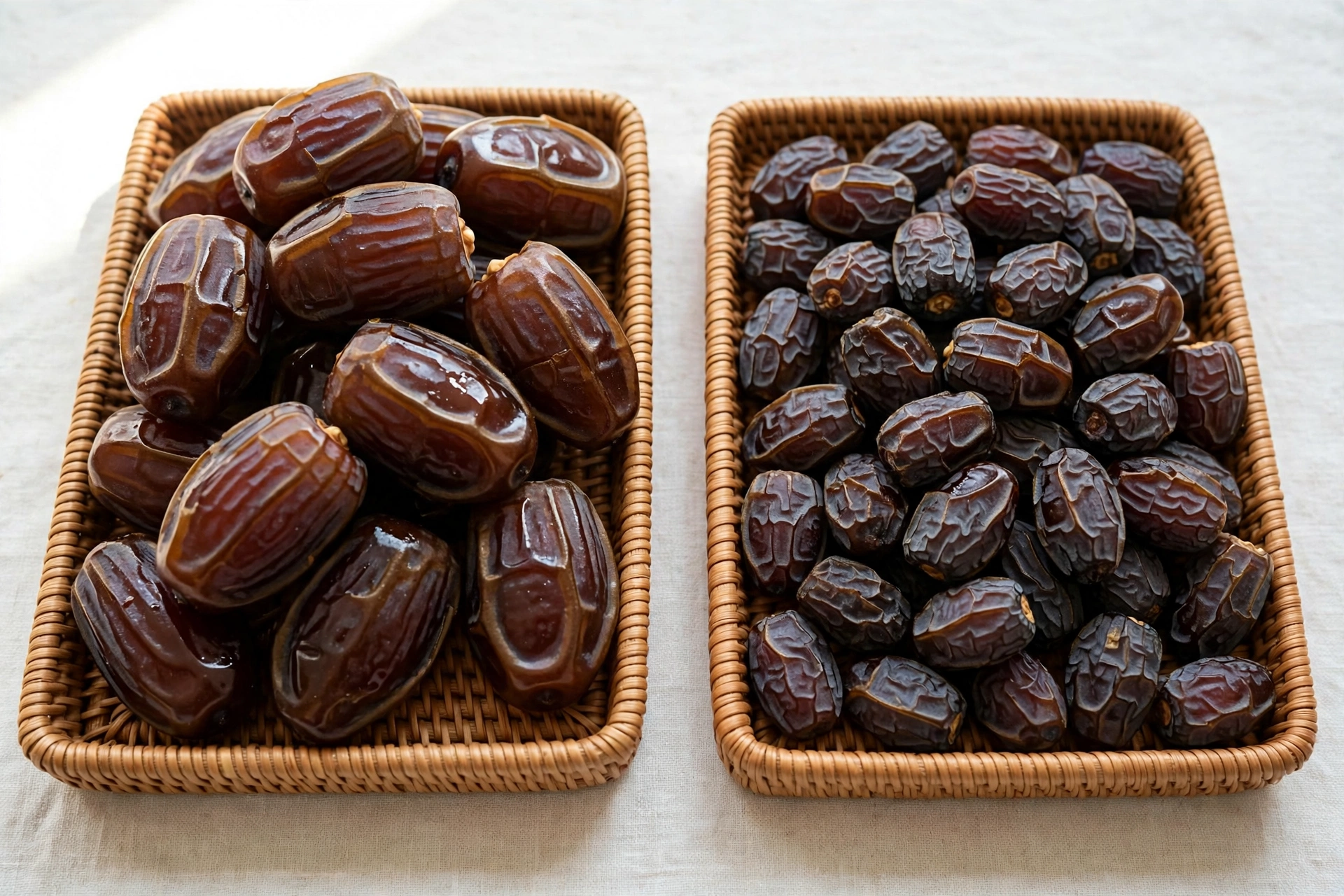
| Colour | Deep brown to near black, with a matt or slightly dewy surface | A hard glossy shine, or jet black that transfers onto a napkin |
| Skin | Smooth to lightly wrinkled, sitting close to the flesh | Heavily shrivelled and papery skin lifting away from the fruit, which usually means it has dried out in storage |
| Give | Yields easily under light thumb pressure and feels sticky | Firm or rubbery, which means low moisture or an older crop |
| Surface liquid | A little natural syrup at the stem end is normal | Pooled syrup in the tray, or a wet patch in the carton, which signals heat damage or fermentation |
| Smell | Sweet and faintly caramel, with no sharpness | Any sour, alcoholic or vinegary note |
| Crystals | A light white bloom of crystallised sugar is harmless | A uniform sandy coating, which can be added sugar rather than natural bloom |
The sour note is the one worth learning. High moisture dates ferment rather than simply going stale, and a sour smell is usually detectable before anything looks wrong.
Grades and size classes in the market
Kimia grading is commercial, not botanical. Two separate systems are in use and sellers often mix them, which is why one shop’s “premium” can be another’s “standard”.
Grading by moisture and cosmetic quality. Iranian exporters generally sort into an A or A plus top class with the highest moisture, plumpest fruit and intact skin, a mid B class with slightly lower moisture and more wrinkling, and a lower C or industrial class that goes to paste, syrup and filling rather than retail trays. The higher the moisture, the softer and more desirable the fruit, and the more fragile the supply chain has to be.
Grading by count per kilogram. Trade listings also sort by size, usually described as jumbo, large, medium and small, expressed as pieces per kilogram. Larger counts per kilogram mean smaller fruit.
Published size for the cultivar is roughly 2.5 to 4.5 cm in length, with a typical fruit weight around 7 to 9 g in one review of Iranian cultivars. That gives a rough feel for how many dates a kilogram contains, but it is a cultivar average and not a guarantee for a specific grade.
Two practical points follow from this.
First, grade is cosmetic and moisture based. A B grade Kimia is the same cultivar, grown in the same groves, and is not nutritionally inferior in any meaningful way. If the dates are going into a smoothie, a chutney, a filling or a date paste, buying the top grade is paying for appearance you are about to destroy.
Second, the higher the grade, the shorter the honest shelf life at warm temperatures. Very high moisture fruit is the most pleasant to eat and the least tolerant of a hot shelf. If you cannot refrigerate, a slightly lower moisture grade is the better purchase, not the worse one.
How Kimia is sold
Pack sizes
Retail packs cluster at 250 g, 400 g and 500 g, with 1 kg boxes common in Indian and Gulf grocery. Bulk and food service supply moves in cartons, usually built from twelve retail boxes or sold as a 5 kg to 6 kg carton. Smaller retail units are the norm for a reason: a soft date deteriorates faster once a pack has been opened and warmed, so the trade sizes it for quicker turnover than a firm date would need.
Chilled versus ambient
This is the single most useful question to ask about a Kimia pack, and the one sellers answer most inconsistently. Some listings describe refrigeration as optional and quote long ambient shelf lives. Others insist on a cold chain and ship in refrigerated containers. Both are describing real products, because the trade splits by grade: lower moisture fruit genuinely does tolerate an ambient shelf, while the plump high moisture grades do not.
In practice, buy on what you can see and smell rather than on what the label promises, and ask where the stock has been held. A soft high moisture Kimia that has sat on a warm shelf for weeks will tell you so.
Seed in or pitted
Kimia is normally sold with the seed in. Pitted Kimia exists, and because pitting a very soft date is awkward, pitted packs are usually a slightly lower moisture grade. If you are comparing prices, compare like with like, because seed weight is typically a meaningful share of the whole fruit.
Storage and shelf life
Kimia is in the awkward category: too wet to be shelf stable, not wet enough to be treated as fresh fruit.
The reason is a threshold rather than a preference. Dates become broadly self preserving below roughly 20 to 25 percent moisture, because at that water activity moulds and yeasts cannot get going. Above about 25 percent, souring becomes a real risk. Kimia at the soft end of the range sits above that line, which is why it behaves like a perishable.
| Where you keep it | Realistic expectation | Notes |
|---|---|---|
| Warm kitchen shelf, above about 25°C | Days to a couple of weeks | Softest grades will weep syrup and can sour. Not a storage plan |
| Cool pantry, airtight, below about 20°C | A few weeks | Workable for lower moisture grades only |
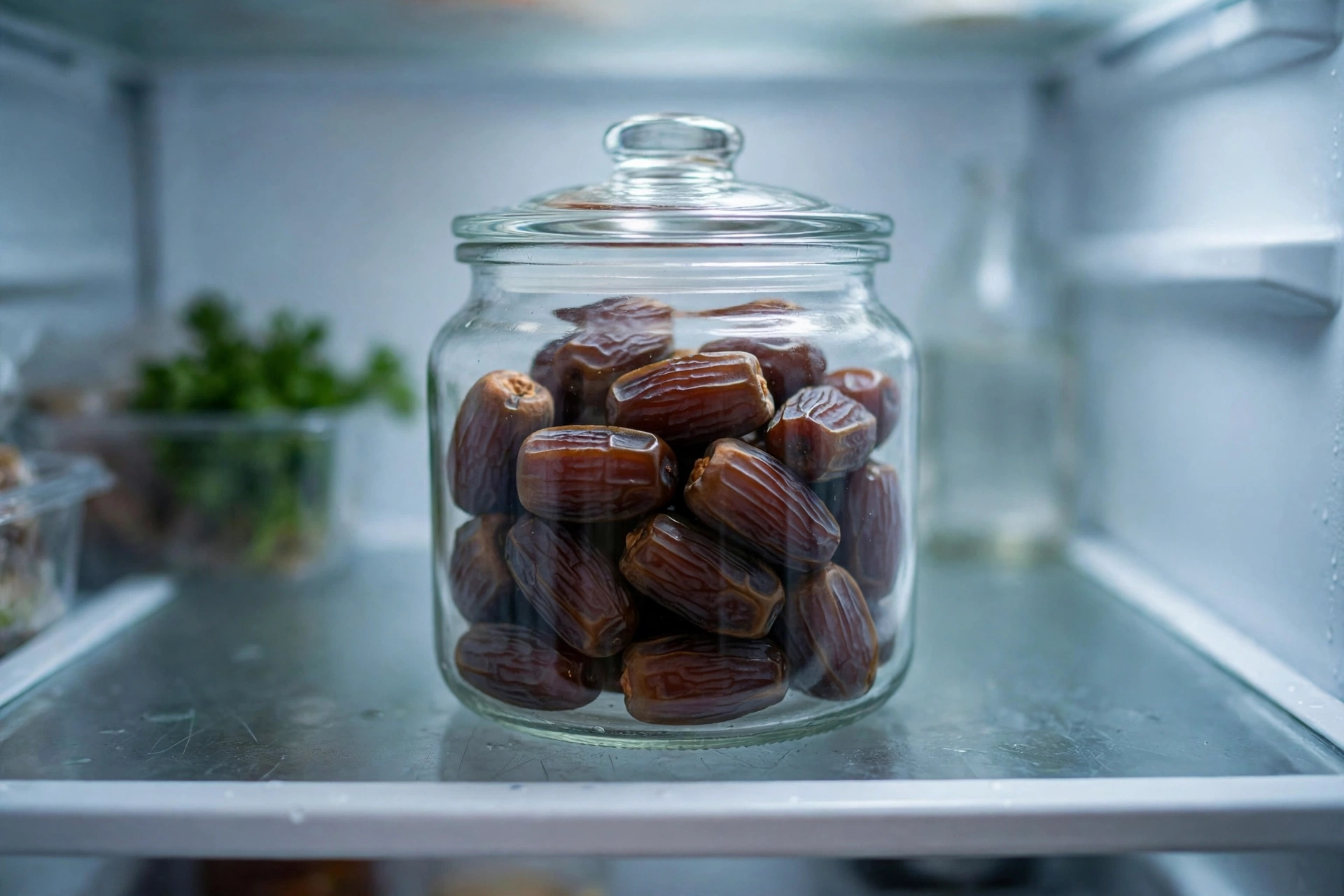
| Refrigerator, 0 to 5°C, airtight | Months | The default for any soft Kimia. Postharvest guidance for high moisture dates recommends about 0°C at 70 to 75 percent relative humidity |
| Freezer, around minus 18°C | Long term | Dates freeze at roughly minus 16°C, and minus 18°C is the standard recommendation for extended storage. Texture survives freezing well |
Four habits that make a real difference
- Keep it airtight. At normal room humidity, uncovered dates exchange moisture with the air. Soft dates dry and harden, and in a humid kitchen they can pick up moisture at the surface instead.
- Avoid temperature swings. Moving a pack in and out of the fridge causes condensation on the fruit, and surface water is what decay starts from. Decant what you need and leave the rest cold.
- Let it come up to temperature before eating. Straight from the fridge, Kimia is firmer and much less aromatic. Twenty minutes at room temperature restores most of the texture and nearly all of the flavour.
- Treat a sour smell as final. Fermentation is not something to rescue by refrigerating harder.
What Kimia is good for in the kitchen
The high moisture and low fibre feel of the flesh make Kimia a blending and binding date rather than a structural one.
Where it performs well
- Date paste and natural sweetener. Kimia breaks down to a smooth paste with very little added liquid, which is the main reason bakers like it. It works as a sugar replacement in energy balls, bars, brownies and loaf cakes.
- Smoothies and milkshakes. It blends without leaving skin flecks the way drier dates do. Date and milk shakes are a staple use for Kimia in Indian and Gulf households.
- Stuffed dates. The flesh is soft enough to open and fill with a nut, nut butter or cheese without tearing, though it is more fragile than a Medjool.
- Ramadan iftar. Soft, sweet and quick to eat, which is why demand and prices firm ahead of Ramadan.
- Chutneys, sauces and glazes. It dissolves readily into savoury reductions and tamarind style chutneys.
- Syrup and molasses. Soft high moisture dates are the natural starting point. The method is on our date molasses page.
Where it is the wrong choice
- Anything that needs the date to hold its shape. Sliced rounds for a tart, chopped pieces that must stay distinct in a cookie dough, or a date that will be handled warm. A firmer semi dry date does this better.
- Date and nut chopping boards or bulk chopping. Kimia clogs a blade and a food processor rather than chopping cleanly.
- Long unrefrigerated travel or gifting into a hot climate. This is a genuine weakness. For a gift that will sit in a warm room for weeks, a drier variety is simply more suitable.
More preparations, including the ones where a softer date is the better option, are collected in date recipes.

Price context
Kimia sits in the affordable half of the premium date market. It is produced at scale, it is a high volume export line into South Asia, and it carries no religious premium, so it is routinely a fraction of the price of Ajwa.
Three things move the price in practice.
Grade and moisture. The A grade high moisture fruit that retail trays are built from costs meaningfully more per kilogram than the lower grades that go into paste and industrial use.
Cold chain. Refrigerated shipping, refrigerated warehousing and refrigerated retail display all cost money, and that cost is in the shelf price of the softest grades.
Season. Harvest runs from roughly August to the end of October, so the freshest and best value fruit reaches market in the months after that. Demand and prices firm ahead of Ramadan, as they do across the whole date category.
We do not publish a Kimia price table on this page, because Kimia pricing varies so sharply by grade, pack format and city that a snapshot would mislead more than it helps. If you are comparing offers, convert everything to a price per 100 g before deciding, check whether the quoted weight is seed in or pitted, and check whether the price includes the cold chain you are assuming. The same normalising method, worked through in detail, is on our Ajwa dates price guide.
Substitution and mislabelling risks
Kimia is both a victim and an instrument of date mislabelling, and it helps to know which way round a given problem runs.
- Kimia sold as something more expensive. Kimia is a soft, almost black date, which is exactly the visual description of several Saudi varieties that trade far higher. Safawi, also sold as Kalmi, is the most common pairing, and Ajwa is sometimes claimed outright. A soft black date offered as Ajwa at a price near ordinary dates is a variety question, not a bargain. The distinguishing features are set out in Ajwa vs Kalmi dates and Kalmi dates.
- Something cheaper sold as Kimia. The reverse also happens. Other Iranian soft cultivars, and lower grade Mazafati that was destined for industrial use, get packed into retail trays as premium Kimia. Here the tells are physical: undersized or very uneven fruit, heavy wrinkling, and flesh that is dry rather than sticky.
- Stated origin that does not match. This is the most common labelling problem in the category. Packs sold as Kimia carry country of origin statements for India, the United Arab Emirates and elsewhere, often while the product description says the fruit was grown in Iran. Sometimes that reflects where the dates were packed rather than grown, which is a legitimate distinction that the label handles badly. Sometimes the origin statement is simply wrong. Either way, a pack whose origin and description contradict each other is a pack whose other claims deserve less weight.
- Added sugar and coatings. Kimia is sweet enough that it does not need help, so a sugar or syrup coating is a quality signal rather than a feature. Check the ingredients list: genuine Kimia should list dates and nothing else. Glucose syrup, added sugar or an unexplained glazing agent all mean you are buying something other than plain fruit.
How Kimia compares in use to Ajwa and Medjool
This comparison is about kitchen behaviour and buying, not about health. Nutrient and health comparisons are handled separately in are Kimia dates healthy.
| Kimia (Mazafati) | Ajwa | Medjool | |
|---|---|---|---|
| Origin of the commercial crop | Kerman province, Iran | Madinah region, Saudi Arabia | Grown at scale in Morocco, the United States, Israel, Jordan and elsewhere |
| Typical texture | Very soft, sticky, high moisture | Soft with a slight chew, drier than Kimia | Soft and fleshy, firmer than Kimia |
| Size | Small to medium | Small to medium, oval | Large |
| Best at | Blending, paste, shakes, sweetening | Eating out of hand, gifting | Eating out of hand, stuffing, chopping |
| Holds its shape when chopped or baked | Poorly | Reasonably | Well |
| Storage tolerance at room temperature | Lowest of the three | Moderate | Moderate to good |
| Carries a religious premium | No | Yes | No |
| Relative price | Lowest of the three | Highest | Middle |
The short version: if you want a date to eat slowly and appreciate, or to give as a gift, Kimia is not the obvious choice. If you want a date to disappear into something else and sweeten it, Kimia is often the best of the three and usually the cheapest.
For the Ajwa and Medjool pair in detail, see Ajwa vs Medjool. For the wider field, including the Saudi varieties Kimia is most often confused with, see other date varieties.

Buying checklist
Before paying, confirm:
- Country of origin stated, and consistent with the product description
- Ingredients list reads as dates only, with no syrup, added sugar or glazing agent
- Grade or size class stated, or the fruit visible through the pack
- Net weight, and whether it is seed in or pitted
- Price recalculated per 100 g, so pack sizes compare honestly
- Packing or harvest date shown, and a crop year you are comfortable with
- Storage instruction on the pack, and evidence the shop has followed it
- No pooled syrup in the tray, no wet patch in the carton, no sour smell
- A plan to refrigerate it once you get it home
Frequently asked questions
Are Kimia and Mazafati the same thing?
Yes. Mazafati is the cultivar name used in agronomy and in Iran. Kimia is the commercial name the same fruit is sold under in India, Pakistan and parts of the Gulf. The naming evidence is set out in what are Kimia dates.
Do Kimia dates have to be refrigerated?
The soft high moisture grades effectively do, because they sit above the moisture level at which dates become self preserving. Lower moisture grades tolerate a cool pantry. If you cannot tell which grade you have, refrigerate it.
Why do some sellers say Kimia dates are from Saudi Arabia?
Because Kimia is a soft black date and so are several well known Saudi varieties, the two get conflated, and the error is then copied between listings. The commercial Mazafati crop is Iranian. Saudi Arabia produces Ajwa, Safawi, Khudri, Mabroom and Sukkari, which are different cultivars.
Is white powder on Kimia dates mould?
Usually not. A light, uneven white bloom is crystallised natural sugar, which is harmless and common on soft dates after cold storage. Mould appears as fuzzy or coloured patches, and is normally accompanied by a sour or musty smell. When the smell is wrong, discard the fruit.
Can I freeze Kimia dates?
Yes, and it is the best option for a large quantity. Dates freeze at around minus 16°C, and about minus 18°C is the standard recommendation for long storage. Freeze them in a sealed container, and thaw in the fridge rather than on a warm counter so condensation does not form on the surface.
Are Kimia dates a good gift?
Only if the recipient can refrigerate them quickly. The qualities that make Kimia pleasant, very soft flesh and high moisture, are the qualities that make it a poor traveller in a hot climate. For gifting, a firmer variety or a drier grade is the safer choice.
Sources
- Karizaki, V. M. (2017). Iranian dates and ethnic date-based products. Journal of Ethnic Foods, 4(3), 204-209. doi:10.1016/j.jef.2017.08.002 – Mazafati described as a soft, fleshy cultivar of 7 to 9 g and 2.5 to 4.5 cm, grown mainly in Bam and Jiroft in Kerman province.
- Barreveld, W. H. (1993). Date Palm Products. FAO Agricultural Services Bulletin No. 101. Rome: Food and Agriculture Organization of the United Nations – date development stages and their moisture levels; the roughly 24 to 25 percent moisture threshold for self preservation; storage life of a 30 percent moisture date at ambient, 5°C and 0°C.
- University of California Postharvest Technology Center, produce facts sheet for dates – recommended 0°C and 70 to 75 percent relative humidity for soft, high moisture cultivars; souring above about 25 percent moisture; freezing point near minus 16°C and minus 18°C for long storage.
- Wikipedia, Mazafati – cultivar identity, Bam and Kerman growing area, Pakistani Balochistan production, 2.5 to 4.5 cm fruit length, harvest from August to the end of October, share of Iranian date exports.
- Wikipedia, List of date cultivars – Mazafati listed with Iran and Pakistan as origins and Mozafati and Muzawati as alternate names; Safawi, Ajwa, Khudri and Mabroom listed as Saudi cultivars; no Kimia entry.
- Sheikhbahaei, N., Rezanejad, F., and Arvin, S. M. J. (2020). Mozafati date as a potential treasure of calcium and antioxidant compounds: assessment of these phytochemicals during development. Journal of Food Measurement and Characterization, 14(3), 1273-1285. doi:10.1007/s11694-020-00375-7 – cultivar studied through its developmental stages, including rutab.
Trade practice described on this page (grade classes, pack formats, cold chain conventions, the origin of the Kimia trade name) is drawn from Iranian exporter and Indian importer listings read on 30 October 2026, including Persa Trading, Exim Asian, Aria Foods, Amoot Iranian and Mumbai based importer catalogues on IndiaMart. These are commercial sources and are cited as evidence of market practice, not of botany. Where they disagree with each other, this page says so rather than picking a figure.