
Ajwa vs Kalmi Dates: How to Tell the Difference Before You Pay
Kalmi is the date most often sold as Ajwa. Here is how the two differ in shape, skin, seed and price, and what to do if you think you bought a substitute.
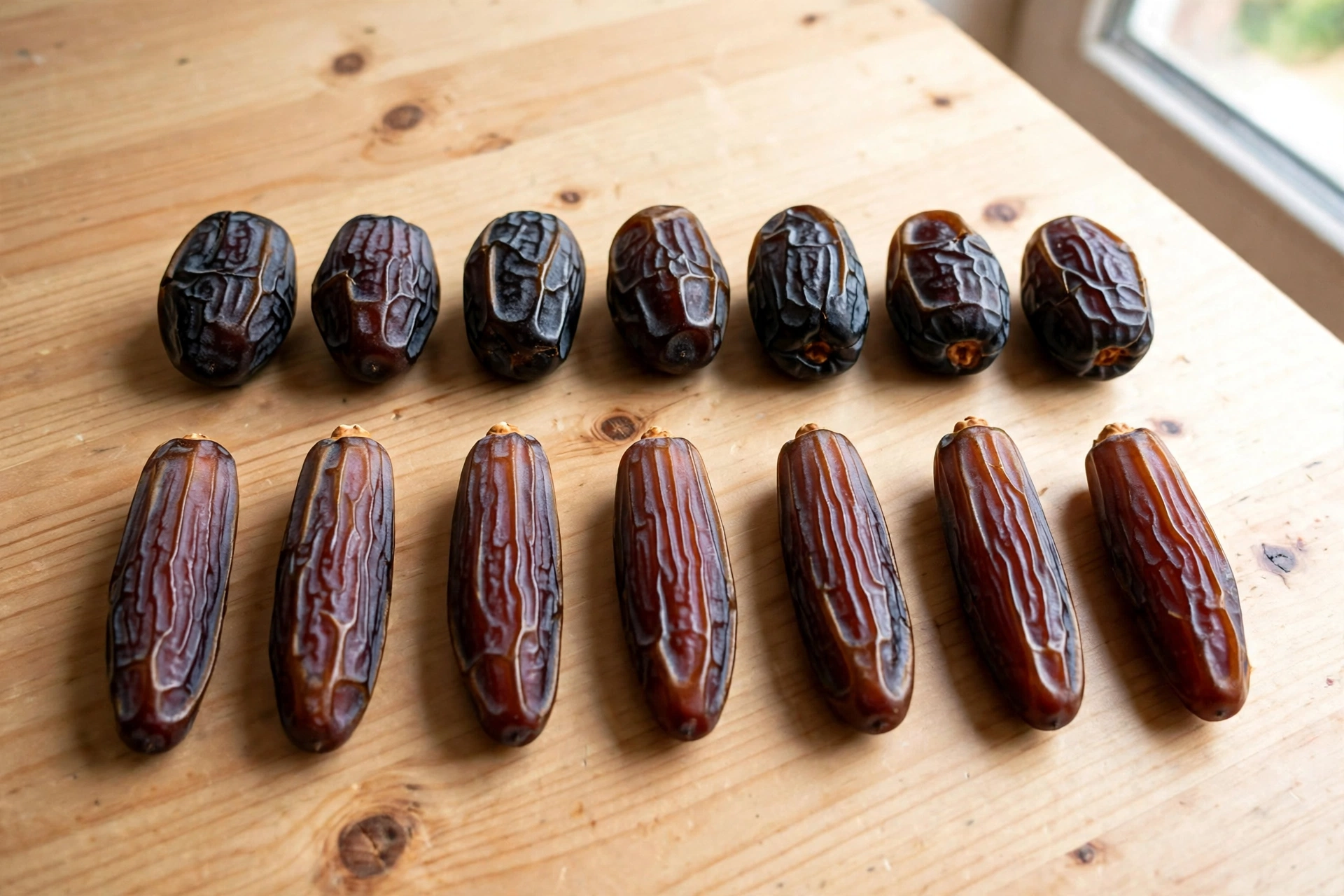
Kalmi and Ajwa are different dates. Ajwa is a short, plump, oval Madinah cultivar with matte, finely wrinkled near black skin and a firm, restrained sweetness. Kalmi is longer and more slender, with a smoother and often glossier dark skin and a sweeter, chewier bite. Kalmi normally trades at roughly half the price of Ajwa or less, which is why it is the variety most often sold as Ajwa.
Why this specific comparison matters
Most date comparisons are about taste preference. This one is about not being overcharged.
Ajwa is a premium product. At source in Madinah, retail grades ran from SAR 56 to SAR 130 per kilogram on 30 October 2026. Outside Saudi Arabia the same kilogram often costs the equivalent of USD 30 to USD 45 once import and retail margins are added. That price gap creates an obvious incentive, and the dates most available to fill it are the other dark, small to medium, wrinkled dates sold across South Asia and the Gulf.
Kalmi is the one that fills it most often. It is dark, it is roughly the right size bracket, it is sold loose from the same style of sack, and it costs a fraction of the price. Shoppers who have only seen Ajwa in photographs have very little to go on when a vendor holds up a handful of Kalmi and calls it Ajwa.
This page is about telling them apart in the hand and on the shelf. For everything else about Kalmi as a variety in its own right, its origins, its uses and its own merits, see our full Kalmi dates profile. It is a good date. It is just not Ajwa, and it should not be priced as Ajwa.
The naming problem, stated honestly
Before the identification checklist, the naming needs clearing up, because the honest answer is messier than most pages admit.
Kalmi is a trade name, not a documented cultivar. Kalmi does not appear as a cultivar in the standard reference works on date palm genetic resources. Safawi does: it is a recognised Madinah cultivar, a soft to semi-dry, medium sized, dark date with chewy flesh. Because Kalmi is not a cultivar name, the question “is Kalmi the same variety as Safawi” is not a botanical question at all.
In the market, the two names are used for one product. Indian wholesale listings routinely carry product names like “Kalmi Safawi Dates” and “Safawi Kalmi Dates” as a single label. One New Delhi supplier lists four separate products under combined Kalmi and Safawi naming, and another lists its entire Kalmi range with “Kalmi/Safawi” as the stated type. So when a South Asian seller says Kalmi, in practice they mean Safawi. That is established market convention, and we state it as convention rather than as botany. Either way, neither is Ajwa.
Ajwa is a specific, documented cultivar. It is a named cultivar of Phoenix dactylifera grown in the Madinah region, documented in the standard reference literature on date palm genetic resources. The grade names you see attached to it, Alia, first class, Quba, second and third class, fourth class, are cosmetic size and quality grades within the one cultivar, not separate varieties.
So the useful mental model is this: Ajwa is one cultivar with several grades. Kalmi is a market name that usually points at Safawi. A seller offering “Kalmi Ajwa” as a single product name is combining two things that are not the same.
Side by side
| Attribute | Ajwa | Kalmi (commonly Safawi or Safawi type) |
|---|---|---|
| Status of the name | Documented cultivar | Trade name, usually pointing at Safawi |
| Origin | Madinah region, Saudi Arabia | Safawi: Madinah region, Saudi Arabia. Kalmi-labelled packs that state an origin generally state Madinah too |
| Shape | Short, plump, oval, blunt ends | Longer, more slender, often tapering towards the ends |
| Overall silhouette | Rounded, almost stubby | Elongated and narrow, distinctly cylindrical |
| Skin finish | Matte, finely and densely wrinkled | Smoother overall, with coarser wrinkling and more surface sheen |
| Colour | Very dark brown to near black, with a dull finish | Dark brown to black, often with more gloss |
| Size and weight | Medium. Measured average fruit weight 11.41 g | No verified published measurement. Generally lighter than Ajwa for its length |
| Flesh | Firm, chewy, drier bite | Softer, chewier, moister in most lots |
| Taste | Restrained sweetness, prune and raisin notes, slightly tannic finish | Distinctly sweeter, simpler, less tannic |
| Typical Saudi source price per kg | SAR 56 to SAR 130 | Safawi at SAR 32 per kg from the same Madinah seller |
| Typical Indian trade price per kg | ₹750 to ₹900 | ₹400 to ₹650 |
| Price relationship | Reference point | Usually around half of Ajwa or less |
The attribute column stays in place while the two date columns scroll sideways on a narrow screen.
Prices read from seller listings on 30 October 2026. See the sources list for the sellers.
That price row is the single most useful line in the table. One Madinah seller lists Safawi at SAR 32 per kilogram and its Ajwa grades from SAR 56 to SAR 130 on the same site. In Indian wholesale, one New Delhi supplier lists Kalmi Safawi grades between ₹400 and ₹650 and its Ajwa grades between ₹600 and ₹900 per kilogram. The gap narrows at the top of the Kalmi range and the bottom of the Ajwa range, which is exactly where mislabelling is most profitable and hardest to spot.
Visual identification checklist
Use this in the shop, with the dates in front of you. No single line below is proof on its own. Three or four of them pointing the same way is a strong signal.
01Shape and silhouette
- Ajwa: short and plump relative to its length, rounded at both ends, close to an oval
- Kalmi: noticeably longer relative to its width, narrow and cylindrical rather than plump
- Line up five or six dates side by side. Ajwa lots look fairly uniform and stubby. Kalmi lots look longer and more variable in length
02Skin
- Ajwa: matte finish. Fine, dense wrinkles across the whole surface, like the surface of a raisin rather than a prune
- Kalmi: smoother between the wrinkles, coarser wrinkling where it occurs, and more light reflection off the skin
- A uniformly glossy, wet looking jet black surface on any date sold as Ajwa is a reason to look harder, not a mark of quality

03Colour
- Ajwa: very dark brown to near black, but with a dull, slightly dusty appearance. Some lots show faint pale lines on the skin
- Kalmi: dark brown through to black, usually with more sheen
- Press a date briefly onto a white paper napkin. Any colour transfer onto the napkin means the fruit has been coated or dyed, and that applies to either variety
04Size and feel
- Weigh a handful if you can. Ajwa has a measured average fruit weight of 11.41 g, which is roughly 85 to 95 dates per kilogram
- Ajwa: firm under light thumb pressure, springs back, does not squash
- Kalmi: softer under the same pressure in most lots, gives more easily

05Seed
- Split one open. Both varieties are usually sold seed in
- Ajwa: elongated seed with a ridged surface and a clear groove along one side, sitting in flesh that separates cleanly
- Kalmi: also elongated, but in Kalmi and Safawi-type lots the seed is often proportionally longer and more slender relative to the fruit
- The seed test is the hardest one to fake and the one most worth doing if you are buying a quantity, though for most buyers the sweetness check below is the faster tell

06Taste
- Ajwa: sweet but restrained, with prune and raisin notes and a slightly dry, faintly tannic finish
- Kalmi: sweeter and more straightforward, with a softer chew and no tannic edge
- If a date sold to you as Ajwa tastes as sweet as a supermarket Medjool, question it. Ajwa’s defining characteristic in the mouth is how restrained it is
07The pack
- Region of origin stated as Madinah or Al Madinah Al Munawwarah
- Grade stated, or fruit visible through the packaging
- Net weight, and whether it is seed in or pitted
- Packing or harvest date present
- Product name is a single variety, not a hyphenated hybrid like “Kalmi Ajwa”
- Price recalculated per 100 g, so a 400 g box cannot hide behind a kilogram comparison
The price test, worked through
The price check is the one you can run before you ever touch the dates, and it catches most substitution.
Work out the per kilogram price from whatever pack size you are looking at. Then ask where it sits.
| Price per kg, outside Saudi Arabia | What it most likely is |
|---|---|
| Close to ordinary dark dates in the same shop | Not Ajwa. Almost certainly a substitute variety |
| Noticeably below the cheapest Saudi Ajwa grade, which was SAR 56 per kg at source on 30 October 2026, before any freight | Not Ajwa, or Ajwa so far off-grade that the description is misleading |
| In the range of local premium imported dates | Plausible. Run the physical checks |
| Well above local premium dates | Plausible Ajwa, possibly top grade, possibly just expensive packaging |
The logic is simple arithmetic. If a kilogram of the cheapest grade costs SAR 56 in Madinah before freight, import duty, local packing and retail margin, a finished retail kilogram abroad cannot be cheaper than that and still be the same fruit. Full current figures sit in the Ajwa dates price guide and the Saudi breakdown is in Ajwa dates price in Saudi Arabia.
One honest caveat. A high price does not prove authenticity. Mislabelled Kalmi sold at Ajwa prices is the whole point of the substitution, so the price test only reliably catches the low end. The physical checks catch the rest.
What to do if you think you were sold a substitute
If you still have the dates and the receipt
Photograph the pack front and back, the batch or packing code, the receipt, and the dates themselves, ideally several beside a ruler or a coin for scale. Photograph a split date showing the seed. If you have genuine Ajwa to hand, photograph both together.
State the product name as sold, the price paid, and the specific observations: shape, skin, taste, seed. Ask for a refund or a replacement. Keep it factual. Many cases are a supplier labelling error rather than deliberate fraud by the shop, and a documented, specific complaint usually gets resolved at this stage.
If the pack says “Kalmi” or “Safawi” anywhere, or carries a hyphenated name, or states no region of origin, then you may have bought exactly what was described, even if the shelf talker or the vendor’s verbal description implied Ajwa. That affects what remedy you can reasonably ask for.

If the seller refuses
Open a dispute through the platform rather than the seller. Platform policies on items not matching their description are usually the fastest route, and your photographs are the evidence. Pay attention to the dispute window, which is often short.
A chargeback for goods not as described is available in many markets. Your bank or card issuer will tell you the window and what evidence they need. This is a last resort, after you have given the seller a chance to resolve it.
Most countries have a body that handles food labelling and misdescription complaints. In Saudi Arabia that is the Ministry of Commerce. In the UK it is Trading Standards via Citizens Advice. In India it is the consumer helpline and the state consumer commission. Report with your documentation. A single complaint rarely produces a refund, but labelling patterns are what these bodies act on.
Going forward
That one filter removes most of the risk.
The cost of a 250 g mistake is much lower than the cost of a 1 kg mistake.
The Saudi harvest runs roughly August to September, and the window after it is when fresh, correctly labelled stock is most available. Substitution tends to rise when genuine stock is tight, which is during Ramadan and Hajj. City by city guidance is in the where to buy posts, including where to buy Ajwa dates in Madinah.
If you ever buy Ajwa you are confident in, keep a few in the freezer. Having a known reference in your hand makes every future comparison trivial.
When Kalmi is the right buy anyway
Worth saying plainly: if you are not buying for religious reasons, Kalmi may be the better purchase for your use.
Kalmi is sweeter, softer and a fraction of the price. For chopping into porridge, blending into smoothies, baking, or simply eating a lot of dates without thinking about cost per date, it does the job and Ajwa’s restrained flavour is largely wasted. Buying Kalmi knowingly, at Kalmi prices, is a sensible decision. Buying Kalmi unknowingly at Ajwa prices is the only problem here.
The full picture on Kalmi as a variety, including its own uses and buying notes, is in Kalmi dates. If you are weighing Ajwa against the other widely available premium date, see Ajwa vs Medjool.
Frequently asked questions
Is Kalmi the same as Ajwa?
No. They are different dates sold at different price points. Ajwa is a documented Madinah cultivar. Kalmi is a market name that in most of the trade points at Safawi or a Safawi-type date. Any product sold as “Kalmi Ajwa” is combining two names that do not describe one thing.
Is Kalmi the same as Safawi?
In the trade, effectively yes. Indian suppliers routinely list products as “Kalmi Safawi” or “Safawi Kalmi” as one label. We state that as established market convention rather than botanical equivalence, because Kalmi does not appear as a cultivar in the standard date palm reference works, so there is no botanical claim to make either way. Safawi is a documented Madinah cultivar. Seller-page origin stories placing Kalmi elsewhere could not be verified, as covered in our Kalmi dates profile.
Which is cheaper, Ajwa or Kalmi?
Kalmi, consistently. One Madinah seller listed Safawi at SAR 32 per kilogram against Ajwa grades from SAR 56 to SAR 130 on 30 October 2026. In Indian wholesale, Kalmi Safawi grades ran ₹400 to ₹650 per kilogram against Ajwa at ₹600 to ₹900.
Can I tell them apart without tasting them?
Usually yes. Shape and skin finish are the two fastest visual checks: Ajwa is short, plump and matte, while Kalmi runs longer, narrower and carries more sheen. Splitting one open to look at the seed proportion is the hardest check to fake. That said, if you can taste them, sweetness is the quickest tell for a buyer who is not an expert, because genuine Ajwa is markedly less sweet than people expect.
Does Kalmi have the religious significance Ajwa has?
No. The narrations in the recognised collections that name a specific date cultivar name Ajwa. That significance is a reason many people seek Ajwa specifically, and it is also why a substitute sold as Ajwa is a more serious matter than an ordinary mislabelling.
Is Kalmi less nutritious than Ajwa?
There is no sound basis for answering this. Neither Ajwa nor Kalmi has a variety-specific entry in USDA FoodData Central, and no laboratory has published a head to head analysis of the two using one method. Both are dark, tamar stage dates in a similar moisture class, so large nutritional differences would be surprising. Anyone showing you a clean nutrient comparison of the two is showing you numbers they did not measure.
Sources
Prices were read from seller listings on 30 October 2026 and are examples of current market pricing, not fixed rates. Naming conventions below are reported as observed in trade listings, not as botanical classification.
- Al-Khayri JM, Jain SM, Johnson DV (eds.). Date Palm Genetic Resources and Utilization. Springer, 2015 (Ajwa as a documented Madinah cultivar of Phoenix dactylifera)
- Arshad MS, Batool SM, Khan MK, Imran M, Ahmad MH, Anjum FM, et al. Bio-evaluation of functional date bars using rats as model organism against hypercholesterolemia. Lipids in Health and Disease. 2019;18:148. doi:10.1186/s12944-019-1087-3 (measured Ajwa average fruit weight 11.41 g and moisture 25.75 percent)
- Munwra Dates Store (Madinah) product listings: Safawi Madina 1 kg at SAR 32, Safawi 5 kg box at SAR 110, Safawi 12 kg carton at SAR 264, Ajwa grades from SAR 56 to SAR 130 per kg. Read 30 October 2026
- AL Fazl International Private Limited, New Delhi, IndiaMart trade listings: Kalmi Safawi Dates ₹400 to ₹540 per kg, Safawi Kalmi Dates ₹450 per kg, Ajwa Saudi Fresh Quba ₹750 per kg, Ajwa Jumbo Quba ₹850 per kg. Read 30 October 2026
- AL Raziq Dates, New Delhi, IndiaMart trade listings: Kalmi range ₹460 to ₹650 per kg with product type stated as “Kalmi/Safawi”, Ajwa range ₹600 to ₹900 per kg. Read 30 October 2026
- Specialty Produce, Black Safawi date profile: semi-dry type, medium sized, dark black cherry colour with hints of brown, soft and chewy flesh, grown in the Madinah region of Saudi Arabia
- FAO. Date Palm Cultivation. FAO Plant Production and Protection Paper 156, Rev. 1. Rome, 2002 (tamar ripening stage, moisture below 25 percent; date texture classes)
- USDA FoodData Central, searched 30 October 2026: no entries returned for Ajwa, Kalmi or Safawi
- Saudi harvest timing and grade naming: as recorded in the Ajwa Hub price research, 30 October 2026
Where to go next

Amira Noor writes about Ajwa dates, their origin in Madinah, nutrition and heritage, with clear, practical guides for readers.