
Kalmi Dates: What They Are, What They Cost and Why They Get Confused With Ajwa
Kalmi is a market name, not a cultivar. What it refers to, how it differs from Ajwa, what it should cost, and how to avoid overpaying.
Kalmi is a South Asian market name for soft, dark, elongated Madinah dates, and sellers themselves usually label the product “Kalmi (Safawi)”. Safawi is the recognised cultivar: a soft to semi-dried black date from the Madinah region of Saudi Arabia whose flavour the reference literature describes as similar to Ajwa. Kalmi is not a separate botanical variety, and that is the single most useful thing to know before buying it.

What “Kalmi” actually refers to
Start with the thing most pages get wrong. Kalmi does not appear as a cultivar in the standard reference works on date palm genetic resources, and it is not one of the named varieties in Saudi Arabia’s own national list. Safawi is in both.
What you find instead is that the name and the cultivar are routinely bundled together by the sellers who use the name. Pakistani retailer Darussalam lists the product as “Kalmi (Safwi)” and states the origin as Madinah, Saudi Arabia. Indian listings appear as “Safawi Dates / Kalmi Dates” from a single brand. The two words are treated as interchangeable labels for one product across the whole South Asian market.

So the accurate way to describe Kalmi is this: a trade name used in Pakistan, India, Bangladesh and the wider South Asian diaspora for soft, dark, elongated dates, in practice almost always Safawi from Madinah.
What is established and what is market convention
It is worth separating these clearly, because the distinction is where most of the misinformation lives.
Market conventionhow the trade uses the name, not a botanical fact.
Not verifiedclaims we could not confirm in any agronomic or government source.
- Safawi is a documented cultivar of Phoenix dactylifera grown mainly in the Madinah region of Saudi Arabia.
- It is soft to semi-dried, deep black, medium sized and elongated, and reference descriptions note that it shares taste characteristics with Ajwa.
- In a 2022 analysis of 35 Saudi date varieties sampled from local markets, Safawi recorded the highest moisture content of the entire set. Moisture across all 35 varieties ranged from 7.3 to 29.2 g per 100 g.
- Safawi trades at a substantial discount to Ajwa at source in Madinah.
- The name “Kalmi” itself. It is a commercial label, and its scope depends on who is using it.
- Any claim that Kalmi and Safawi are, or are not, “the same variety”. Since Kalmi is not a cultivar, the question is not a botanical one. In practice, when a South Asian seller says Kalmi, they mean Safawi.
- Claims about a precise origin or history for a variety called Kalmi. Some seller pages attribute Kalmi to Oman, others to Iran, others to Pakistan’s Sindh province, and some place its history in “Mughal court records from the 13th century”, which is impossible since the Mughal empire was founded in the sixteenth century. None of these origin stories can be verified in agronomic or government sources, and they contradict each other.
- Worth knowing: the name is often explained as coming from an Urdu word relating to a pen, describing the fruit’s elongated shape. That explanation is plausible and widely repeated, but we could not verify it in a linguistic or agricultural source, so treat it as folk etymology rather than fact.
The practical upshot: if a pack says Kalmi, look for a stated region of origin. If it says Madinah or Saudi Arabia, you are almost certainly buying Safawi. If it states no origin at all, you do not know what you are buying.
Where Kalmi and Safawi dates come from
Safawi is a Madinah variety. Saudi Arabia’s national reference lists it among the kingdom’s recognised varieties, and the reference literature places its cultivation mainly in the Al Madinah region.
That is the same growing area as Ajwa, and it matters. Madinah province holds roughly 4.5 million date palms producing about 70 varieties, of which around 800,000 palms are Ajwa. Safawi, Anbara, Mabroom and Barni all come from the same region. Several of the dates sold worldwide as distinct premium products are neighbours in the same oasis belt.
Saudi Arabia produced about 1.9 million tonnes of dates in 2024 according to FAO figures, from more than 37 million palms of which over 32 million are fruit bearing, per the kingdom’s 2024 agricultural statistics. The main harvest runs roughly August to September.
Safawi is described in the reference works as a productive cultivar, and that productivity is the reason for its price position. Ajwa is scarce and in religiously driven demand; Safawi is abundant from the same region.
What Kalmi dates look and taste like
Appearance
Medium sized, elongated and distinctly cylindrical rather than plump. Deep black to very dark brown, usually with a soft sheen rather than a hard gloss, and a wrinkled surface. The fruit is longer and narrower than Ajwa, which is oval and comparatively short.
Texture
Soft and chewy, with more give than most semi-dry dates. This is consistent with the measured moisture finding: in the 2022 Saudi study, Safawi samples were the wettest of 35 varieties tested. A fresh-crop Kalmi date should yield easily to finger pressure without being sticky or wet on the outside.
Taste
Properly caramel. Noticeably sweeter and more straightforwardly sugary than Ajwa, which is mild and faintly savoury. There is usually a slight nuttiness underneath and very little of the dried-fruit tang you get from Iranian soft dates.
Seed
Single, hard, elongated. Pitted Kalmi exists but is less common than pitted Deglet Noor or Medjool.

Size claims Not verified
A note on size claims: various seller pages give precise dimensions and weights for Kalmi, typically 3 to 4.5 cm long and 10 to 16 g. We could not verify those figures in an agronomic or government source, and Saudi Arabia’s published grading standards cover a defined list of varieties that does not include Safawi, so there is no official weight grade to quote. Expect variation by grade and crop year.
Nutrition: what the data actually supports
Here is the honest position. There is no reliable, widely replicated nutrient panel for Safawi or Kalmi specifically. What exists is good data on dates in general and scattered single-study measurements on individual Saudi cultivars that use different methods and are not safely comparable.
USDA reference data for dates gives, per 100 g:
| Nutrient | Deglet Noor dates | Medjool dates |
|---|---|---|
| Energy | 282 kcal | 277 kcal |
| Carbohydrate | 75 g | 75 g |
| Total sugars | 63 g | 66 g |
| Dietary fibre | 8.0 g | 6.7 g |
| Protein | 2.4 g | 1.8 g |
| Fat | 0.4 g | 0.2 g |
| Potassium | 656 mg | 696 mg |
| Magnesium | 43 mg | 54 mg |
Those two varieties sit at opposite ends of the moisture classification, semi-dry and soft, and their profiles are still close. That tells you something useful: variety-to-variety differences in dates are real but small, and they are swamped by portion size. Kalmi will land in the same territory.
What can be said with reasonable confidence about dates as a food, Kalmi included:
- They are an energy-dense, high-sugar fruit. A single date contributes meaningful calories and sugar.
- They supply useful dietary fibre, in the region of 7 to 8 g per 100 g.
- They are a good source of potassium and contribute magnesium.
- FAO composition data notes that protein at 1 to 3 percent is not nutritionally significant, and dates are not a meaningful source of vitamin C.
- Most varieties are the invert sugar type, meaning the sucrose has largely converted to glucose and fructose by the time the fruit is ripe.
On glycemic index: a Saudi study of 17 locally grown varieties found values in the low range for the varieties it tested, for example Shaqra at 42.8, Sukkari at 43.4 and Sagai at 44.6. Safawi was not among the varieties with published figures we could verify. Across dates generally, measured glycemic index varies widely with variety and ripeness, so a single number should not be generalised.
What we are not going to claim
You will find pages asserting that Kalmi dates kill intestinal parasites, cure anaemia, prevent specific diseases or should be eaten on an empty stomach for a particular medical effect. Those claims are not supported by evidence in humans, and some of them originate in traditional lore reproduced uncritically by sellers. Dates are a nutritious food. They are not a treatment. If you manage diabetes, are pregnant, or have been told to control potassium or sugar intake, discuss portion size with your own clinician rather than relying on a variety guide.
How to use Kalmi dates in the kitchen
Kalmi’s softness and clean caramel sweetness make it one of the more versatile dark dates.
Eaten whole
This is the main use, and it is where the price advantage over Ajwa shows most clearly. For iftar, for a mid-afternoon sugar lift, or alongside coffee, Kalmi delivers more obvious sweetness than Ajwa at roughly a third of the cost.
Blended
High moisture means Kalmi purees smoothly without soaking. Good in smoothies, and good as the sweetener in no-bake energy balls where you want the mixture to bind.
Paste, syrup and molasses
An excellent choice, precisely because appearance does not matter. Soft dates reduce well and Kalmi’s caramel character suits the application. Technique is covered in date molasses.
Stuffed
Workable but not ideal. The fruit is narrow, so the cavity is small. For stuffing with nuts or cheese, a large Medjool or a Dayri is easier to handle.
Baking
Use with a little care. A soft, high-moisture date adds liquid as well as sugar, so chopped Kalmi will make a batter wetter than chopped Deglet Noor would. Reduce other liquid slightly, or dust the chopped pieces in a spoonful of the recipe’s flour to stop them sinking. More ideas are in the date recipes collection.
Storage
Treat Kalmi as a soft date. Cool and airtight. Refrigeration extends life considerably and the fruit firms up when cold, so let it come back to room temperature before eating. Sugar crystals appearing on the surface of an older date are crystallised fruit sugar, not mould, and are harmless.
Kalmi dates price: where they sit
Prices read directly from seller listings on 30 October 2026. These are examples of current market pricing, not fixed rates.
| Market | Seller and product | Pack | Listed price | Approximate price per kg |
|---|---|---|---|---|
| Saudi Arabia (Madinah) | Munwra Dates Store, Safawi dates of Madinah | 1 kg | SAR 32 | SAR 32 |
| Saudi Arabia (Madinah) | Munwra Dates Store, Safawi box | 5 kg | SAR 110 | SAR 22 |
| Saudi Arabia (Madinah) | Munwra Dates Store, Safawi carton | 12 kg | SAR 264 | SAR 22 |
| Pakistan | Darussalam, Kalmi (Safwi) dates | 1 kg | Rs 3,800 | Rs 3,800 |
| Pakistan | Darussalam, Kalmi (Safwi) dates | 500 g | Rs 1,950 | Rs 3,900 |
| India | Tata Sampann premium Kalmi dates (BigBasket) | 500 g | ₹584 | about ₹1,168 |
| India | Happilo premium Kalmi dates (BigBasket) | 350 g | ₹399 | about ₹1,140 |
| Bangladesh | Chaldal, premium Kalmi dates | 1 kg | ৳550 | ৳550 |
Saudi retail prices are shown inclusive of 15 percent VAT, and the riyal is pegged at 3.75 to the US dollar, which puts the Madinah kilogram at roughly USD 8.50 and the bulk carton rate at under USD 6 per kilogram.

Three things to read out of that table.
Bulk is priced like a different product
SAR 32 for one kilogram against SAR 22 per kilogram in a 12 kg carton. That is a larger proportional discount than most varieties carry and reflects how abundantly Safawi is produced.
The Indian branded premium is steep
Roughly ₹1,140 to ₹1,170 per kilogram, about USD 13, for dates that leave Madinah at under USD 9 retail. A good part of that is branded 350 g and 500 g packaging rather than the fruit.
The Bangladeshi listing is the one to question
At ৳550 per kilogram, roughly USD 4.50, with the origin field stating Bangladesh rather than Saudi Arabia. That is below the Madinah bulk rate before any freight. It may be a lower grade, a different variety, or a dry date entirely.
How Kalmi compares to Ajwa on price
This is the comparison that explains the whole substitution problem. All figures from the same Madinah seller on the same day, 30 October 2026:
| Product | 1 kg listed price | Multiple of Safawi |
|---|---|---|
| Safawi (Kalmi) | SAR 32 | 1.0x |
| Sukkari, luxury | SAR 40 | 1.3x |
| Mabroom | SAR 60 | 1.9x |
| Anbara | SAR 70 | 2.2x |
| Ajwa, fourth class | SAR 56 | 1.8x |
| Ajwa Quba | SAR 89 | 2.8x |
| Ajwa Alia 100 percent | SAR 95 | 3.0x |
| Ajwa, luxury first class | SAR 110 | 3.4x |
| Ajwa, first class Alia | SAR 130 | 4.1x |
Retail grade Ajwa costs roughly three to four times what Safawi costs in the same shop in the same city. The full picture on Ajwa pricing is in the Ajwa dates price guide.
Why Kalmi is the date most often substituted for Ajwa
Four factors line up, and together they make Kalmi the near-perfect substitution candidate.
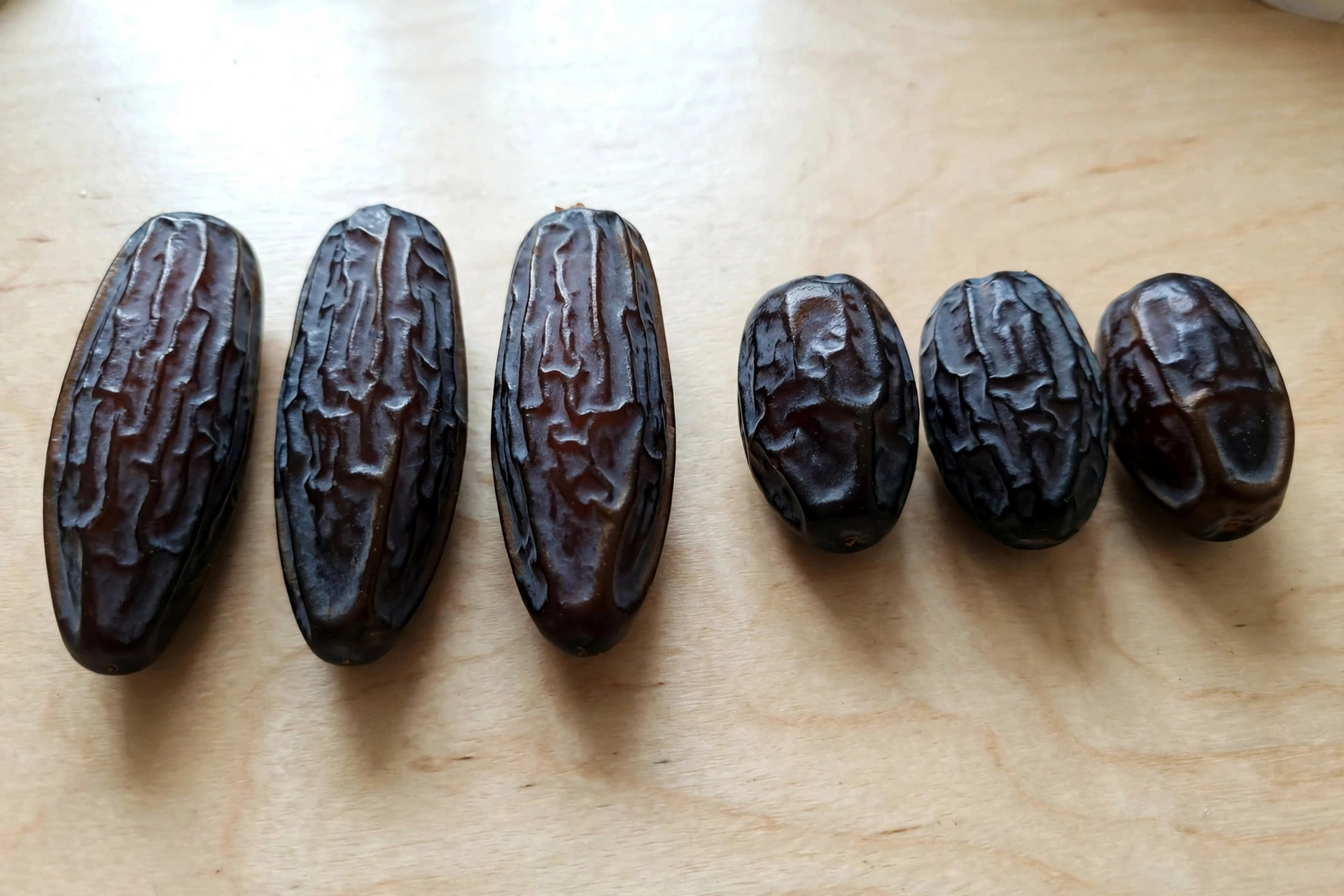
It looks the part
Both are dark, wrinkled, medium-sized Madinah dates. To a buyer who has never handled genuine Ajwa, the resemblance is close enough.
It tastes adjacent
The reference literature itself notes that Safawi shares taste characteristics with Ajwa. A substitution that tastes plausible is far harder to detect than one that does not.
It comes from the same place
A seller can state “product of Madinah, Saudi Arabia” entirely truthfully while selling Safawi as Ajwa. The origin claim does not catch the swap.
The margin is enormous
Buy at SAR 22 to 32 per kilogram, sell at an Ajwa price. At international retail, where Ajwa commonly reaches USD 30 to 40 per kilogram, the gap is wide enough to be worth the risk.
How to tell them apart
| Check | Ajwa | Safawi sold as Kalmi |
|---|---|---|
| Shape | Oval, comparatively short and rounded | Elongated, narrow, cylindrical |
| Colour | Dark brown-black, matte, with fine lighter surface lines | Deeper black to very dark brown, slight sheen |
| Sweetness | Mild, restrained, faintly savoury | Clearly sweeter, caramel forward |
| Texture | Dense, firm chew | Softer, wetter, more yielding |
| Average weight | About 11.4 g in published measurement | No verified published figure, generally lighter |
The sweetness test is the most reliable one for a non-expert. Genuine Ajwa surprises most first-time buyers by being less sweet than they expected. If a date sold as Ajwa tastes frankly sugary and caramel-like, that is a flag.
The side-by-side comparison, including seed shape, grading and the authenticity checks that actually hold up, lives on its own page: Ajwa vs Kalmi dates.
Should you buy Kalmi dates
Reasons to choose Kalmi over a premium Madinah variety:
- You want a soft, sweet, dark date for everyday eating rather than for gifting.
- You are buying volume for a household through Ramadan.
- You are blending, pureeing or making syrup, where appearance is irrelevant.
- You like a frankly sweet date and find Ajwa too mild.
Reasons to choose something else:
- You specifically want Ajwa for its religious associations. No other variety substitutes for that, whatever it tastes like.
- You want a gift with visible prestige. Ajwa, Anbara and Sagai all carry more.
- You want a firmer date that holds its shape when chopped into baking. Deglet Noor or Zahidi will behave better.
For the full category view and where every commercial cultivar sits, see other date varieties.
Frequently asked questions
Are Kalmi and Safawi dates the same thing?
In practice yes, for South Asian retail. Sellers label the product “Kalmi (Safwi)” or “Safawi / Kalmi dates” and state Madinah origin. Strictly, Safawi is the cultivar name found in the reference literature and Kalmi is a market name, so they are not two varieties being compared, they are two labels for one product.
Are Kalmi dates from Saudi Arabia or Pakistan?
The fruit sold as Kalmi by the main South Asian retailers states Madinah, Saudi Arabia as its origin. Pakistan is a major date producer in its own right, with about 0.7 million tonnes in 2024 and an industry concentrated around Khairpur in Sindh, but the principal Pakistani variety is Aseel, not Safawi. Origin claims placing Kalmi in Sindh, Oman or Iran appear on seller pages but we could not verify any of them in an agronomic or government source.
Why are Kalmi dates so much cheaper than Ajwa?
Supply and demand, not quality. Safawi is a productive cultivar grown abundantly in the same region, while commercial Ajwa comes from a limited number of mature palms, around 800,000 of Madinah province’s 4.5 million, and carries religious demand that is seasonal and largely price-insensitive. The reasoning is set out in full in why Ajwa dates are so expensive.
How many Kalmi dates are in a kilogram?
There is no verified published average fruit weight for Safawi, so an exact count is not something we can give honestly. For scale: Ajwa has a measured average of 11.41 g, which works out at roughly 85 to 95 dates per kilogram. Kalmi dates are generally a little lighter, so expect somewhat more per kilogram. The Ajwa calculation is worked through in how many Ajwa dates are in 1 kg.
Do Kalmi dates have health benefits?
They have the nutritional properties of dates: energy density, dietary fibre of roughly 7 to 8 g per 100 g, potassium and magnesium. There is no reliable variety-specific research establishing benefits unique to Safawi or Kalmi, and claims that they treat or prevent any condition are not supported by human evidence. Portion size matters more than variety.
How should Kalmi dates be stored?
As a soft, high-moisture date: airtight and cool. Refrigeration meaningfully extends life. White crystals on an older date are crystallised sugar, which is harmless; soft white or grey fuzz is mould, and that date should be discarded.
Sources
Prices were read directly from seller listings on 30 October 2026 and are examples of current market pricing, not fixed rates.
- Al-Khayri, J. M., Jain, S. M. and Johnson, D. V. (eds.), Date Palm Genetic Resources and Utilization, Springer, 2015 (Safawi cultivar description: Madinah region, soft and semi-dried, deep black, taste similar to Ajwa)
- AlShwyeh, H. and Almahasheer, H., “Glucose content of 35 Saudi Arabian date fruits (Phoenix dactylifera L.)”, Journal of the Saudi Society of Agricultural Sciences, 2022, 21(6), 420-424 (Safawi highest moisture of 35 varieties; range 7.3 to 29.2 g/100 g)
- Saudipedia (Saudi national reference), list of date varieties in Saudi Arabia, and the Ajwa entry (Madinah province palm and variety counts; Ajwa palm count; harvest timing)
- General Authority for Statistics, Saudi Arabia, 2024 Agricultural Statistics publication (1,923 thousand tonnes; 37.6 million palms, over 32 million fruit bearing)
- UN Food and Agriculture Organization, FAOSTAT, dates production quantity 2024 (Saudi Arabia 1.9 million tonnes, Pakistan 0.7 million tonnes)
- FAO, Date Production and Protection, composition chapter (protein 1 to 3 percent, no significant vitamin C, invert sugar type, potassium and fibre content)
- AlGeffari, M. A. et al., “Glycemic indices, glycemic load and glycemic response for seventeen varieties of dates grown in Saudi Arabia”, Annals of Saudi Medicine, 2016, 36(6), 397-403
- USDA nutrient reference data for dates, Deglet Noor and Medjool, per 100 g
- Fruit weight reference for Ajwa: Lipids in Health and Disease, 2019, date variety texture and fruit weight table (11.41 g average)
- Seller listings read on 30 October 2026: Munwra Dates Store (Madinah) Safawi 1 kg SAR 32, 5 kg SAR 110, 12 kg SAR 264, plus Ajwa, Mabroom, Anbara and Sukkari lines; Darussalam Pakistan Kalmi (Safwi) 1 kg Rs 3,800 and 500 g Rs 1,950; BigBasket India Tata Sampann Kalmi 500 g ₹584 and Happilo Kalmi 350 g ₹399; Chaldal Bangladesh premium Kalmi 1 kg ৳550
Not verified: the Urdu etymology of “Kalmi”; precise fruit dimensions and weights for Kalmi or Safawi; and all seller-page origin stories placing the variety in Oman, Iran or Sindh, which conflict with each other and with the Madinah origin the same retailers state on their product pages.
Where to go next

Amira Noor writes about Ajwa dates, their origin in Madinah, nutrition and heritage, with clear, practical guides for readers.