
Date Varieties
Mabroom Dates: A Practical Buying, Grading and Storage Guide
Mabroom is the long, slim, toffee-chewy date grown around Madinah – easy to spot once you know the shape, and easy to mix up with its nearest lookalikes if you don’t. This guide covers identity, measured size, grading, storage, price context and the substitution traps to watch for.
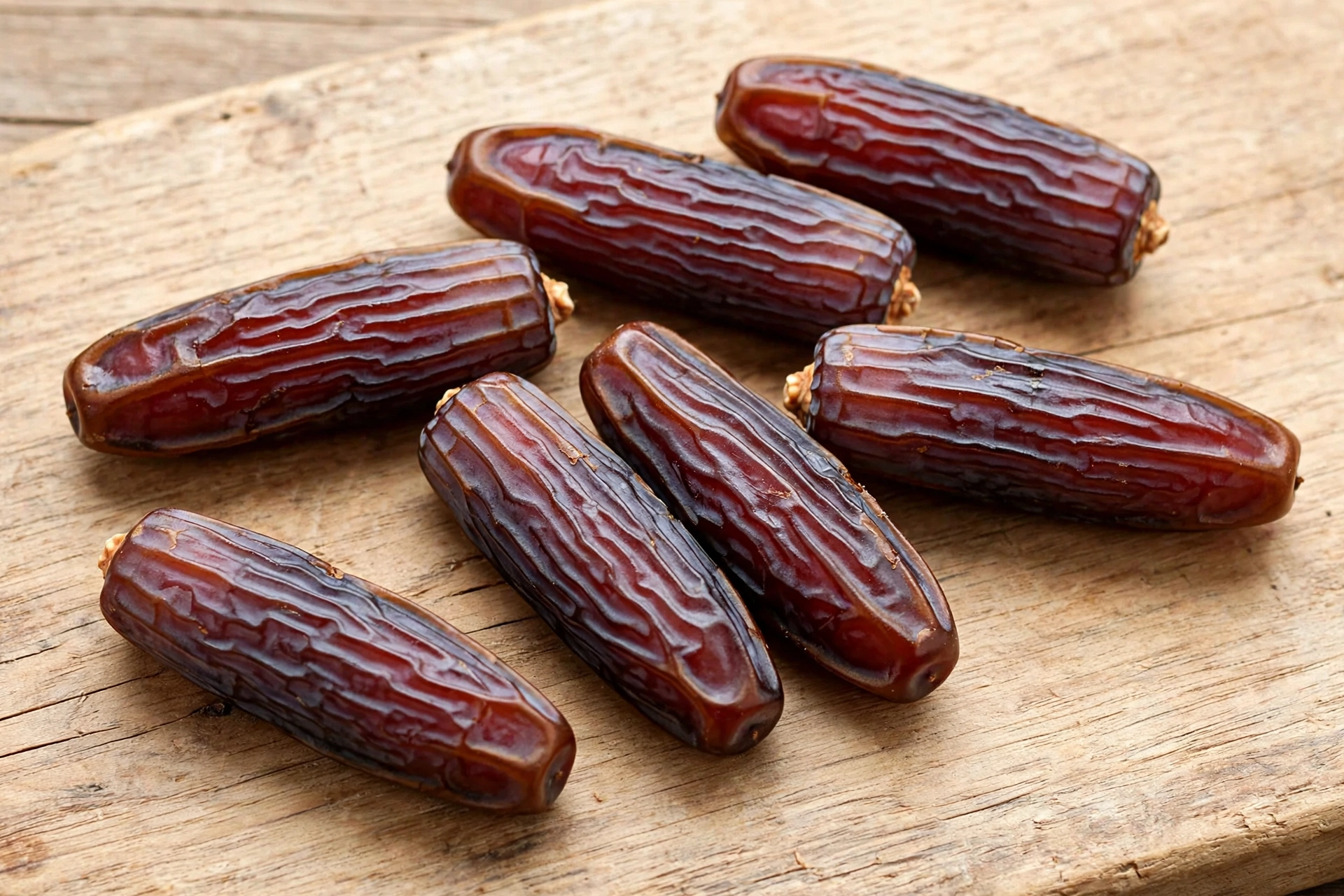
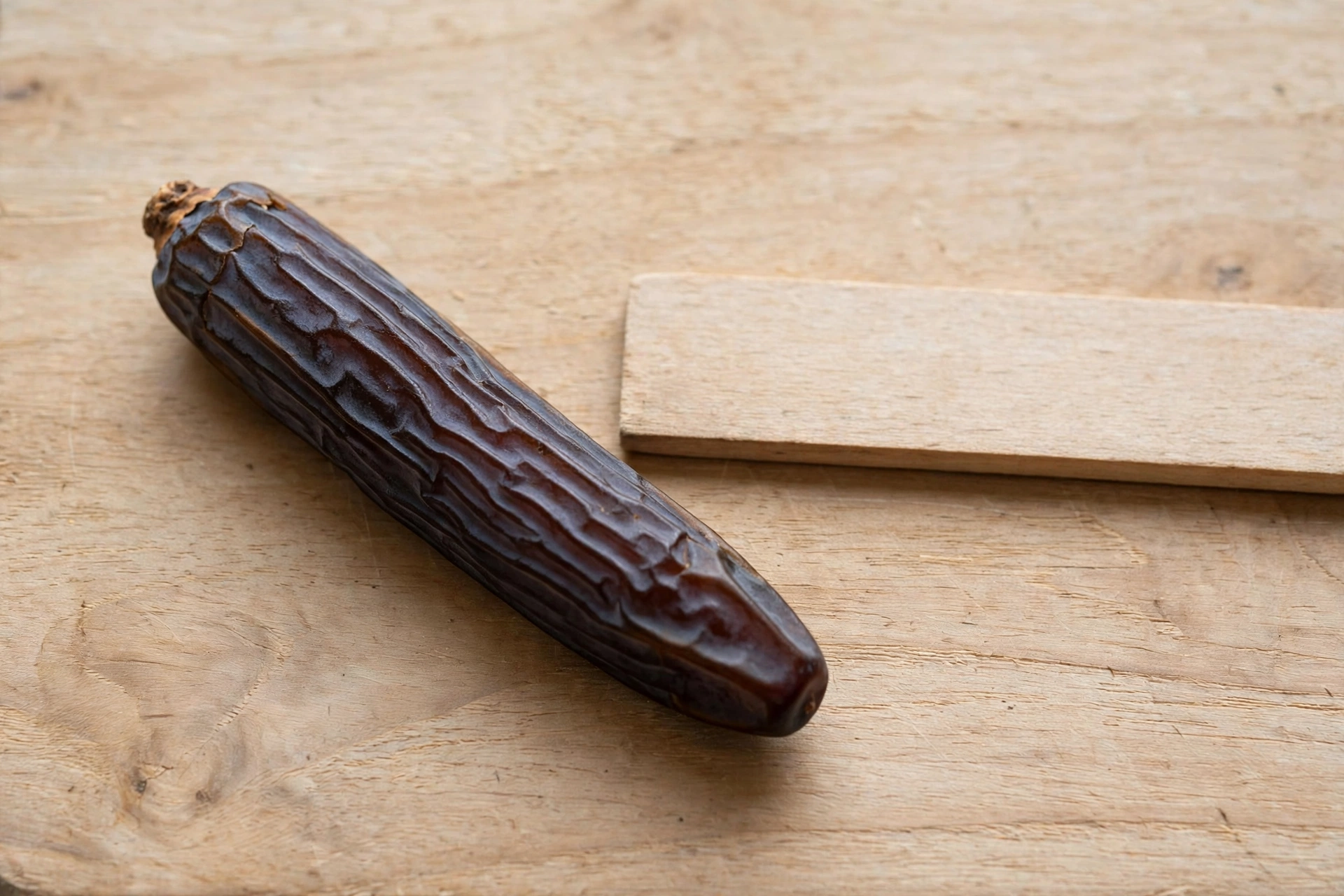
Mabroom is a date cultivar native to the Madinah region of Saudi Arabia and widely grown there and nearby. It is unmistakable on sight: long, slim and tapered, with a deep reddish brown to near black skin and shallow lengthwise wrinkling. The fruit is firm and chewy rather than soft, it is sold at the fully ripe tamr stage, and Saudi sources describe it as an inexpensive variety relative to the region’s premium names.
Which Cultivar You Are Buying, and Where It Comes From
Mabroom, in Arabic مبروم, is a recognised cultivar of Phoenix dactylifera. It appears in Date Palm Genetic Resources and Utilization, the Springer reference work edited by Al-Khayri, Jain and Johnson, where it is described as a large, elongated fruit resembling the Iranian Piarom cultivar.
Saudipedia, the national encyclopedia published under the Saudi Ministry of Media, is more specific on origin. It records Mabroom as native to Al Madinah Al Munawwarah in the west of the Kingdom, widely cultivated in Madinah and the surrounding areas, with a colour it describes as red tending toward black. It also notes something unusual: Mabroom may come from the same palm line as the Mashrook and Adi dates, meaning the three are closely related selections rather than wholly separate lines.
The Madinah region as a whole holds around four million date palms producing roughly 189,000 tonnes a year across about 270 varieties, so Mabroom shares its home ground with Ajwa, Safawi, Barni, Anbara and dozens of others. This is why Mabroom and Ajwa are so often sold side by side, and why buyers who have only ever bought Ajwa tend to meet Mabroom next.
Spellings
Mabroom, Mabroum, Mabrum, Maboom and Mabroom Al-Ula all appear on packs. The first three are transliterations of the same name. Mabroom Al-Ula identifies fruit grown in the AlUla area and is the form used in published cultivar research, which is useful because it is the version with measured data behind it.
The Arabic name shares a root with the verb meaning to twist or spin, which fits the fruit’s appearance. We could not verify a scholarly source confirming that etymology, so treat it as a plausible reading rather than an established fact.
The Measured Fruit: Why Size Language on Mabroom Packs Is Confusing
Mabroom is sold as a large date, and the fruit is long. It is also narrow, which means that a Mabroom and a Medjool described as the same weight look nothing alike in the hand.
A 2022 study in BMC Plant Biology by Alaida and Aldhebiani measured fourteen cultivars from the Al Madinah region, including Mabroom Al-Ula. Its figures, set against two reference cultivars from the same study:
| Measurement | Mabroom Al-Ula | Ajwah | Majdool (Medjool) |
|---|---|---|---|
| Fruit length | 4.40 cm | 2.93 cm | 4.82 cm |
| Fruit width | 1.73 cm | 2.23 cm | 2.28 cm |
| Length to width ratio | 2.54 | 1.31 | 2.11 |
| Fruit weight | 11.75 | 9.75 | 13.07 |
| Seed weight | 0.92 | 0.99 | 0.94 |
| Pulp as percent of fruit | 92.09 | 89.85 | 92.73 |
| Seed length | 3.40 cm | 2.18 cm | 2.28 cm |
| Seed shape | Linear-oblong | Ovoid | Ovoid-oblong |
Weights in the published table are given without stated units; read them as grams, which is the scale the figures imply.
Three things fall out of that table and they are all practical.
Mabroom is the slimmest of the three by a wide margin. At 1.73 cm wide against Medjool’s 2.28 cm, it is roughly a quarter narrower while being almost as long. That is what produces its distinctive silhouette.
Mabroom gives you more edible flesh per gram than Ajwa. At 92.09 percent pulp against Ajwa’s 89.85 percent, and with a seed that is lighter in absolute terms, a kilogram of Mabroom contains measurably more fruit than a kilogram of Ajwa. This matters when comparing seed-in prices.
The seed is the identification feature. Mabroom’s seed is 3.40 cm long and linear-oblong, the longest in the fourteen cultivar study. Ajwa’s is 2.18 cm and ovoid. If a seller tells you a date is Mabroom and the seed is short and plump, something is wrong.
One caveat: these are measurements of Mabroom Al-Ula from one study area in one season. Fruit from other Madinah orchards will vary, and pack calibres will vary more. Use the ratios rather than the absolute numbers.

Grades and Sizes
Mabroom is graded on calibre, uniformity and skin condition. As with every Saudi variety, grade describes appearance and size within the cultivar. A lower grade Mabroom is still Mabroom.
| Grade signal on the pack | What it describes | Where it sits |
|---|---|---|
| Large, jumbo, premium, royal | Longest fruit, even calibre, unbroken skin | Top of the range |
| Medium | Shorter fruit, even calibre, minor skin marks accepted | The usual retail grade |
| Small or economy | Mixed calibre, shorter fruit, more skin marking | Lower priced |
| Loose or bulk carton, 3 kg and 5 kg | Mixed calibre, often later in the crop year | Lowest per kilogram |
| Seedless or pitted | Any calibre with the seed removed | Priced for convenience |

Two notes specific to Mabroom.
Length is the grade variable, not plumpness. Because the fruit is narrow by nature, a packer cannot sort for width the way they would with a Medjool. Large Mabroom means longer fruit.
Pitted Mabroom loses more than you would guess. The seed is long and runs most of the length of the fruit, so pitting leaves a date that is noticeably hollow and more fragile. Seedless Mabroom is widely sold and is perfectly good for chopping and baking, but it does not present well whole. Darussalam Pakistan and several Indian sellers list medium and large grades in both seeded and seedless form, and the seeded packs state plainly that the seeds are included.
Does Grade Change the Eating?
Less than it does on softer varieties. Mabroom’s appeal is its chew and its toffee note, and a shorter fruit delivers both. The main thing grade buys on this variety is presentation, which means it matters for a gift box and barely matters for a lunchbox.
Price Context
Saudipedia describes Mabroom as inexpensive, and the listings bear that out at source. Outside Saudi Arabia the picture varies more than the variety’s reputation suggests. Full price tables are owned by the Ajwa dates price guide and Ajwa dates price in Saudi Arabia; what follows is context.
Four Mabroom listings read directly on 30 October 2026:
| Seller and market | Listing | Per kg as listed |
|---|---|---|
| Farzana, United Arab Emirates | Mabroom 500 g at AED 21.00 | about AED 42 |
| Farzana, United Arab Emirates | Mabroom 5 kg box at AED 210.00 | AED 42 |
| Darussalam Pakistan | Mabroom Large 1 kg at Rs 5,200 | Rs 5,200 |
| Darussalam Pakistan | Mabroom Medium 250 g at Rs 1,300 | Rs 5,200 |
Listed figures are examples of market pricing on the date shown, not fixed or current rates.
Two patterns are worth reading out of that.
The UAE seller prices the 5 kg box at exactly the same per-kilogram rate as the 500 g pack. That is unusual and tells you the bulk discount on this variety is thin at that retailer. Do not assume a big box is automatically cheaper per kilogram; check.
The Pakistani seller prices medium and large at the same per-kilogram rate too. Grade is being used to sort fruit for presentation rather than to set price at that shop. Where two grades are priced the same, buy the one that suits the use.
Against Ajwa the comparison is the useful one. On the same date, Ajwa from a Madinah seller ran from SAR 56 to SAR 130 per kilogram, and the same Pakistani seller listed Ajwa large at Rs 5,200 per kilogram, identical to its Mabroom large. That last point is worth pausing on: in at least one market, Mabroom is not the budget alternative to Ajwa that its Saudi reputation implies. Price it where you are rather than assuming.
Storage and Shelf Life
Mabroom is sold at the tamr stage, which means it has dried below the point at which a date becomes self preserving. The FAO date products handbook puts that threshold at roughly 24 to 25 percent moisture and notes that tamr dates keep for long periods without special precautions provided they are protected from insects.
| Storage | Effect | Reasonable window |
|---|---|---|
| Sealed, cool pantry, below 20°C | Slow moisture loss, gradual firming | Several months |
| Refrigerated, 4 to 5°C, airtight | Chew preserved, sugar crystallisation slowed | Up to around a year |
| Frozen, airtight, minus 18°C | Texture and colour largely held | Longer still, thaw in the sealed bag |
| Warm kitchen, open packet | Hardening, then brittleness | Weeks |
Mabroom specifics worth knowing.
It hardens rather than spoils. Because it starts firm, moisture loss takes Mabroom toward hard and candy-like rather than toward dry and crumbly. One UAE retailer describing its own Mabroom stock on 30 October 2026 noted that some customers find the variety hard to chew, comparing it to candy. That is the variety’s firm end, not a fault, but it is the direction an old pack moves in.
Reviving a hard pack works well on this variety. A minute of steam, or a ten minute soak in warm water, brings the chew back. This is more effective on Mabroom than on a soft variety, where soaking produces mush.
White bloom is crystallised sugar, not mould. It wipes off, and warming reverses it. Mould is fuzzy, localised and smells wrong.
Airtight storage beats cold storage. Insects, not microbes, are the realistic threat to a tamr date. A sealed jar in a cupboard outperforms a loose bag in a fridge.
Culinary and Practical Uses
Mabroom’s firm chew and toffee note put it between an eating date and a cooking date, and it has one use it is genuinely best at.
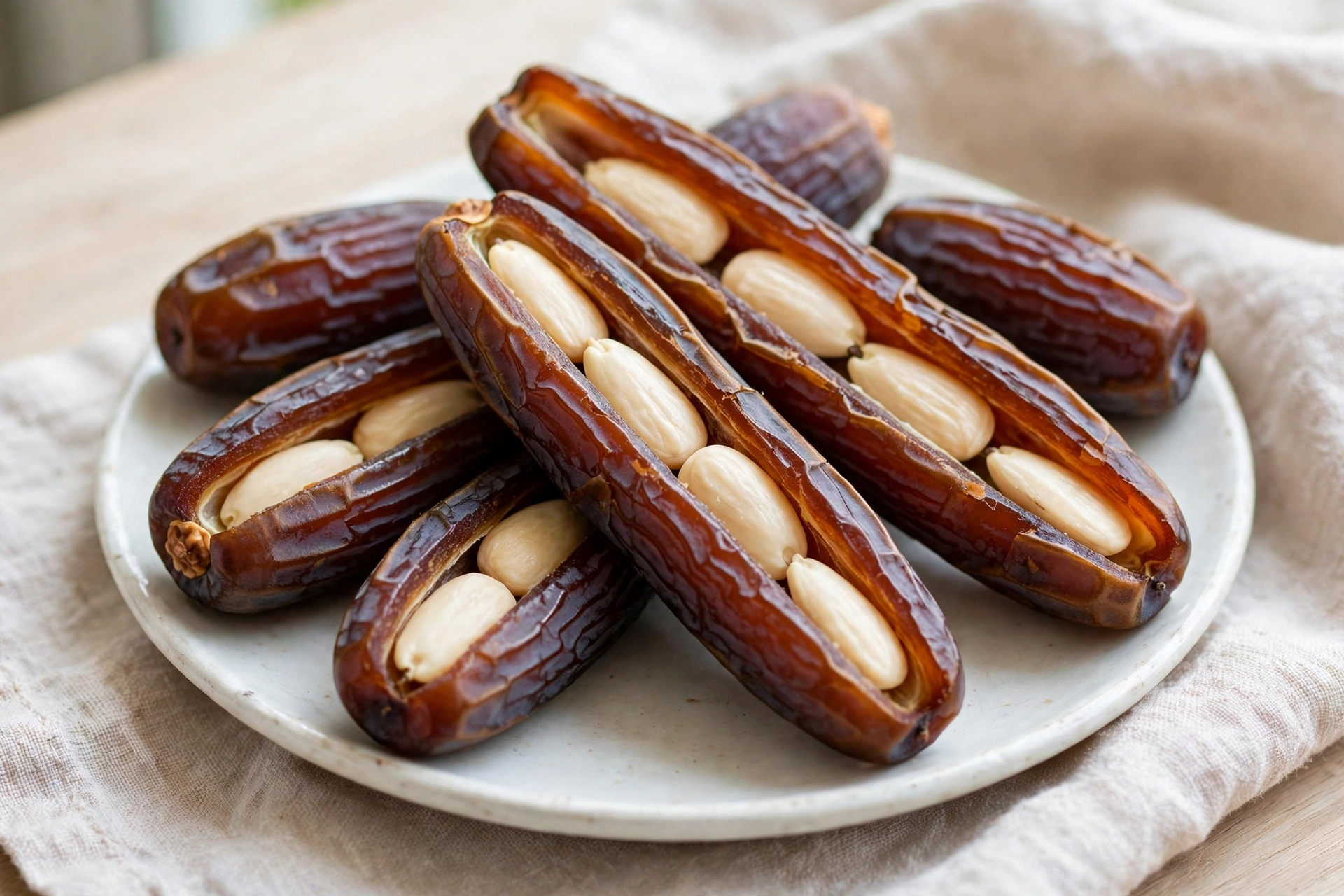
The long narrow cavity left by the seed takes a slim filling better than any round date. Split lengthways, remove the long seed and press in a blanched almond, a thin strip of marzipan, a piece of candied orange peel or a pistachio paste. The fruit holds its shape because it is firm.
The toffee character and the resistance in the bite suit a date eaten one at a time rather than by the handful. This is the standard Gulf serving context and it is where Mabroom reads as a premium date rather than a cheap one.
The firm flesh holds its shape through chopping and does not smear into a dough, which makes it a better structural choice than Medjool in oat bars and loaf cakes. Flour the pieces lightly to keep them separate.
Mabroom blends to a paste after soaking, though it needs a longer soak than a soft variety, around 30 minutes in hot water. Lower grades and seedless packs are the correct choice here since appearance is destroyed. Methods are in date recipes.
Mabroom’s seeds are the longest of the cultivars measured in the Madinah study, which means a given weight of fruit yields unusually long seeds for roasting and grinding. The method on how to make Ajwa seed powder applies unchanged.
Where Mabroom disappoints: anything that wants the date to melt. It will not. A sticky toffee pudding, a soft date caramel or a smooth filling all work better with a softer variety.
Buying Guidance
What to Check on the Pack
- Country of origin stated as Saudi Arabia, ideally naming Madinah or AlUla
- Variety named, not just “premium dates”
- Net weight, and whether seeded or seedless
- Grade or calibre word, or fruit visible through the pack
- Fruit visibly long and narrow, not oval
- Packing or best before date
- Ingredients listed as dates only, with no glucose syrup, oil or preservative
- Price recalculated per 100 g before comparing
Substitution Risks
Mabroom’s distinctive shape makes it harder to fake than most varieties, and that cuts both ways.
Piarom sold as Mabroom. This is the realistic substitution. The Springer cultivar reference notes Mabroom resembles Piarom, an Iranian cultivar that is also long, slim, dark and chewy. The two are genuinely similar in the hand. Check country of origin: Piarom is Iranian, Mabroom is Saudi. Neither is inferior, but they are not the same cultivar and should not be sold as one another.
Mabroom sold as Ajwa, or Ajwa sold as Mabroom. Both come from the Madinah region and often sit in the same shop, which is why the substitution happens. It is easy to catch. Ajwa is oval at a 1.31 length to width ratio and has a short ovoid seed. Mabroom is 2.54 and has a 3.4 cm linear seed. Look at the shape, and if you can, look at a seed. The authenticity checks that matter for Ajwa are set out on the Ajwa dates price guide.
Glazed or oiled fruit. A thin glaze adds shine and weight and hides a dry batch. Rub one between finger and thumb: a glazed date leaves a slick film.
Nutrition panels you should not rely on. Retail nutrition labels on named date varieties are supplier declarations, not laboratory measurements of the cultivar, and across the date varieties we checked on 30 October 2026 they disagreed with one another significantly. Use them for allergen and ingredient information, not for nutrient precision. What the published data does and does not support is covered in what Mabroom dates are.
Mabroom Against Ajwa and Medjool, as a Buying Decision
| Practical question | Mabroom | Ajwa | Medjool |
|---|---|---|---|
| Shape | Long and narrow, 2.54 length to width | Oval, 1.31 | Long and broad, 2.11 |
| Measured fruit weight | 11.75 | 9.75 | 13.07 |
| Pulp percentage | 92.09 | 89.85 | 92.73 |
| Bite | Firm, chewy, can be candy-hard | Soft with slight chew | Soft, dense, fudge-like |
| Flavour note | Toffee, caramel | Moderate, restrained | Pronounced caramel |
| Price position | Low to mid, but check locally | High | Mid to high |
| Best for | Stuffing, slow eating, chopping into bakes | Gifting, religious observance | Dessert, eating out of hand |
| Supply | Madinah region and nearby | Madinah region only | Multi-country, industrial scale |
Fruit weight, pulp percentage and ratio figures are from Alaida and Aldhebiani, 2022.
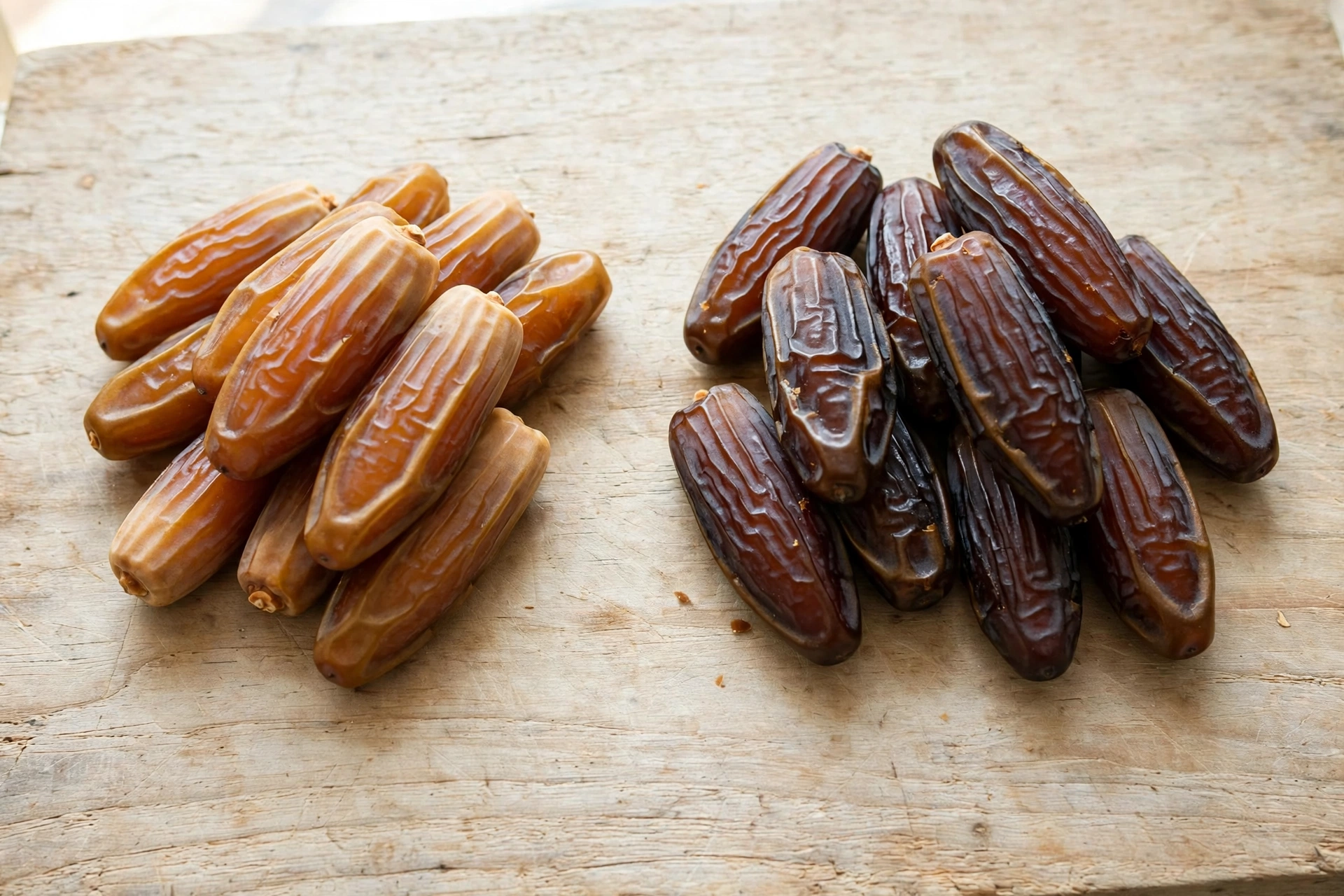
The honest summary: Mabroom and Medjool are closer in measured size than their reputations suggest, but they eat completely differently, because Medjool’s weight is in soft flesh and Mabroom’s is in firm flesh. Mabroom and Ajwa share a growing region and nothing else: different shape, different seed, different texture, and a very different market position. Buying Mabroom as a cheap Ajwa substitute will disappoint; buying it on its own terms, for stuffing and slow eating, will not.
The Ajwa and Medjool comparison in full is on Ajwa vs Medjool. For the other Saudi variety in this silo see Khudri dates, and for the wider field see other date varieties.
Frequently Asked Questions
Is Mabroom the same as Mabroum or Mabrum?
Yes. All three are transliterations of مبروم. Mabroom Al-Ula identifies fruit from the AlUla area and is the spelling used in published cultivar research.
Why are Mabroom dates long and thin?
It is a genetic characteristic of the cultivar. The 2022 Madinah cultivar study measured Mabroom Al-Ula at 4.40 cm long and 1.73 cm wide, a length to width ratio of 2.54, the second highest of the fourteen cultivars it examined. The fruit grows that shape; nothing in processing creates it.
Are Mabroom dates supposed to be hard?
Firm, yes. Hard enough to be unpleasant, no. Mabroom is a firm chewy date by nature and one UAE retailer notes that some customers find it candy-like, but a pack that has dried too far will soften with a minute of steam or a short warm soak.
Do Mabroom dates need refrigeration?
Not for safety. They are tamr stage dates, below the roughly 24 to 25 percent moisture at which dates become self preserving. Refrigeration keeps the chew pleasant for longer, so it is a quality decision. An airtight container matters more, because insects rather than microbes are the real threat.
Is Mabroom cheaper than Ajwa?
At source in Saudi Arabia, yes: Saudi sources describe Mabroom as inexpensive while Ajwa carries a single region supply limit and religious demand. In export markets the gap narrows, and we found one Pakistani seller listing Mabroom large and Ajwa large at the same price per kilogram on 30 October 2026. Check your own market.
Is seedless Mabroom worth buying?
For chopping, baking and blending, yes, and it saves work. For serving whole or stuffing, no: the long seed cavity leaves a hollow, fragile date that does not present well.
Can Mabroom be confused with Piarom?
Yes, and this is the realistic mix-up. The Springer date palm cultivar reference notes the resemblance directly. Piarom is Iranian and Mabroom is Saudi, so country of origin on the pack settles it.
Sources
Prices and product details were read directly from seller listings on 30 October 2026 and are examples of market pricing, not fixed rates.
- Alaida, M. F. and Aldhebiani, A. Y. (2022), “Comparative study of the morphological characteristics of Phoenix dactylifera L. cultivars in Al-Madinah Al-Munawarah, Saudi Arabia”, BMC Plant Biology, 22, 461 (all fruit and seed dimensions, weights, pulp percentages and seed shapes for Mabroom Al-Ula, Ajwah and Majdool)
- Saudipedia, Mabroom Date (native to Al Madinah Al Munawwarah, widely cultivated there and nearby, red tending to black, described as inexpensive, possible shared palm line with Mashrook and Adi, Madinah region figures of about four million palms, roughly 189,000 tonnes a year and around 270 varieties)
- Al-Khayri, J. M., Jain, S. M. and Johnson, D. V. (eds.) (2015), Date Palm Genetic Resources and Utilization, Springer (Mabroom as a large elongated cultivar resembling Piarom)
- FAO, Date Palm Products, Chapter 1: Whole Dates (maturity stages, the self preserving moisture threshold at roughly 24 to 25 percent, and insect protection as the key storage requirement for tamr dates)
- Farzana product listings, Mabroom 500 g and Mabroom 5 kg box (prices and the firm-texture description)
- Darussalam Pakistan product listings, Mabroom Dates Large 1 kg, Mabroom Dates Medium 250 g and Ajwah Dates Large 1 kg
- Saudipedia, List of Date Varieties in Saudi Arabia (national context: around 34 million palms and roughly 300 varieties)