
Date Varieties: How the World’s Commercial Cultivars Actually Differ
Several hundred names, one species, and two facts that predict almost everything: the moisture class of the ripe fruit and the stage at which it was picked. This is the orientation page for the whole category, with a 25-cultivar comparison table at its centre.

How date varieties actually differ
There are several hundred named date varieties, but only a few dozen matter commercially. All are cultivars of one species, Phoenix dactylifera. The useful way to tell them apart is by two things: the moisture class the ripe fruit falls into, soft, semi-dry or dry, and the ripening stage at which it is picked and sold. Those two facts predict texture, sweetness, shelf life and price better than the variety name alone.
How many date varieties exist
The honest answer is that nobody has a definitive count. Surveys of Saudi Arabian date palms alone reported about 400 named varieties in one 1975 Ministry of Agriculture and Water study and around 250 in an earlier 1954 count. Saudi Arabia’s own national reference puts the current figure at roughly 300 varieties across about 34 million palms.
Most of those names never leave the oasis that produced them. A 2015 survey of date palm genetic resources notes that only a few dozen cultivars have achieved broad commercial importance, and the picture at a global trade level is narrower still: a handful of names account for almost everything you will see in a shop outside the growing regions.
Two more numbers worth keeping in mind. A genetic study that collected 109 distinct named varieties across 14 countries found real genetic separation between many of them, so the names are not arbitrary. But a University of California study of Californian plantings found 33 Deglet Noor samples almost genetically identical, while 23 Medjool samples resolved into 20 distinct types. The same variety name can therefore hide very different material depending on how it was propagated.
That is why this page is organised around classification rather than around a list. The framework below is what makes the whole category make sense.
The ripening stages: the single most useful thing to understand about dates
A date passes through named developmental stages, and which stage a variety is harvested at changes the product completely. These names appear on Gulf packaging and in trade documents, and almost no consumer variety list explains them.

| Stage | Arabic | What the fruit is like | Approximate moisture | Typical length |
|---|---|---|---|---|
| Hababouk | حبابوك | Just after fertilisation, chickpea sized, pale green | Very high | 4-5 weeks |
| Kimri | كمري | Immature, green, hard, astringent, highest acidity | Up to about 85 percent | 9-14 weeks |
| Khalal | خلال | Full size, firm and crunchy, yellow or red, sucrose peaks, tannins drop | Roughly 50-66 percent | 3-5 weeks |
| Rutab | رطب | Softening and browning from the tip, sugar inverting | Roughly 35-43 percent | 2-4 weeks |
| Tamr | تمر | Fully ripe, wrinkled, dark, sweetest, self-preserving | About 25 percent or lower | 2-4 weeks |
Moisture figures are drawn from FAO date production documentation and from a 2025 review in Frontiers in Sustainable Food Systems. The two sources give slightly different numbers for khalal and rutab, which reflects real variation between cultivars rather than a disagreement about the biology.
Why the stage matters more than the label
Three practical consequences follow.
A tamr-stage date keeps itself. At roughly 20 to 25 percent moisture and 60 to 80 percent sugar, the fruit is too sweet and too dry for most spoilage organisms. This is why almost all dates in international trade are tamr. It is also why a date needs no preservative.
A rutab-stage date is fresh produce. It is softer and more aromatic but perishable, which is why rutab is mostly a local and seasonal pleasure in the producing countries and why Iranian soft dates shipped abroad travel chilled or frozen.
A khalal-stage date is a different fruit entirely. Crunchy, mildly sweet and faintly astringent, closer to a firm apple than to a dried date. Only a few varieties are pleasant at khalal. Barhi is the best known, which is why it appears at Gulf markets as yellow fruit still on the strand.
Sweetness is also stage dependent, not just variety dependent. Research summarised in a 2025 nutrition review found that tamr-stage dates have a lower glycemic index than khalal-stage fruit of the same variety, while rutab-stage fruit carried the highest glycemic load. Ripeness, in other words, is a variable in its own right.
Soft, semi-dry and dry: what the classes mean
Dates are divided into three classes based on the texture and pliability of the ripe fruit at the tamr stage. FAO documentation notes that this grouping broadly correlates with how much of the sugar remains as sucrose, though not reliably in every case.
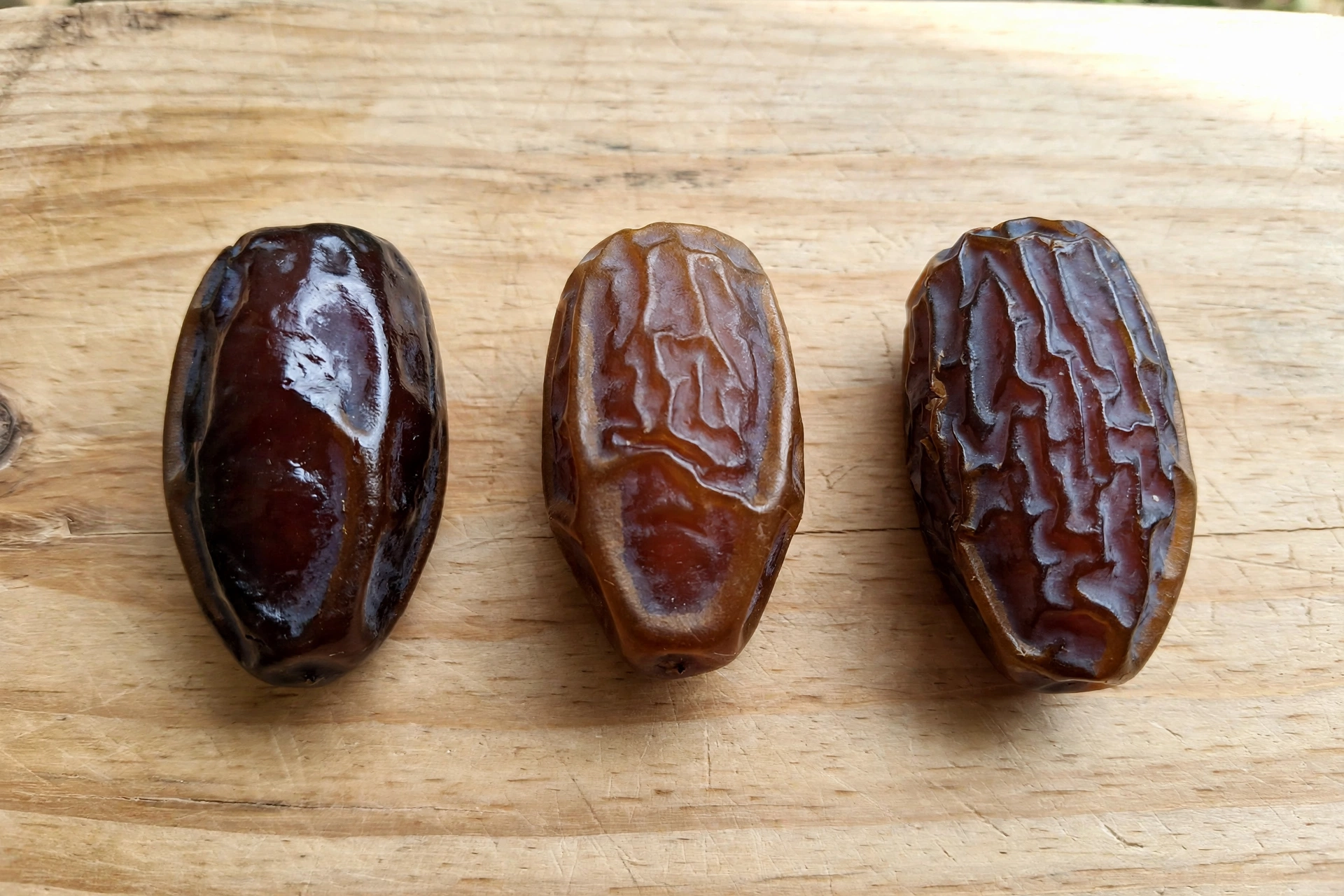
| Class | How it behaves | Measured examples (moisture, sucrose as percentage of sugars) |
|---|---|---|
| Soft | Stays pliable and moist, can be squashed between the fingers, shorter shelf life | Barhee 37.3 percent moisture, no sucrose; Khadrawy 24.4 percent, no sucrose |
| Semi-dry | Firm but yielding, holds its shape, long keeping | Deglet Noor 24.1 percent moisture, sucrose about half the sugar; Dayri 22.2 percent; Zahdi 13.6 percent |
| Dry | Firm to brittle flesh, very long keeping, sometimes called bread dates | Thoory 15.5 percent moisture, sucrose about a third of the sugar |
Those figures come from an FAO composition table and are reported on a fresh weight basis for moisture and a dry weight basis for sugars.
A warning about the moisture numbers
Different authorities draw the lines in different places. North American produce trade references define soft as up to 30 percent moisture, semi-soft as 20 to 30 percent and dry as under 20 percent. Yet the FAO table lists Barhee, an unambiguously soft date, at 37.3 percent, and Zahdi, usually sold as semi-dry, at 13.6 percent.
The classes are therefore a texture judgement that happens to correlate with moisture, not a standardised measurement scale. Treat them as a guide to how a date behaves, not as a specification.
The sugar point most lists get wrong
Dates are usually described as “high in sugar”, which is true but not very informative. The more useful distinction is the form that sugar takes.
Most date varieties are what the trade calls the invert sugar type. By the time the fruit reaches commercial maturity, an enzyme called invertase has converted nearly all of the sucrose into glucose and fructose in roughly equal parts. Deglet Noor is the classic exception: inversion is only partly complete at harvest, so a substantial share of its sugar is still sucrose.
This is not a nutrition claim, it is a food science one, and it explains a lot. Fructose is more hygroscopic than sucrose, so invert-type dates stay softer and are stickier to handle. Sucrose-retaining varieties like Deglet Noor hold their shape better when chopped, baked or sliced, which is exactly why Deglet Noor dominates industrial and baking use while Medjool dominates eating out of hand.
For a worked nutrient profile, USDA reference data for Deglet Noor dates gives, per 100 g: 282 kcal, 75 g carbohydrate of which 63 g sugars, 8 g fibre, 2.4 g protein, 0.4 g fat, 656 mg potassium and 43 mg magnesium. Medjool is close: 277 kcal, 66 g sugars, 6.7 g fibre and 696 mg potassium. Differences between varieties are real but modest, and they do not justify choosing one variety over another on health grounds.
Master comparison table: the major commercial cultivars
Origins below are the cultivar’s place of origin or the region where it is commercially concentrated, not a complete list of countries that grow it. Sizes are typical ranges and vary with grade and season.
| Variety | Origin or main production | Moisture class | Typical size | Taste and texture | Common uses | Market position |
|---|---|---|---|---|---|---|
| Ajwa | Madinah, Saudi Arabia | Soft to semi-dry | Medium, about 11 g average | Mild, lightly sweet, faintly savoury, dense chew | Eaten whole, gifting, seed powder | Premium, religious demand |
| Safawi (sold as Kalmi) | Madinah, Saudi Arabia | Soft, semi-dried | Medium, elongated | Deep caramel sweetness, soft chew | Everyday eating, iftar, paste | Mid, the value Madinah date |
| Mabroom | Saudi Arabia | Semi-dry | Large, long and slender | Firm, chewy, moderate sweetness | Eaten whole, gifting | Upper mid |
| Khudri | Saudi Arabia | Semi-dry | Medium to large | Rich, raisin-like, slightly fibrous | Everyday eating, bulk, baking | Value to mid |
| Sukkari | Qassim, Saudi Arabia | Soft | Large, oval | Very sweet, light, almost crystalline | Eaten whole, with coffee | Premium domestically |
| Khalas | Al Ahsa, Saudi Arabia, UAE, Oman | Semi-dry | Medium, oval | Clean honeyed sweetness, smooth | Eaten whole at all stages | Mid to premium in the Gulf |
| Sagai | Riyadh region, Saudi Arabia | Semi-dry | Large, 10-14 g by grade | Two-tone fruit, crisp tip, soft base | Eaten whole, gifting | Mid to premium |
| Anbara | Madinah, Saudi Arabia | Soft | Very large, 10-13 g by grade | Dark red, aromatic, rich | Gifting | Premium, low yield |
| Barhi | Iraq, now widely grown | Soft | Small, 2-4 cm | Butterscotch and honey when ripe, crunchy and faintly astringent at khalal | Eaten fresh at khalal or rutab | Seasonal specialty |
| Medjool | Morocco, now Israel, US, Jordan, Saudi Arabia | Soft | Very large | Caramel, moist, fibrous | Eaten whole, stuffing, smoothies | Premium, highest volume premium date |
| Deglet Noor | Tolga, Algeria, then Tunisia and US | Semi-dry | Medium, slender | Mildly sweet, nutty, translucent, not sticky | Baking, chopping, date sugar, industrial | Volume export leader |
| Zahidi | Iraq and Iran | Semi-dry | Medium, cylindrical | Golden, very sugary, firm | Baking, pastes, processing | Value |
| Thoory | Algeria | Dry | Medium, very wrinkled | Sweet and nutty, firm to brittle | Baking, granola, long storage | Niche |
| Halawy | Iraq, also California | Soft | Small to medium | Honey and caramel, very sweet | Eaten whole, baking | Value to mid |
| Khadrawy | Iraq and the Levant | Soft | Medium | Very dark, soft, distinctly sweet | Eaten whole, local markets | Value, poor keeper |
| Dayri | Iraq and Iran | Semi-dry | Long and slender | Nearly black, soft, less sweet, earthy | Stuffing, paste | Niche |
| Sayer | Iran and Iraq | Soft | Medium | Dark orange-brown, soft, syrupy | Processing, paste, bulk export | High volume, low price |
| Mazafati (sold as Kimia) | Bam and Kerman, Iran | Soft, high moisture | Medium | Dark, fleshy, caramel, very moist | Eaten fresh, chilled, purees | Mid, needs cold chain |
| Piarom | Hormozgan, Iran | Semi-dry | Large, long, thin skinned | Toffee and chocolate notes, chewy | Eaten whole, premium retail | Premium |
| Rabbi | Iran and Pakistan | Semi-dry | Medium to large | Reddish black, sweet, long keeping | Eaten whole, export | Mid |
| Hayany | Egypt | Soft | Medium, elongated | Dark red to near black, soft, meaty | Eaten fresh, local markets | Domestic |
| Zaghloul | Egypt | Khalal specialty | Long | Dark red, very crunchy, extremely sweet | Eaten fresh at khalal | Domestic, seasonal |
| Aseel | Khairpur, Pakistan | Semi-dry to dry | Medium | Firm, sweet | Pitted, diced, processing, dry date production | Volume, low price |
| Barni | Oman and Madinah | Semi-dry | Medium | Mild, firm | Everyday eating, bulk | Value |
| Naghal and Fardh | Oman | Semi-dry | Small to medium | Fardh dark and sweet, small stone | Everyday eating, processing | Domestic volume |
Four of the varieties in that table are covered in depth elsewhere on this site rather than here: Ajwa across the Ajwa dates price guide and its related pages, plus Kimia dates, Khudri dates and Mabroom dates. The profiles below cover the rest.
Profiles: the varieties without their own page
Kalmi and Safawi
Safawi is a recognised cultivar of Madinah: soft to semi-dried, deep black, medium sized and elongated, and described in the reference literature as sharing taste characteristics with Ajwa. In a 2022 study that measured 35 Saudi date varieties bought from local markets, Safawi samples recorded the highest moisture of the whole set, with the range across all varieties running from 7.3 to 29.2 g per 100 g.
Kalmi is a different kind of word. It is a South Asian market name, not a cultivar name in the botanical reference works, and Pakistani and Indian sellers routinely label the same product “Kalmi (Safwi)” or “Safawi Dates / Kalmi Dates”. Because Kalmi is the variety most often substituted for Ajwa, it gets its own detailed treatment: see Kalmi dates.

At the same Madinah retailer, on 30 October 2026, 1 kg of Safawi was listed at SAR 32 against SAR 89 to SAR 130 for Ajwa grades. That gap is the commercial reason the substitution happens.
Deglet Noor
An FAO working paper described Deglet Nour as the leading date cultivar by export value, and it is the one most people in Europe and North America have eaten without knowing its name.
Deglet Noor originated in the oasis of Tolga in Algeria. Pierre Munier’s history places its spread from Tolga to Biskra and the Oued Righ at the end of the thirteenth or beginning of the fourteenth century, and its arrival in Tunisia at the end of the seventeenth century through a grower from Tozeur. W. T. Swingle brought offshoots to California in 1900, and the variety became popular in the United States during wartime sugar rationing as a sweet substitute.
It is semi-dry, translucent amber, firm without being sticky, and mildly sweet with a nutty edge. The sucrose it retains is the reason it chops, slices and bakes better than any soft date. Tunisia built an export industry on it: an FAO market study recorded Tunisia holding 48 percent of EU supply volume and 55 percent of EU import value in the early 2000s while producing only about 2 percent of world dates, almost entirely Deglet Nour. Algeria reserves commercial use of the “Deglet Nour” label for Algerian fruit.
Barhi
Native to Iraq, where it originated around Basra. Paul Popenoe brought it to the United States in 1913 as part of a collection of roughly 9,000 palm offshoots from southern Iraq and Baghdad. The name is usually traced to the Arabic barh, a hot wind.

Barhi is the variety that makes the ripening stages visible. The fruit is small, 2 to 4 cm, nearly spherical, and it is one of very few cultivars that is genuinely good at khalal: firm, crunchy, faintly astringent, with notes of cinnamon and sugarcane. Left to ripen it becomes soft, creamy and unmistakably butterscotch. Saudi Arabia’s national reference describes a palm yielding around 250 kg of fruit a year and notes that Barhi is eaten at every stage.
It is not grown at large commercial scale for export because the ripe fruit is too delicate to ship well. Outside the Gulf you will mostly find it at farmers markets in a short autumn season.
Khalas
One of the major Gulf cultivars and the commercial variety of Saudi Arabia’s Eastern Province, concentrated around Hofuf in Al Ahsa and Qatif, with large plantings in the UAE and Oman. In Oman it is the single largest variety, accounting for about 15 percent of a 2024 national crop of 396,775 tonnes.
The fruit is oval, apricot-yellow early, turning light then reddish amber with soft honey-coloured translucent skin. Saudi grading sets premium Khalas at a minimum of 10 g per date, first grade at 7 g and second at 5 g. It is edible at every ripeness stage, which is unusual, and its sweetness is clean rather than heavy.
Sukkari
The name is Arabic for “sugary”. Sukkari is grown mainly in Qassim province in Saudi Arabia and is often marketed as a royal or premium date domestically. The fruit is large, light golden, soft and extremely sweet, with a light, almost crystalline texture quite unlike the dense chew of Ajwa.
Measured sugar composition varies a lot between published studies, which a 2025 review in Frontiers in Nutrition attributes to differences in sample origin and method rather than to the variety itself. One Saudi glycemic index study covering 17 local varieties placed Sukkari at 43.4 on the GI scale, within the low range, alongside Shaqra at 42.8 and Sagai at 44.6. Treat single GI figures as indicative, not definitive. Sukkari has its own health-angle page: Sukkari dates health benefits.
Its position in Madinah retail is instructive: the same seller that lists Ajwa at SAR 89 to SAR 130 per kilogram listed luxury Sukkari at SAR 40.
Sagai
A Riyadh-region variety, grown particularly in the al-Aarid area, and one of the most visually distinctive dates on the market. The fruit is thick and roughly rectangular to oval with a pale yellowish tip that stays firm while the lower part of the fruit darkens and softens, which gives Sagai its two-tone look and its unusual mix of crisp and soft in one bite.
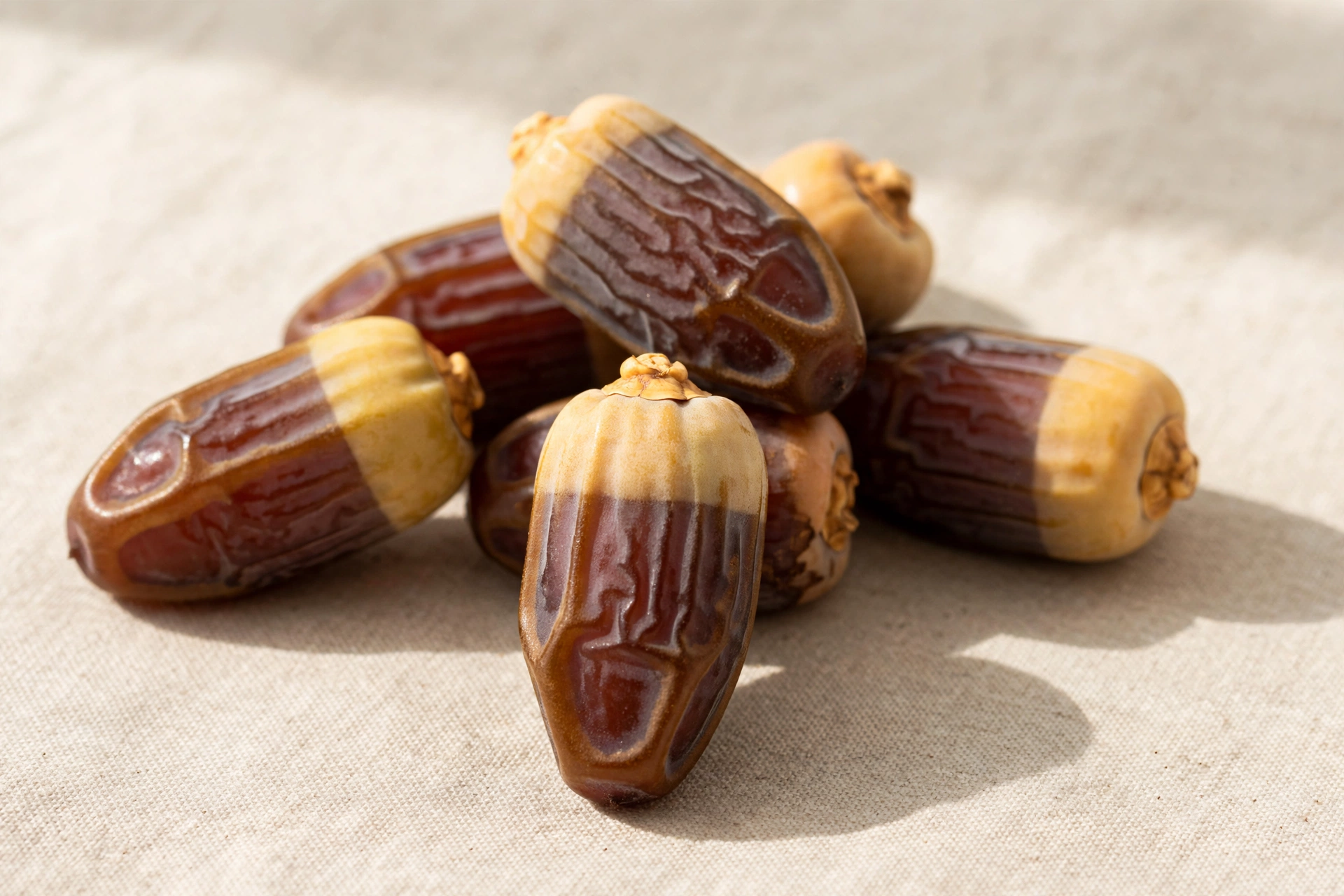
Saudi grading sets superior Sagai at a minimum of 14 g per date, which works out at about 35 dates per 500 g, first grade at 10 g and second at 7 g. National reference data gives roughly 330 kcal per 100 g with 43 mg magnesium and 36 mg calcium, and classes it as a monosaccharide date, meaning its sugar is predominantly glucose and fructose.
Anbara
The rarity case. Anbara is a Madinah variety described in Saudi Arabia’s national reference as one of the kingdom’s rare palm yields, grown in limited quantity because planting frequently fails, offshoots are expensive and yields are low. A mature palm produces no more than about 70 kg a year, against roughly 250 kg for Barhi.
The fruit is large and dark red with a pronounced aroma, and the palm is fragile enough that growers thin the crop so that no fruit stalk carries more than about eight dates. Superior grade Anbara starts at 13 g per date. It is bought almost entirely as a gift.
At the Madinah retailer checked on 30 October 2026, Anbara was listed at SAR 70 per kilogram, above Safawi and Sukkari but below every Ajwa grade in the same shop.
Zahidi
The workhorse of Iraqi and Iranian date production. The name is Arabic for “ascetic”. Zahidi is medium sized, cylindrical, light golden-brown, semi-dry and very sugary, and it is sold at three different firmness levels: soft, medium-hard and hard. That flexibility, plus a low price and good keeping, is why so much of it ends up in pastes, fillings and bakery products rather than in a gift box.
Zahidi is also one of the varieties that breaks the neat relationship between class and sugar type: FAO data records it at only 13.6 percent moisture, which is dry-date territory, while the trade sells it as semi-dry.
Medjool
Large, moist, caramel-heavy and the premium date most familiar in Western supermarkets. Medjool probably originated in the Tafilalt district of Morocco. Swingle introduced it to California in 1927, and it is now grown at scale in Israel, Jordan, the United States, South Africa and Peru as well as Morocco.
Medjool’s commercial importance is out of proportion to the volumes involved: one 2022 trade estimate put Israeli Medjool exports alone at USD 330 million. Its contrast with Ajwa is the comparison people search for most, and it has its own page: Ajwa vs Medjool.
Thoory
The clearest example of a genuinely dry date. Thoory is popular in Algeria, cures to a brown-red colour with a bluish bloom and a heavily wrinkled skin, and has flesh that can be firm to brittle with a sweet, nutty flavour. Dry dates like this are sometimes called bread dates, because they were historically stored and carried rather than eaten fresh. They keep almost indefinitely and are best used chopped into baking or granola.
The Iraqi and Iranian soft dates: Halawy, Khadrawy, Dayri, Sayer
These four built the historic Iraqi date trade and remain important in Iran.
Halawy is small to medium, soft and extremely sweet, with honey and caramel flavour, and it holds its shape reasonably well in baking. Khadrawy takes its name from the Arabic for green and is a soft, very dark date long favoured in Iraq, but it keeps poorly, which limits its export reach. Dayri, the “monastery” date, is long, slender, nearly black and soft, less sweet than the others and useful where you want date texture without overwhelming sugar. Sayer, whose name is simply Arabic for “common”, is dark orange-brown, soft and syrupy, and it moves in very large volumes at low prices into processing and bulk export.
The Iranian premium soft dates: Mazafati and Piarom
Mazafati, grown around Bam and Kerman, is dark, fleshy and notably high in moisture, which makes it a fresh-eating date rather than a dried one. Handled cold it keeps remarkably well: reference sources record up to two years at minus 5 degrees Celsius. In India and parts of the Gulf it is sold as Kimia, and that trade name has its own page: what are Kimia dates.
Piarom, from Hormozgan, is large, long and thin skinned with a dark brown-black colour, a semi-dry chew and toffee notes. It commands some of the highest prices of any Iranian date.
The Egyptian varieties: Hayany and Zaghloul
Egypt is the world’s largest or second largest date producer depending on the data year, but very little of its crop reaches Western shelves because so much of it is consumed fresh domestically.
Hayany is dark red to nearly black and soft, eaten fresh. Zaghloul is the more striking: long, dark red skinned and eaten crunchy at the khalal stage, intensely sweet, and essentially exclusive to Egypt, where it carries a degree of national sentiment from sharing a name with the independence leader Saad Zaghloul.
The South Asian varieties: Aseel and the dry date trade
Aseel, grown principally around Khairpur in Pakistan’s Sindh province, is the backbone of Pakistani date production. It is commonly pitted and diced, and a large share of the crop is processed into hard dry dates rather than sold as soft fruit. Pakistan produced around 0.7 million tonnes in 2024, fifth in the world, but almost none of it reaches premium retail under its own variety name.
Names that look like varieties but are not
This is where most variety lists go wrong, and where a buyer loses money.
Rutab. Rutab is a ripening stage, not a variety. In Gulf and Iranian markets “rutab” on a label means soft fresh dates picked before the tamr stage, which could be any of several cultivars. There is also a listed Iranian and Iraqi cultivar recorded as Rotab, described simply as dark and soft, which makes the confusion worse. If a pack says rutab, ask which variety.
Kalmi. A South Asian trade name, discussed above and in detail on the Kalmi page.
Khajoor or khajur. The Urdu and Hindi word for dates in general. It is not a variety and tells you nothing.
Alia, first class, Quba, fourth class. Saudi grade names, describing size and cosmetic uniformity within one variety. A fourth class Ajwa is still Ajwa. Grades are covered in the Ajwa dates price guide.
Chinese date or red date. The jujube, Ziziphus jujuba, a completely different plant that is not a date palm fruit at all.
Honey dates. Usually a descriptive group name for any soft, pale, mild date, and sometimes a processing description for dates that have been dipped or coated.
Which variety should you actually buy
| What you want to do | Reach for | Why |
|---|---|---|
| Eat a few dates as a treat | Medjool, Sukkari, Mazafati | Large, soft, high impact sweetness |
| Everyday eating without the premium price | Safawi, Khudri, Halawy | Good flavour, far lower price per kilogram |
| Bake, chop, or fold into a batter | Deglet Noor, Zahidi, Thoory | Firmer and less sticky, hold their shape |
| Make a paste, syrup or date molasses | Sayer, Zahidi, lower grade Khudri | Cheap, sweet, appearance irrelevant |
| Stuff with nuts or cheese | Medjool, Dayri | Large cavity, flesh that does not collapse |
| Give as a gift | Ajwa, Anbara, Sagai, Piarom | Appearance, rarity and recognised prestige |
| Taste something genuinely unfamiliar | Barhi at khalal, Zaghloul | Crunchy, barely sweet, nothing like a dried date |
For paste and syrup uses, date molasses and the date recipes collection cover technique in detail.
Where the world’s dates come from
Global production reached 9.9 million tonnes in 2024 according to FAO statistics, with Saudi Arabia at 1.9 million tonnes, Egypt at 1.8, Algeria at 1.3, Iran at 1.2, Pakistan at 0.7 and Iraq at 0.6. The top four countries account for 63 percent of world output.
Production volume and prestige are not the same thing, and the mismatch between them is the subject of its own page: where do the best dates come from.
Frequently asked questions
Are all date varieties the same species?
Yes. Every cultivar on this page is Phoenix dactylifera. The differences come from selection and vegetative propagation from offshoots, which is why a named variety is genetically a clone line rather than a seed-grown type.
Which date variety is the sweetest?
Sweetness depends as much on ripeness as on variety, so the question has no single answer. Among commonly sold varieties, Sukkari, Halawy and Zaghloul are at the intensely sweet end, while Ajwa, Dayri and Deglet Noor are noticeably milder. Total sugar across cultivars typically falls between 67 and 87 percent of dry weight.
What is the difference between a soft and a dry date?
Texture at the ripe tamr stage, which tracks moisture content. Soft dates stay pliable and have a shorter shelf life. Dry dates have firm or brittle flesh and keep almost indefinitely. Semi-dry sits in between and covers most of the dates in international trade.
Why do the same dates have different names in different countries?
Because trade names travel faster than cultivar names. Mazafati is sold as Kimia in India, Safawi is sold as Kalmi across South Asia, and Medjool appears as Majhoul or Mejhoul in North Africa. The fruit is the same; the label follows the market.
Which varieties are grown in Saudi Arabia?
Around 300 named varieties across roughly 34 to 37 million palms. The commercially significant ones include Ajwa, Safawi, Anbara, Mabroom and Barni from the Madinah region, Sukkari from Qassim, Khalas from Al Ahsa, Sagai from the Riyadh region, Khudri from several provinces, and Barhi, which was introduced from Iraq and is now widespread. Madinah province alone has about 4.5 million palms and 70 varieties.
Can I substitute one variety for another in a recipe?
Within a class, usually yes. Across classes, be careful. Swapping a soft Medjool for a semi-dry Deglet Noor in a chopped application will make the mixture wetter and stickier, and swapping the other way will leave visible firm pieces where you wanted them to melt in.
Sources
- UN Food and Agriculture Organization, FAOSTAT, dates production quantity 2024 (world 9.9 million tonnes; country figures)
- FAO, Date Production and Protection, chapter on fruit development, ripening stages and composition (kimri, khalal, rutab, tamr; soft, semi-dry and dry classification; moisture and sugar table; invert sugar type)
- FAO, The World Market for Dates working paper (Tunisia and Algeria EU market shares, Deglet Nour export position)
- Al-Khayri, J. M., Jain, S. M. and Johnson, D. V. (eds.), Date Palm Genetic Resources and Utilization, Springer, 2015 (cultivar descriptions and origins)
- Hussain, F. and El-Zeid, A., Studies on physical and chemical characteristics of date varieties of Saudi Arabia, Ministry of Agriculture and Water, Saudi Arabia, 1975 (400 named varieties); Nixon, R. W., Date culture in Saudi Arabia, 1954 (about 250)
- Saudipedia (Saudi national reference), list of date varieties in Saudi Arabia, and individual entries for Ajwa, Barhi, Khalas, Sagai and Anbara (regions, weight grades, yields, harvest timing)
- General Authority for Statistics, Saudi Arabia, 2024 Agricultural Statistics publication (1,923 thousand tonnes; 37.6 million palms)
- National Centre for Statistics and Information, Oman, 2024 date production (396,775 tonnes; Khalas 15 percent, Naghal 12 percent, Fardh 9 percent)
- Frontiers in Sustainable Food Systems, 2025 review of date fruit development and postharvest handling (stage durations and moisture at khalal and rutab)
- Frontiers in Nutrition, 2025 review of Sukkari date composition (sugar and polyphenol variability; glycemic index context)
- AlGeffari, M. A. et al., “Glycemic indices, glycemic load and glycemic response for seventeen varieties of dates grown in Saudi Arabia”, Annals of Saudi Medicine, 2016, 36(6), 397-403
- AlShwyeh, H. and Almahasheer, H., “Glucose content of 35 Saudi Arabian date fruits (Phoenix dactylifera L.)”, Journal of the Saudi Society of Agricultural Sciences, 2022, 21(6), 420-424 (moisture range 7.3 to 29.2 g/100 g; Safawi highest moisture)
- Produce Blue Book, date commodity reference (US moisture class definitions, US grades, storage specifications)
- University of California Agriculture and Natural Resources, date varieties in California (Swingle introductions 1900 and 1927; Coachella acreage; Deglet Noor and Medjool genetic variation study)
- Specialty Produce, Barhi date reference (Popenoe 1913 introduction; khalal and rutab eating characteristics)
- Wikipedia, List of date cultivars and Deglet Nour, used as index pages to the Al-Khayri et al. descriptions and to Munier’s history of Deglet Nour
- USDA nutrient reference data for dates, Deglet Noor and Medjool, per 100 g
- Munwra Dates Store (Madinah) listings read on 30 October 2026: Safawi 1 kg SAR 32, Sukkari luxury 1 kg SAR 40, Mabroom 1 kg SAR 60, Anbara 1 kg SAR 70, Ajwa grades SAR 56 to SAR 130
- Last checked
- Page type
- Category reference
Botanical and production claims on this page are sourced to the FAO, national statistics bodies and the Al-Khayri et al. reference work, all listed above. Production figures are re-verified annually when FAOSTAT publishes, and the Madinah price line quarterly. See our editorial policy and affiliate disclosure.