
Date Varieties
What Are Khudri Dates?
Khudri is a widely planted Saudi date cultivar with a chewy bite and moderate sweetness. What it tastes like, what the nutrient data really shows, and how to use it.
Last checked / verified: 30 October 2026Direct Answer
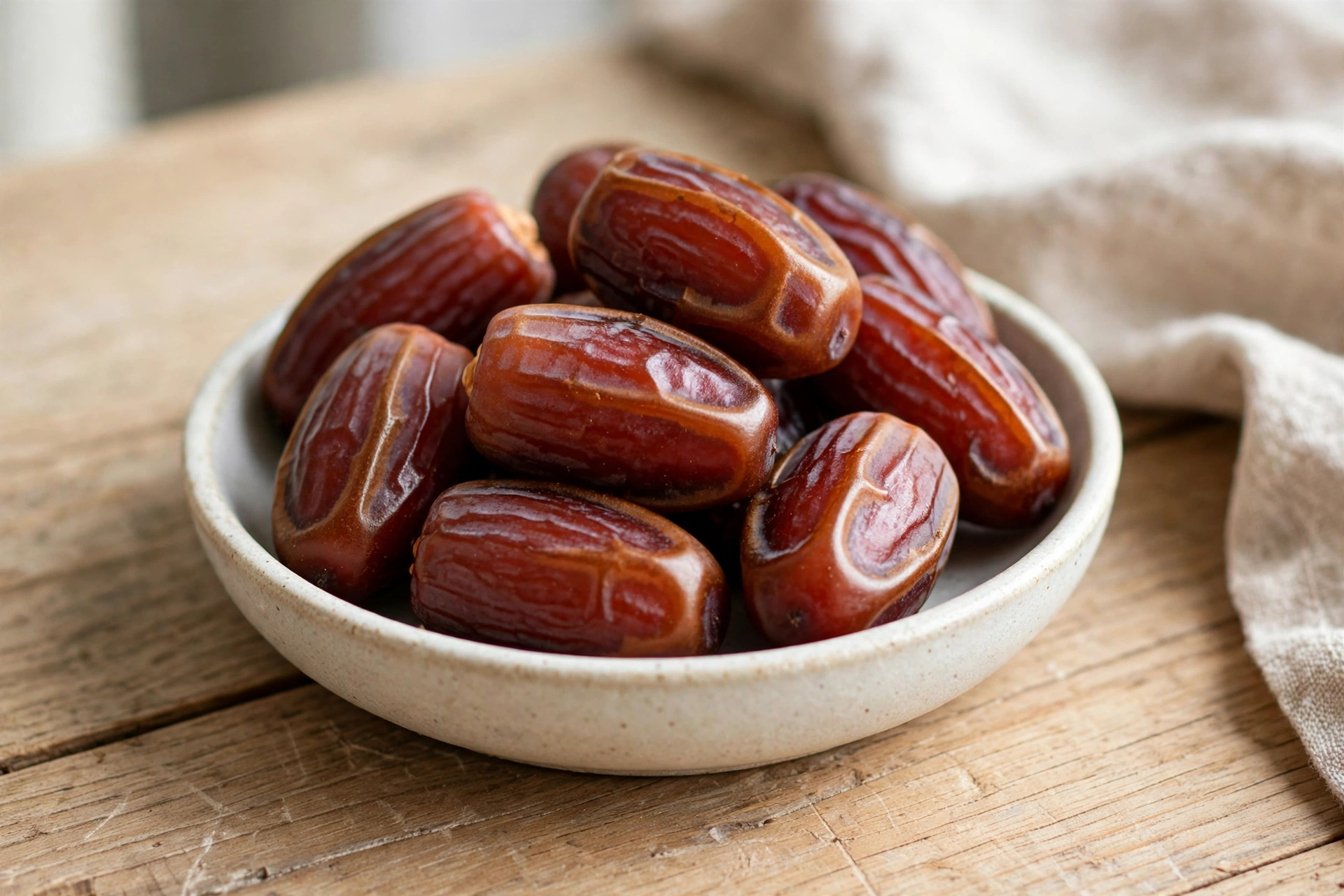
Khudri dates are the fruit of a Phoenix dactylifera cultivar planted across several regions of Saudi Arabia, including al-Jawf, Hail and the central governorates. The fruit is medium to large, dark brown and lightly wrinkled, with a chewy texture and a moderate, mildly caramel sweetness. Khudri is one of the Kingdom’s everyday varieties: widely available, modestly priced and better suited to cooking than to ceremony.
The cultivar and where it grows
A date variety is a cultivar, a clonally propagated selection of the single species Phoenix dactylifera. Every named date you have eaten, from Medjool to Ajwa to Khudri, is the same species. What differs is the genetics of the individual palm line, and therefore the size, sugar balance, moisture and texture of its fruit.
Khudri, in Arabic الخضري, is one of the varieties Saudipedia lists among the Kingdom’s principal commercial cultivars. Saudi Arabia holds around 34 million date palms producing roughly 300 distinct varieties, with national output recorded at about 1.6 million tonnes in 2023, and only a handful of those varieties reach export scale. Khudri is one of them.
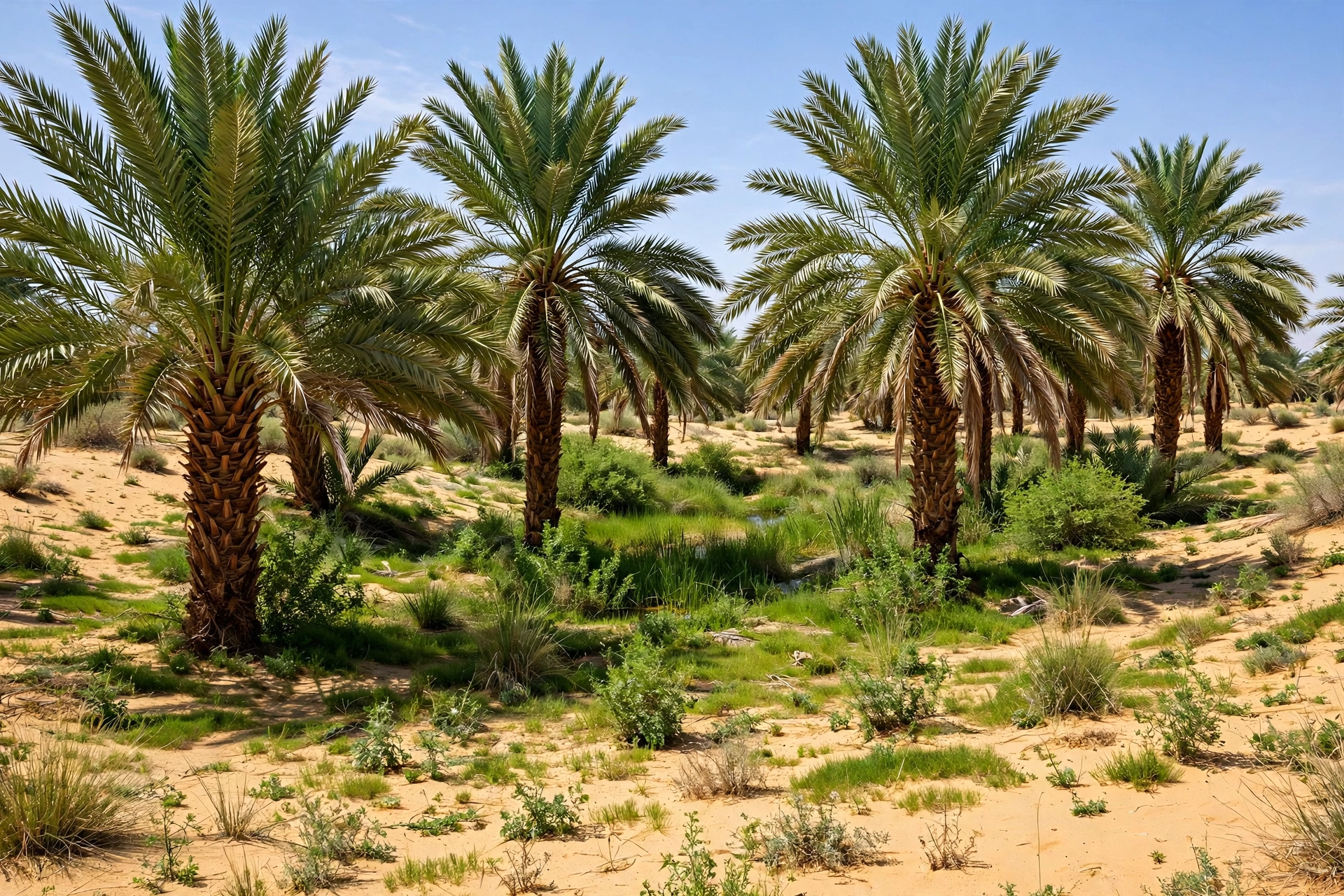
Its geography is the first thing worth understanding. Saudipedia’s survey of the Kingdom’s palm areas places Khudri in al-Jawf and Hail in the north, in the southwestern oases, and in the central governorates of al-Zulfi, Sudair and al-Aarid, where it records Khudri as the first ranked variety.
That distribution is unusual among the famous Saudi names. Ajwa is tied to the Madinah region and stays there. Anbara is a Madinah variety. Sukkari is centred on Qassim. Khudri is spread across the map, which is exactly why it is affordable and reliably available, and why it has become one of the varieties Saudi exporters push into volume markets. Saudi date exports reached SAR 1.695 billion in 2024, up 15.9 percent on the previous year according to the National Center for Palms and Dates, reaching consumers in 133 countries.
Khudri, Khudari, Khidri, Khadrawi
Four spellings, two different cultivars, and a genuine source of mis-sold fruit.
Khudri, Khudari, Khudry, Khodari and Khodry are all transliterations of الخضري, the Saudi cultivar described above. Pack spelling varies by importer and carries no information about quality.
Khadrawi, also written Khudrawi and Khadrawy, is a different cultivar. It originated in Iraq and is now grown commercially in Pakistan, Iran and the United States. The FAO date products handbook classes Khadrawy as a soft date measured at 24.4 percent moisture. A 2016 study of 32 cultivars at the Date Palm Research Station in Jhang, Pakistan, recorded Khudrawi at 22.31 percent moisture and 52.93 percent total sugars at the fully ripe tamr stage.
Some traders also market Iranian dates as Khidri and locate the variety’s origin in Bushehr Province. That reflects an Iranian naming convention, not the Saudi cultivar that Saudi government sources document. If origin matters to you, read the country of origin on the pack rather than the spelling on the front.
What Khudri looks like, and why
The fruit is medium to large, oval and slightly elongated, with skin that runs from a reddish brown to a deep dark brown. Looked at closely, the skin is lightly wrinkled rather than deeply creased, and it flakes a little under the thumb.
Each of those features traces back to how the fruit ripens.

Taste and texture
Khudri tastes of straightforward date. The sweetness is moderate, there is a mild caramel or light malty note behind it, and there is no strong secondary flavour.
Independent descriptions converge on this. A UK supermarket listing we read on 30 October 2026 describes the variety as mildly sweet with a traditional date flavour and a chewy texture. A UK importer describes balanced sweetness with a slightly firm, chewy bite. An Austrian organic retailer describes sweetness with a light caramel note and a hint of malty spice. A US seller describes a caramel-like flavour and chewy texture.
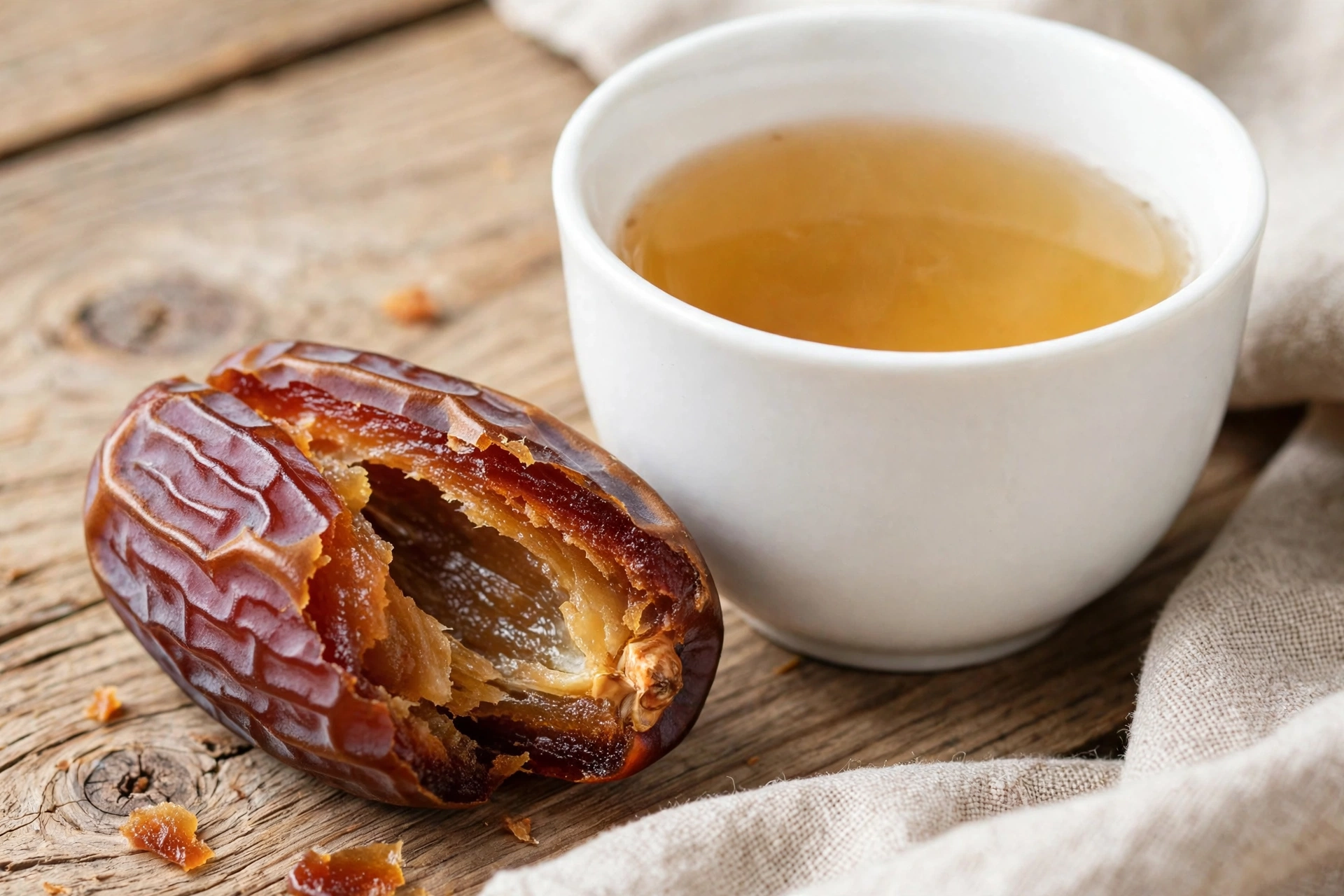
The texture is the defining characteristic. Khudri is chewy, not soft. It has resistance. You bite it rather than let it dissolve. Compared to a Medjool it is drier and more fibrous in the mouth; compared to a very dry date it is still pliable and moist. The published measurement behind that impression is the moisture class: a tamr date below roughly 25 percent moisture is semi-dry to soft, firm enough to handle but not brittle.
What this means in practice:
| If you like | Khudri will feel |
|---|---|
| Medjool’s dense fudge softness | Firmer and less sweet than you expect |
| A dry, crisp date | Softer and chewier than you expect |
| Ajwa’s gentle sweetness and slight chew | Broadly familiar, drier, slightly less complex |
| Sukkari’s intense caramel sugar | Much more restrained |
Honest assessment: Khudri is not the best eating date in the world and nobody in the trade claims it is. It is a good, dependable, inexpensive date that does its job. For the varieties that compete at the top of the eating scale, see the best dates in the world.
Nutrition: what the data actually supports
This section needs a caveat before a single number.
There is no published, variety-specific nutrient panel for Khudri that we could verify. The nutrition labels on Khudri retail packs are supplier declarations, not laboratory measurements of the cultivar, and they disagree with each other. One European organic Khudri listing read on 30 October 2026 declared 430 kcal, 10 g fat and 6 g saturated fat per 100 g, which is not possible for a date: every reference database puts dates well under 1 g of fat per 100 g. A UK supermarket pack of the same variety declared 309 kcal and under 0.5 g fat per 100 g for the same product category. At least one of those is wrong, and the pattern is a reason not to trust any single pack panel.
So the honest approach is to use a named reference database for dates generally and say plainly which one.
Reference figures for dates, from USDA FoodData Central
These are the USDA SR Legacy entries for the two date types with established records. Khudri is neither of them, so read these as the shape of a date’s nutrition rather than as Khudri’s own numbers.
| Per 100 g | Dates, deglet noor (FDC 171726) | Dates, medjool (FDC 168191) |
|---|---|---|
| Energy | 282 kcal | 277 kcal |
| Water | 20.5 g | 21.3 g |
| Carbohydrate | 75.0 g | 75.0 g |
| Total sugars | 63.4 g | 66.5 g |
| Dietary fibre | 8.0 g | 6.7 g |
| Protein | 2.45 g | 1.81 g |
| Total fat | 0.39 g | 0.15 g |
| Potassium | 656 mg | 696 mg |
| Magnesium | 43 mg | 54 mg |
| Calcium | 39 mg | 64 mg |
| Iron | 1.02 mg | 0.90 mg |
| Sodium | 2 mg | 1 mg |
What that table establishes, and what it does not. It establishes that dates as a food group are energy dense, carbohydrate dominated, essentially fat free, a useful source of dietary fibre and notably high in potassium. It does not establish anything specific to Khudri, and Khudri’s moisture is likely to sit below the roughly 20 to 21 g per 100 g of these two entries, which would push its per-100 g energy and sugar slightly higher.
What variety-level research does show
A 2015 study in Molecules analysed twelve date cultivars from Saudi Arabia, including a sample labelled Khodry and one labelled Mabroom, measuring sugars and minerals. Two findings are relevant.
First, the sugar profile in the Khodry sample was dominated by glucose and fructose, with sucrose well behind. That is the reason dates behave as a fast-absorbing energy food: glucose and fructose need no breakdown step before absorption. Among the twelve cultivars tested, the Khodry sample’s glucose and fructose readings sat in the upper middle of the range.
Second, potassium was the dominant mineral in every cultivar tested, and the Khodry sample’s potassium reading was among the higher ones in the set. That is consistent with the USDA picture for dates generally.
Two cautions on using those numbers. The study measured sugars on a fresh weight basis and minerals on a dry weight basis, so the two tables are not directly comparable to each other. And a single market-bought sample of one cultivar in one year is not a nutrient database entry: growing conditions, harvest timing and storage all move these figures.
What we are not going to say
Khudri is a nutritious food. It is not a treatment. Dates are frequently promoted online as lowering blood pressure, preventing anaemia or improving specific health markers, and the Khudri trade pages we reviewed on 30 October 2026 made several such claims without citing anything. Research on dates and human health outcomes remains limited, much of it is small, short or conducted in laboratory and animal models, and it does not support claims that any date variety cures, prevents or treats disease.
What can be said carefully: dates supply potassium and dietary fibre, both of which are nutrients many diets fall short on, and they are a whole fruit rather than a refined sugar. They are also energy dense, at roughly 20 to 25 kcal per date depending on size, which matters if you are eating them by the handful. Anyone managing diabetes, kidney disease, a potassium restriction or a weight goal should take portion guidance from their own clinician rather than from a food page.
How Khudri is used
Khudri’s firm bite and restrained sweetness make it a working date rather than a showpiece.
Khudri compared with Ajwa and Medjool
| Khudri | Ajwa | Medjool | |
|---|---|---|---|
| Growing area | Several Saudi regions | Madinah region, Saudi Arabia | Morocco, Israel, the United States, Jordan and elsewhere |
| Measured average fruit weight | Not published | 9.75 g (Madinah cultivar study, 2022) | 13.07 g (same study, listed as Majdool) |
| Appearance | Dark brown, lightly wrinkled, flaking skin | Small to medium, dark, finely wrinkled | Large, glossy, amber to dark brown |
| Texture | Chewy, firm | Soft with slight chew | Soft, dense, fudge-like |
| Sweetness | Moderate | Moderate | Pronounced caramel |
| Typical price position | Low | High | Mid to high |
| What it is for | Cooking, stuffing, everyday eating | Gifting, religious observance | Dessert, eating out of hand |

A fair reading: the three are not really competitors. Medjool is the eating date, Ajwa carries provenance and religious significance that no other variety carries, and Khudri is the one you buy in quantity and cook with. Choosing between them is a question of purpose, not of ranking.
The Ajwa and Medjool pairing is examined properly in Ajwa vs Medjool. For Mabroom, the other Saudi variety most often confused with these, see Mabroom dates and what Mabroom dates are.
Frequently asked questions
What does Khudri mean?
الخضري derives from the Arabic root for green, khudra. The name refers to the palm line rather than to the colour of the ripe fruit, which is dark brown.
Are Khudri dates Saudi or Iranian?
The cultivar documented by Saudi government sources is Saudi, planted across al-Jawf, Hail, the southwestern oases and the central governorates. Some Iranian and Pakistani traders use Khidri or Khudri for dates grown in Iran, which are a different cultivar line. Read the country of origin on the pack.
Are Khudri dates good for you?
They are a whole fruit that supplies dietary fibre and potassium with essentially no fat, which is a reasonable thing to include in a varied diet. They are also energy dense. No date variety treats or prevents disease, and anyone with diabetes or a potassium restriction should take portion advice from their clinician.
Why do Khudri nutrition labels disagree with each other?
Because they are supplier declarations rather than measurements of the cultivar. We found packs of the same variety declaring 309 kcal and 430 kcal per 100 g on 30 October 2026, and the higher figure also declared a fat content no date contains. Use a named reference database instead.
Is Khudri drier than Medjool?
Yes, noticeably. Both are tamr stage dates, but Khudri holds less moisture in the flesh, which is why it chews rather than dissolves.
Can I substitute Khudri for Medjool in a recipe?
In anything baked, blended or chopped, yes, and often with a better result because Khudri holds its shape. In a recipe where the date is served whole and is meant to be lusciously soft, the swap will be noticeable.
Sources
Product listings and label data were read directly on 30 October 2026.
- Saudipedia, List of Date Varieties in Saudi Arabia (Khudri among the principal cultivars; 34 million palms, around 300 varieties, 1.6 million tonnes in 2023)
- Saudipedia, Palm Areas in Saudi Arabia (Khudri in al-Jawf, Hail and the southwestern oases; first ranked variety in al-Zulfi, Sudair and al-Aarid)
- FAO, Date Palm Products, Chapter 1: Whole Dates (kimri, khalal, rutab and tamr stages with moisture figures; Khadrawy classed as soft at 24.4 percent moisture)
- Qadri, R. W. K. et al. (2016), “Physicochemical characterization of fruit of different date palm (Phoenix dactylifera L.) varieties grown in Pakistan”, The Journal of Animal and Plant Sciences, 26(5), 1268-1277 (Khudrawi moisture and total sugars at tamr)
- Hamad, I., AbdElgawad, H., Al Jaouni, S., Zinta, G., Asard, H., Hassan, S., Hegab, M., Hagagy, N. and Selim, S. (2015), “Metabolic analysis of various date palm fruit (Phoenix dactylifera L.) cultivars from Saudi Arabia to assess their nutritional quality”, Molecules, 20(8), 13620-13641
- Alaida, M. F. and Aldhebiani, A. Y. (2022), “Comparative study of the morphological characteristics of Phoenix dactylifera L. cultivars in Al-Madinah Al-Munawarah, Saudi Arabia”, BMC Plant Biology, 22, 461 (Ajwah and Majdool fruit weights)
- USDA FoodData Central, SR Legacy: Dates, deglet noor (FDC ID 171726) and Dates, medjool (FDC ID 168191)
- National Center for Palms and Dates, via Saudi Press Agency and Arab News, April 2025 (2024 date exports of SAR 1.695 billion, up 15.9 percent, reaching 133 countries)
- Sainsbury’s product listing and nutrition panel, Tahira Khudri Dates 450 g
- Darussalam UK product listing, Khudry Dates 400 g
- Dattelbaer product listing and nutrition panel, Khidri organic dates 600 g
- Mecca Books product listing, Khudri Dates 400 g
- Farzana product listing, Khudri Large 1 kg (appearance description)

Amira Noor writes about Ajwa dates, their origin in Madinah, nutrition and heritage, with clear, practical guides for readers.