
Sukkari Dates: Composition, Calories and Nutrition
What Sukkari dates contain, what the research on dates and blood sugar shows, and where the evidence runs out. Named sources, honest numbers, no hype.

What the evidence supports
Sukkari dates are a nutrient containing, energy dense fruit, not a health food in any special sense. They are mostly sugar: published analyses put total sugars around 78 percent of dry weight. A few dates supply useful potassium, fibre and some B vitamins alongside a concentrated dose of calories. Most claimed health effects come from laboratory or rat studies, not human trials.
What Sukkari dates are
Sukkari is a cultivar of Phoenix dactylifera, the date palm, grown mainly in Saudi Arabia. A 2025 review in Frontiers in Nutrition associates it particularly with the Al-Qassim region. The name comes from the Arabic for sugar, which reflects how the variety is known: it is one of the sweetest commercially traded dates.
In appearance it is quite different from the dark Madinah varieties. The same review describes Sukkari as plump and slightly oval, golden yellow through to dark golden brown, with soft, shiny skin and moist, tender, chewy flesh carrying a caramel-like taste. Sellers distinguish a softer and a firmer type, with the softer usually preferred.

It is also inexpensive relative to the premium Madinah cultivars. One Madinah seller listed luxury grade Sukkari at SAR 40 per kilogram on 30 October 2026, against Ajwa grades from SAR 56 to SAR 130 per kilogram on the same site.
That combination, very sweet and comparatively cheap, is the useful starting point for a nutrition discussion. The honest question about Sukkari is not what it cures. It is how much sugar and energy you are taking on, and what you get alongside it.
Calories and macronutrients

The numbers, and exactly where they come from
There is no USDA Foundation Foods or SR Legacy entry for Sukkari dates. Searching USDA FoodData Central for “Sukkari” on 30 October 2026 returned exactly one record, a branded commercial product: SWEET CARAMEL SUKKARI DATES, FDC ID 2592401, brand Natural Delights, brand owner Bard Valley Medjool Date Growers Association, published 29 June 2023, ingredients listed as “SUKKARI DATES”, stated serving 40 g described as two dates.
Here is that branded entry, with USDA’s generic Dates, medjool entry beside it for context.
There is no laboratory-analysed Sukkari entry in USDA FoodData Central. No Foundation Foods or SR Legacy record exists for the variety. The Sukkari column below is a single branded commercial product, FDC ID 2592401, carrying manufacturer declared label values rather than USDA laboratory analysis, for fruit grown in the Bard Valley area on the California and Arizona border, not Saudi Arabian Sukkari.
The Medjool column beside it is different in kind: an SR Legacy record derived from laboratory analysis. The two columns were not produced by the same method, so the apparent difference between them is not a measured difference between varieties. Read the table for rough orientation and nothing more.
| Per 100 g | Sukkari dates, brandedUSDA 2592401. Label values, not analysis. Not Saudi fruit. | Dates, medjoolUSDA 168191. Laboratory analysis. Not Sukkari. |
|---|---|---|
| Energy | 325 kcal | 277 kcal |
| Carbohydrate | 75.0 g | 74.97 g |
| Total sugars | 62.5 g | 66.47 g |
| Dietary fibre | 7.5 g | 6.7 g |
| Protein | 2.5 g | 1.81 g |
| Total fat | 0 g | 0.15 g |
| Potassium | 625 mg | 696 mg |
| Calcium | 50 mg | 64 mg |
| Iron | 1.0 mg | 0.9 mg |
| Sodium | 0 mg | 1 mg |
The limitations of that table, stated plainly
The branded figures are manufacturer declared label values, not laboratory analysis by USDA. Label values in the Branded Foods dataset are rounded to label conventions, which is why fat appears as 0 g and several values land on round numbers. They describe one company’s product from one growing region, which for this brand is the Bard Valley area on the California and Arizona border, not Saudi Arabian Sukkari.
The Medjool column is different in kind. It is an SR Legacy entry derived from laboratory analysis, published 1 April 2019. Putting the two columns side by side is useful for rough orientation and nothing more. They were not produced by the same method, so the apparent 48 kcal difference between them should not be reported as a real difference between varieties.
Per date
USDA’s branded Sukkari entry states a 40 g serving as two dates, which implies about 20 g per date and about 65 kcal per date. That is a label derived figure, not a measured fruit weight, and date size varies substantially with grade and growing conditions. Treat it as an order of magnitude: a Sukkari date is roughly 60 to 70 kcal, and a modest handful of five reaches roughly 300 to 350 kcal.
For comparison, USDA lists one pitted Medjool at 24 g, about 66 kcal, and one pitted Deglet Noor at 7.1 g, about 20 kcal. Date varieties differ enormously by fruit size, so counting dates without knowing the variety tells you very little about energy intake.
What published research reports for Sukkari specifically
The 2025 Frontiers in Nutrition review compiles composition figures from several primary studies, reported on a dry weight basis. The ranges it gives are:
These are dry weight ranges compiled from several different primary studies, not a single analysis and not comparable with the per 100 g as-eaten figures above. The ranges are wide, particularly fibre at 2.13 to 10.2 percent, because the underlying studies used different samples and methods, and the review itself says its sources conflict.
| Component | Reported range, dry weight basis |
|---|---|
| Total sugars | about 78 percent |
| Carbohydrates | 69.2 to 84.2 percent |
| Moisture | 11.1 to 18.13 percent |
| Protein | 2.26 to 3.20 percent |
| Fat | 0.26 to 3.15 percent |
| Ash | 1.9 to 2.80 percent |
| Fibre | 2.13 to 10.2 percent |
Two things to note. The ranges are wide, particularly fibre at 2.13 to 10.2 percent, because the underlying studies used different samples and methods, and the review itself says its sources conflict. And these are dry weight figures, which are not directly comparable with the per 100 g as-eaten figures in the USDA table above. The review reports glucose at 51.80 g, fructose at 47.50 g and sucrose at 3.20 g per 100 g dry weight from one cited study, which indicates a glucose and fructose dominant profile rather than a sucrose one, in line with most date varieties.
A separate 2022 study in the Journal of the Saudi Society of Agricultural Sciences measured moisture and glucose across 35 Saudi date varieties bought from local markets. Moisture across all varieties ranged from 7.3 to 29.2 g per 100 g fresh weight, highest in Safawi. The variety closest to Sukkari in that paper is listed as “Sukari Alriyad”, which it reported with the second highest glucose reading of the 35. That is a regional sample under a regional name, so it supports the general picture of Sukkari as a high sugar variety without being a definitive Sukkari measurement.
Fibre and micronutrients
The genuinely useful part of a date’s profile is what travels with the sugar.
Fibre. The branded Sukkari entry declares 7.5 g per 100 g, and the published dry weight range is 2.13 to 10.2 percent. Taking the lower, label-based figure, a 40 g serving supplies around 3 g of fibre. UK guidance puts adult fibre intake at 30 g a day, which most adults do not reach, averaging about 20 g. So two Sukkari dates make a measurable but modest contribution, roughly a tenth of a day’s target.
Potassium. 625 mg per 100 g on the branded label, so around 250 mg in a 40 g serving. Dates are a genuinely good potassium source relative to their weight, which is one of the few nutritional claims about them that holds up without qualification.
Magnesium and calcium. The branded label declares 50 mg calcium per 100 g and does not declare magnesium. FAO’s reference work on date palm cultivation reports potassium as about 50 percent of date ash and magnesium about 12 percent, with magnesium around 600 mg per kg of fruit. Those are general date figures, not Sukkari figures.
B vitamins and vitamin E. The Frontiers in Nutrition review reports Sukkari vitamin values per gram of dry weight, including thiamin, niacin, vitamin B6, folate and vitamin E at 19.74 mg mainly as alpha-tocopherol. We are not reproducing those figures as a nutrient table here, for a specific reason: the review’s own table lists vitamin B12 at exactly the same value as thiamin, 0.55 mg, and dates are a plant food in which meaningful B12 would be unexpected. That looks like a transcription error in the source. Where a published table contains an internal inconsistency, the responsible thing is to flag it rather than copy it.
Iron. 1.0 mg per 100 g declared, so about 0.4 mg per 40 g serving. That is a small contribution against adult requirements, and it is non-haem iron, which is less readily absorbed than iron from animal sources.
The overall picture: Sukkari delivers real potassium, useful fibre and small amounts of several micronutrients, carried in a food that is roughly three quarters sugar by weight. Nothing in that profile makes it exceptional among dried fruits. Nothing in it makes it a problem food either.
What the research on dates and blood sugar actually shows
This is the section where most articles about dates overclaim in one direction or the other. Here is what the human evidence contains, graded.
Glycaemic index measurements: moderate quality, variety specific
AlGeffari and colleagues, Annals of Saudi Medicine, 2016
A 2016 study in Annals of Saudi Medicine tested 17 Saudi date varieties in 19 healthy adults, using 50 g available carbohydrate portions against a glucose reference. Mean glycaemic index across the varieties was about 55, with a range of 42.8 to 74.6. Sukkary was among the three lowest, at 43.4 with a standard error of 4.7, alongside Shaqra at 42.8 and Sag’ai at 44.6.
- It places Sukkari in the low glycaemic index band, below the conventional 55 threshold, when eaten alone in a 50 g carbohydrate portion by healthy adults.
- The study found that glycaemic load differed significantly between varieties while glycaemic index did not, which means the between-variety differences in glycaemic index were within the noise of the measurement. Picking Sukkari over another variety on the strength of a 1 or 2 point glycaemic index gap is not supported by this data.
- The participants were 19 healthy adults, each eating each variety once. That is a small sample with no repeat measurement per person, which is normal for glycaemic index work and also a real limitation.
- The authors state they tested only tamar stage fruit, so the results do not transfer to dates at other ripeness stages.
- A 50 g available carbohydrate portion is a large amount of dates, considerably more than most people eat at once.
Miller and colleagues, Saudi Medical Journal, 2002
An earlier 2002 study in the Saudi Medical Journal tested three Emirati varieties in healthy volunteers and reported glycaemic index values of about 35.5 for Khalas, 49.7 for Barhi and 30.5 for Bo ma’an, also in the low band. The authors noted the differences between varieties were significant but unexplained.
Dates in people with type 2 diabetes: one reasonable trial, null result
Butler and colleagues, Nutrients, 2022
A 2022 randomised clinical trial published in Nutrients gave 79 adults with type 2 diabetes either 60 g of Khalas dates or 60 g of raisins daily, split across two snacks, for 12 weeks. Sixty-one completed the study.
The result was null. HbA1c moved from 7.6 to 7.5 percent in the date group, with no statistically significant within-group or between-group change in HbA1c, fasting glucose, total cholesterol, LDL, HDL or triglycerides.
A moderate daily intake of dates over three months did not worsen glycaemic control in this group, and did not improve it either. It is one trial, it was not blinded, the authors acknowledge the dose was capped at 60 g a day and the duration was relatively short, and it used Khalas rather than Sukkari. A null result in one unblinded trial is weak evidence for either a reassuring or a cautionary conclusion, and it should not be presented as showing that dates are safe for people with diabetes in general.
What the laboratory and animal work shows, and why it is not enough
The therapeutic material in the 2025 Frontiers in Nutrition review
The 2025 Frontiers in Nutrition review on Sukkari compiles a range of findings on antioxidant activity, liver protection, metabolic effects and antibacterial activity. Nearly all of the therapeutic material in it comes from in vitro assays or rat studies. The liver protection work it cites was conducted in rats. The diabetes and obesity work it cites was conducted in rats. An antibacterial study on acne found no effect.
The review’s own framing is that its therapeutic claims are drawn largely from compound-level research rather than human trials on Sukkari dates, and that values conflict across its source studies.
Variety-specific health effects of Sukkari in humans
That is the single most important thing to understand about health claims for any individual date variety. A compound that scavenges radicals in a test tube, or lowers a marker in a rat fed a high cholesterol diet, has not been shown to do anything in a person eating a handful of dates. Evidence in humans for variety-specific health effects of Sukkari dates is insufficient. Not negative, not promising, insufficient: the trials have not been done.
Portion context
Specific portion prescriptions for an individual belong to that person’s clinician or dietitian, not to an article. What a page like this can usefully do is give you the arithmetic and the public guidance so you can have an informed conversation.
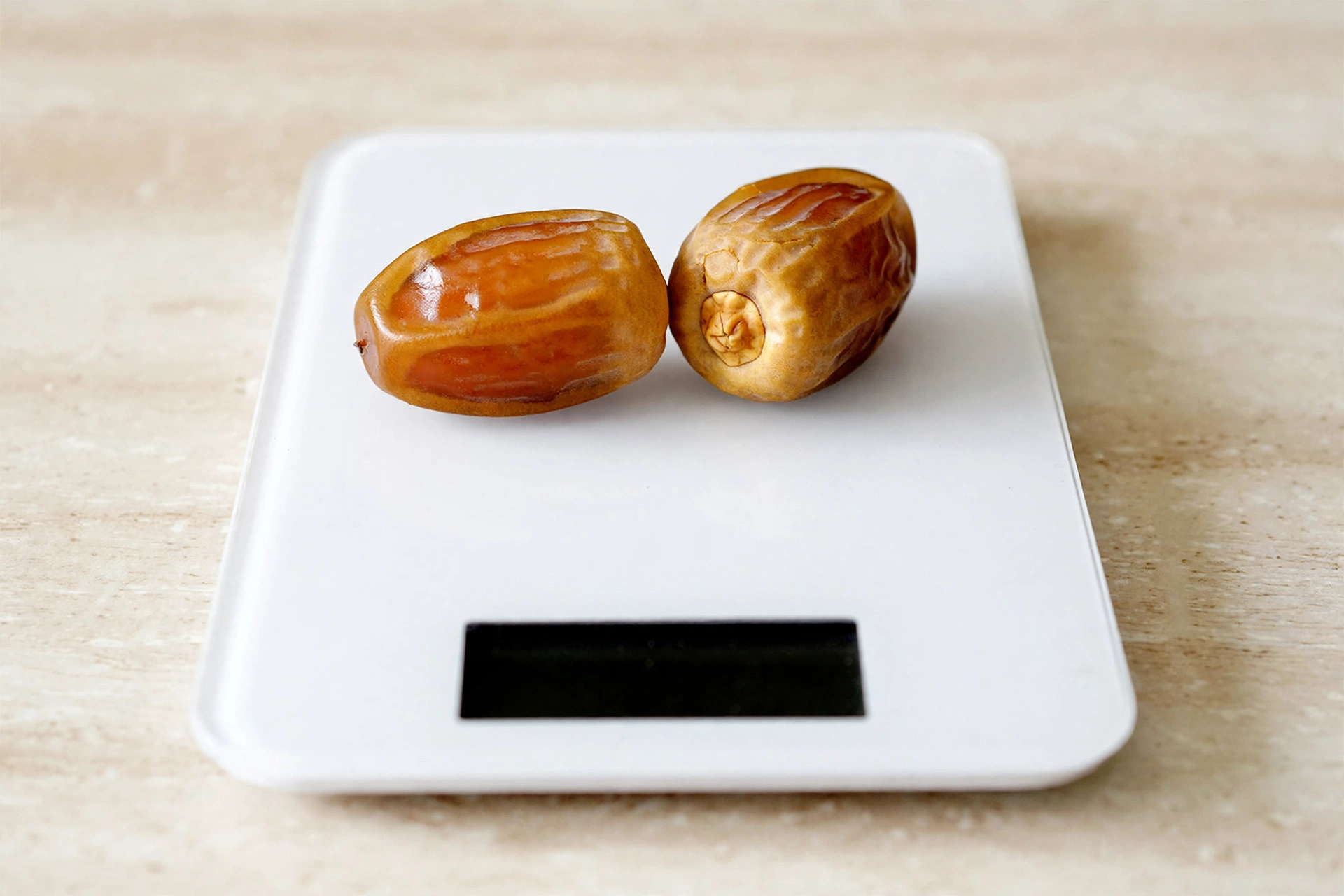
The general guidance on dried fruit. NHS 5 A Day guidance counts about 30 g of dried fruit as one portion, roughly a heaped tablespoon of raisins or three prunes. Diabetes UK uses the same 30 g portion and notes that such a serving can contain as much as 20 g of carbohydrate. It also advises spreading fruit intake across the day rather than eating a lot in one sitting, because dried fruit is easy to over-consume.
What that means for Sukkari. At the label-derived figure of about 20 g per date, a 30 g dried fruit portion is one and a half Sukkari dates. Two dates is about 40 g, roughly 65 to 70 kcal each and around 30 g of carbohydrate in total. Five dates is roughly 100 g, which on the branded figures is about 325 kcal and 62 g of sugar.
Where sugar guidance fits. WHO recommends that free sugars be kept below 10 percent of total energy intake, about 50 g a day on a 2,000 kcal diet, and suggests a further reduction to below 5 percent as a conditional recommendation. Critically, the WHO definition of free sugars covers sugars added by a manufacturer, cook or consumer plus those naturally present in honey, syrups, fruit juices and fruit juice concentrates. It does not cover the sugars in fresh fruits and vegetables. Dried fruit sits in an awkward position in that definition: it is not fresh fruit and it is not a juice, and WHO’s guideline does not resolve it explicitly. The practical upshot is that you should not assume dates fall outside the free sugars target, and you should not assume they fall inside it either.
The one thing that is not in dispute. Energy density. Dates are a small, easy to eat, highly palatable food with roughly three times the calorie density of a fresh apple per gram. If you are managing energy intake, dates are a food worth counting rather than grazing on. That is true of every variety, and it is more true of a variety whose selling point is its sweetness.
Dental considerations
This is a real, well established and frequently omitted point about dates.
Dried fruit is sticky and high in sugar, so it sits on tooth surfaces. WHO states that plaque converts sugars from food and drink into acids that destroy the tooth over time, and that a continued high intake of free sugars together with inadequate fluoride exposure and poor plaque removal leads to caries. Untreated caries in permanent teeth is the most common health condition worldwide according to the Global Burden of Disease 2021.
NHS guidance is specific about dried fruit. It notes that dried fruit can be bad for teeth because it is high in sugar and sticky, recommends fresh fruit instead as a between-meal snack, and advises eating dried fruit as part of a meal, such as at the end of one, rather than on its own between meals.
Applied to Sukkari, which is soft, moist and among the sweetest dates in trade, the sensible practice is:
- Eat them with or at the end of a meal rather than grazing through a bowl across an afternoon
- Rinse with water afterwards, since frequency of sugar exposure matters alongside quantity
- Follow standard dental advice on brushing twice daily with fluoride toothpaste at 1,000 to 1,500 ppm, which WHO identifies as essential to caries prevention
- Treat this as more relevant, not less, for children, whose snacking patterns tend towards frequency
This is established public health guidance, not a claim specific to Sukkari. It applies to any sticky dried fruit.
Where Sukkari fits among the varieties
Taken as a food rather than a remedy, Sukkari has a clear place. It is soft, very sweet, caramel-flavoured and relatively inexpensive, which makes it a good everyday eating and cooking date. Its sweetness means it works well where you want a date to carry sweetness into something else, and its price means you are not using an expensive fruit to do it.
It is not interchangeable with the premium Madinah cultivars in terms of why people buy those. If you are looking at dates for reasons of religious observance, that is a different question and a different variety. For a comparison of the two most sought after premium dates, see Ajwa vs Medjool. For the wider variety landscape, see other date varieties and the best dates in the world.
Frequently asked questions
How many calories are in one Sukkari date?
Roughly 60 to 70 kcal, derived from the USDA branded entry that states a 40 g serving as two dates at 325 kcal per 100 g. That is a label-based derivation rather than a measured average fruit weight, and date size varies considerably by grade, so treat it as approximate.
Are Sukkari dates healthier than other date varieties?
There is no evidence that would support saying so. No laboratory has published a head to head human comparison of health outcomes between date varieties. Composition differences between varieties are real but modest, and in the glycaemic index study the differences between varieties were not statistically significant. Choose on taste, texture and price.
Do Sukkari dates have more sugar than other dates?
Published analyses report total sugars around 78 percent of dry weight, which is at the higher end but within the normal range for tamar stage dates. The variety’s reputation for sweetness is as much about how it tastes, soft and caramel-like with no tannic edge, as about measurably higher sugar.
Can I eat Sukkari dates every day?
For most people a small daily portion of dried fruit is an ordinary part of a varied diet. The relevant guidance is general rather than variety specific: NHS and Diabetes UK treat about 30 g as one dried fruit portion, WHO advises keeping free sugars below 10 percent of energy intake, and dental guidance suggests eating dried fruit with meals rather than between them. If you have diabetes, kidney disease or are managing weight, discuss it with a clinician.
Is there a USDA nutrition entry for Sukkari dates?
Only one branded commercial product, FDC ID 2592401, with manufacturer declared label values. There is no Foundation Foods or SR Legacy laboratory entry for the variety. Any article presenting a precise USDA Sukkari nutrient profile is not citing USDA.
This page reviews published evidence about a food. It is information, not medical, dietary or antenatal advice, and it is not a substitute for any of them. It does not diagnose, treat or prescribe, and nothing on it should be used to change a medication, a carbohydrate plan, a potassium restriction or any part of antenatal care. If you are managing diabetes, kidney disease, pregnancy, weight or dental health, speak to a qualified clinician or registered dietitian who knows your history. Our full terms are in the site disclaimer, and how we grade and handle health content is set out in our editorial policy.
Sources
Nutrition database entries and prices were checked on 30 October 2026.
- Ali RFM, El-Anany AM. From traditional fruit to modern functional food: chemical constituents, bioactive compounds, and therapeutic applications of Sukkari date palm (Phoenix dactylifera): a review. Frontiers in Nutrition. 2025;12. doi:10.3389/fnut.2025.1651121 (narrative review: Sukkari description, Al-Qassim association, composition ranges, and the in vitro and rat studies underlying its therapeutic claims)
- USDA FoodData Central, Branded Foods entry SWEET CARAMEL SUKKARI DATES, FDC ID 2592401, Natural Delights, Bard Valley Medjool Date Growers Association, published 29 June 2023 (manufacturer declared label values)
- USDA FoodData Central, SR Legacy entry Dates, medjool, FDC ID 168191, published 1 April 2019
- USDA FoodData Central, SR Legacy entry Dates, deglet noor, FDC ID 171726, published 1 April 2019
- AlGeffari MA, Almogbel ES, Alhomaidan HT, El-Mergawi R, Barrimah IA. Glycemic indices, glycemic load and glycemic response for seventeen varieties of dates grown in Saudi Arabia. Annals of Saudi Medicine. 2016;36(6):397-403. doi:10.5144/0256-4947.2016.397 (19 healthy adults, 50 g available carbohydrate portions, Sukkary GI 43.4 with SEM 4.7)
- Miller CJ, Dunn EV, Hashim IB. Glycemic index of 3 varieties of dates. Saudi Medical Journal. 2002;23(5):536-538. PMID 12070575
- Butler AE, Obaid J, Wasif P, Varghese JV, Abdulrahman R, Alromaihi D, Atkin SL, Alamuddin N. Effect of date fruit consumption on the glycemic control of patients with type 2 diabetes: a randomized clinical trial. Nutrients. 2022;14(17):3491. doi:10.3390/nu14173491 (79 randomised, 61 completed, 60 g Khalas dates daily for 12 weeks, null result, unblinded)
- AlShwyeh H, Almahasheer H. Glucose content of 35 Saudi Arabian date fruits (Phoenix dactylifera L.). Journal of the Saudi Society of Agricultural Sciences. 2022;21(6):420-424
- World Health Organization. Guideline: Sugars intake for adults and children. Geneva, 2015, and the accompanying WHO news release of 4 March 2015 (free sugars definition, strong recommendation below 10 percent of energy intake, conditional recommendation below 5 percent, exclusion of sugars in fresh fruits and vegetables)
- World Health Organization. Healthy diet fact sheet (free sugars at about 50 g on a 2,000 kcal diet; at least 400 g of fruit and vegetables daily for people over 10)
- World Health Organization. Oral health fact sheet (plaque converting sugars to acids, free sugars and caries, fluoride toothpaste at 1,000 to 1,500 ppm, Global Burden of Disease 2021 figures)
- NHS. 5 A Day portion sizes (about 30 g as one dried fruit portion; dried fruit and tooth decay; eat with a meal rather than between meals)
- NHS. How to get more fibre into your diet (30 g daily adult fibre recommendation; current average intake about 20 g; dried fruit stickiness and tooth decay)
- Diabetes UK. Fruit and diabetes (30 g dried fruit portion, up to 20 g carbohydrate per portion, advice to spread fruit intake through the day)
- FAO. Date Palm Cultivation. FAO Plant Production and Protection Paper 156, Rev. 1. Rome, 2002 (general date composition, mineral distribution in date ash, tamar stage moisture)
- Munwra Dates Store (Madinah), Sukkari luxury 1 kg at SAR 40 and Sukkari 5 kg box at SAR 160. Read 30 October 2026
- Written by
- Amira Noor
- Last checked and verified
- Nutrition review
- Not yet reviewedNo reviewer holding a current nutrition or dietetics registration has signed off on this page. The byline above claims no nutrition or medical qualification.
Why that row is there. We do not attach a reviewer name to content that person did not review, and we do not publish a credential we cannot evidence. Our review standards for health and nutrition content are set out on the authors page and in the editorial policy. Corrections are published rather than quietly edited.
Related reading

Amira Noor writes about Ajwa dates, their origin in Madinah, nutrition and heritage, with clear, practical guides for readers.