
Where Do the Best Dates Come From? A Criteria-Based Answer
No country or variety wins outright. Which dates suit eating, baking, gifting and value, and what FAO production data really shows.
There is no single best date, because the varieties that excel at different jobs barely resemble each other. Morocco and Israel lead for eating fresh with Medjool, Algeria and Tunisia lead for baking with Deglet Noor, Saudi Arabia leads for gifting and historical significance with Ajwa, Iran and Iraq lead on value, and Saudi Arabia and Egypt lead on sheer volume at about 1.9 and 1.8 million tonnes in 2024.
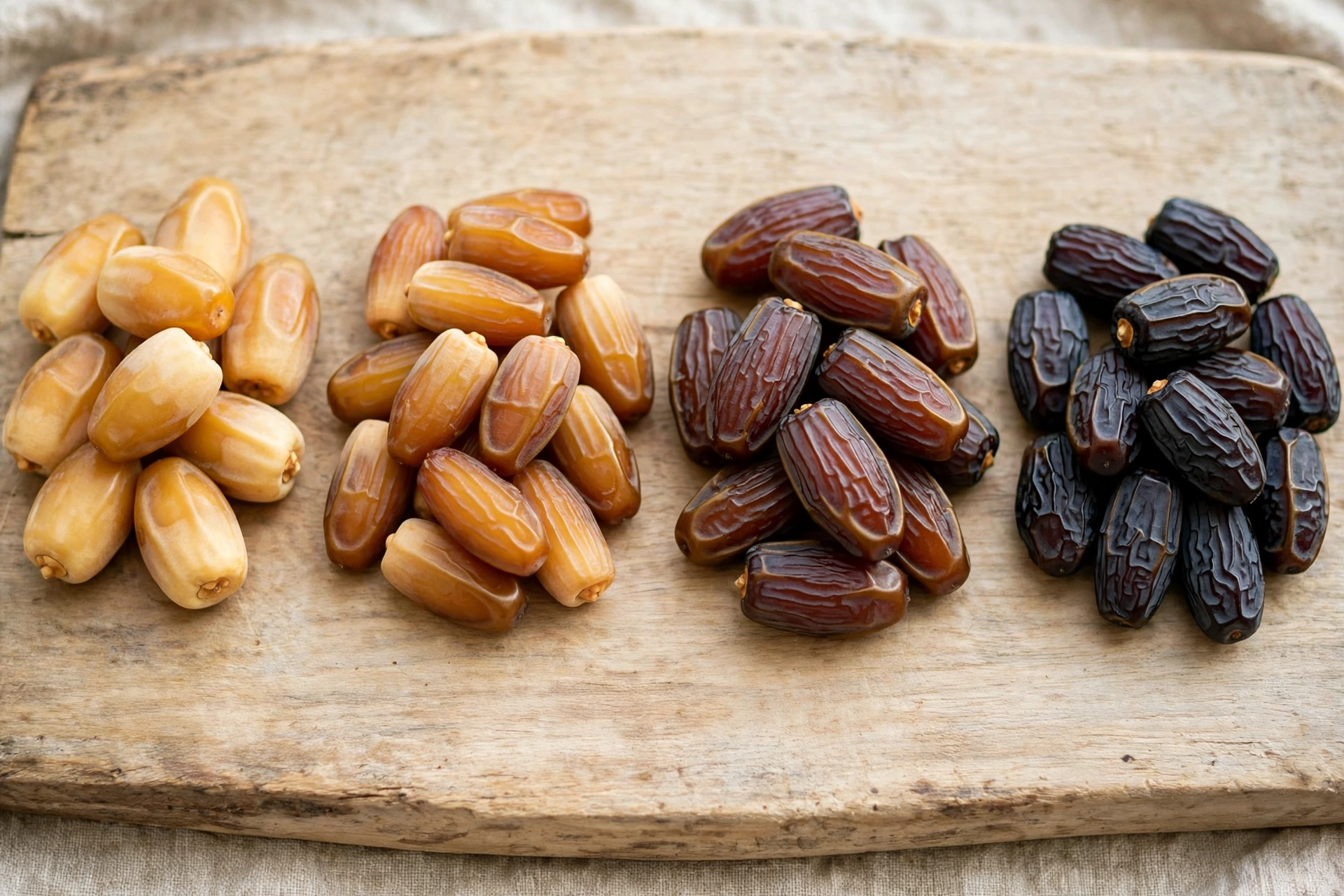
Why “best” has no single answer
The question “which country has the best dates” assumes dates are one product being made to one standard, like olive oil or single-origin coffee. They are not.
A Barhi date eaten crunchy and barely sweet at the yellow khalal stage and a Medjool date eaten soft, dense and caramel-heavy are closer to being different fruits than different grades. There is no scale on which one beats the other. A Deglet Noor that keeps its shape perfectly when chopped into a cake would be a disappointing date to eat on its own, and a Medjool that is wonderful on its own will turn that cake into a sticky mess.
So the useful version of the question is: best at what?
There is also a commercial problem with the way this question usually gets answered. Almost every page ranking for it is published by someone who sells dates, and the winner is reliably whatever that seller stocks. Even the one broadly independent signal, TasteAtlas’s 2025 best-rated dates ranking, is a crowd-rated popularity list rather than a quality assessment, and its top result went to a specific producer’s organic Medjool from Boudnib in eastern Morocco rather than to a variety or a country as such.
What follows is organised by use instead, with the production data kept separate from the quality judgement because the two genuinely have little to do with each other.
Best at what? Pick the job
Each criterion below has a different answer. None of them is the answer to the others.
- Eating fresh Best for eating fresh and out of hand Medjool, and increasingly Mazafati
- Baking Best for baking and cooking Deglet Noor, with Zahidi and Thoory behind it
- Gifting Best for gifting Ajwa for significance, Anbara and Piarom for scarcity
- Value Best value Safawi from Madinah, and Iraqi or Iranian soft dates in bulk
- History Most historically significant Iraq for the industry, Egypt and Mesopotamia for the fruit, Madinah for the cultural weight
- Volume Largest production Saudi Arabia and Egypt, effectively tied in the 2024 FAOSTAT figures
Best for eating fresh and out of hand
The answer: Medjool, and increasingly Mazafati.
Medjool is the default premium eating date worldwide for good reasons. It is very large, soft, moist and heavily flavoured with caramel and a faint spice note, and it has the fibrous, meaty flesh that makes a single date feel substantial. It probably originated in the Tafilalt district of Morocco and reached California in 1927 when W. T. Swingle introduced it. Today it is grown at commercial scale in Morocco, Israel, Jordan, the United States, South Africa and Peru.

The honest caveat: Medjool’s dominance is partly agronomic and partly commercial. It travels and stores well enough for global retail, it photographs beautifully, and it is produced in enough volume to support marketing. Varieties that taste as good or better are often simply too delicate to ship.
The challenger. Mazafati, from the Bam and Kerman regions of Iran, is darker, wetter and more intensely caramel than Medjool, with a melting rather than chewy texture. It is high enough in moisture that it is handled as fresh produce: reference sources record keeping quality of up to two years at minus 5 degrees Celsius, which tells you it is a cold-chain product rather than a shelf-stable one. Sold as Kimia in India and parts of the Gulf, it has its own page: Kimia dates.
The one most people have never tried. Barhi, at the khalal stage. Firm, crunchy, faintly astringent, with notes of cinnamon and sugarcane and only mild sweetness. Barhi is one of very few cultivars that is genuinely good before it softens, which is why it appears in Gulf markets as yellow fruit still attached to the strand. It is not grown at scale for export because ripe fruit is too fragile to ship, so outside the producing regions it is a short autumn farmers-market find. If you want to understand what the date category actually contains, this is the one to seek out.
Best for baking and cooking
The answer: Deglet Noor, with Zahidi and Thoory behind it.
This is the category where the best eating dates are the wrong choice, and the reason is food chemistry rather than taste.
Most date varieties are what the trade calls the invert sugar type: by the time the fruit is ripe, an enzyme has converted nearly all the sucrose into glucose and fructose. Deglet Noor is the notable exception, because inversion is only partly complete at commercial maturity. FAO composition data records Deglet Noor at roughly half sucrose and half reducing sugars, where soft varieties like Barhee and Khadrawy measure effectively zero sucrose.
Fructose is more hygroscopic than sucrose. That one fact explains everything about why Deglet Noor behaves differently: it is firmer, less sticky, chops cleanly, holds its shape in a batter and does not weep moisture into a dough. Semi-dry at about 24 percent moisture, translucent amber, mildly sweet with a nutty edge.
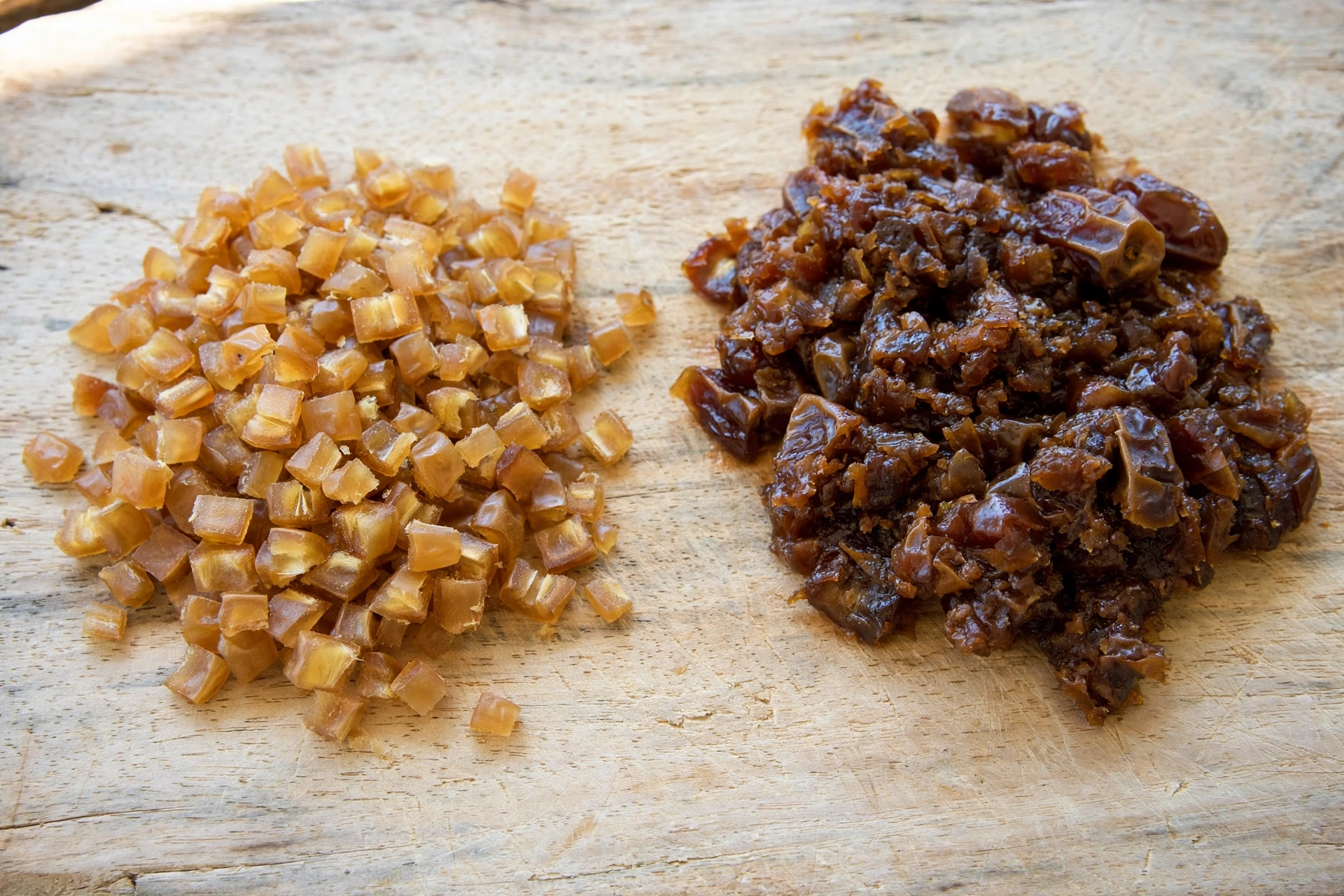
Deglet Noor originated in the oasis of Tolga in Algeria and spread to Tunisia at the end of the seventeenth century through a grower from Tozeur. Both countries built export industries on it. An FAO market study recorded Tunisia holding 48 percent of EU supply volume and 55 percent of EU import value in the early 2000s while producing only about 2 percent of world dates, almost all of it Deglet Nour. Algeria now reserves commercial use of the “Deglet Nour” label for Algerian fruit.
Zahidi, from Iraq and Iran, is the budget version of the same logic: semi-dry, firm, very sugary, cheap and sold at three different firmness levels. It is the date that ends up in industrial fillings and pastes.
Thoory, from Algeria, is the genuinely dry option, with firm to brittle flesh, a nutty flavour and near-indefinite keeping. Dry dates like this were historically called bread dates, and they are the right choice for granola, trail mixes and anything that needs to survive being carried around.
For pastes and syrups, none of this matters. Appearance and structure are destroyed anyway, so the correct choice is whichever soft date is cheapest: Sayer from Iran and Iraq moves in large volumes at low prices for exactly this reason. See date molasses for technique.
Best for gifting
The answer: Ajwa for significance, Anbara and Piarom for scarcity.
Gifting is the one category where the fruit’s meaning matters as much as its flavour, and it is where the usual quality logic inverts.
Ajwa, from the Madinah region of Saudi Arabia, is the most given date in the world and not primarily because of how it tastes. It is oval, medium sized at a measured average of 11.41 g, dark skinned, and notably mild rather than sweet. First-time buyers are often surprised by how restrained it is. Its position comes from its association with the Sunnah of the Prophet Muhammad ﷺ, which means millions of pilgrims to Madinah each year buy it to take home.
That demand is religious, not gastronomic, and it should be understood as its own category. No other variety substitutes for it, however good the substitute tastes. Madinah province has roughly 4.5 million date palms across about 70 varieties, of which around 800,000 palms are Ajwa, and that limited base against pilgrim-season demand is what holds the price up.
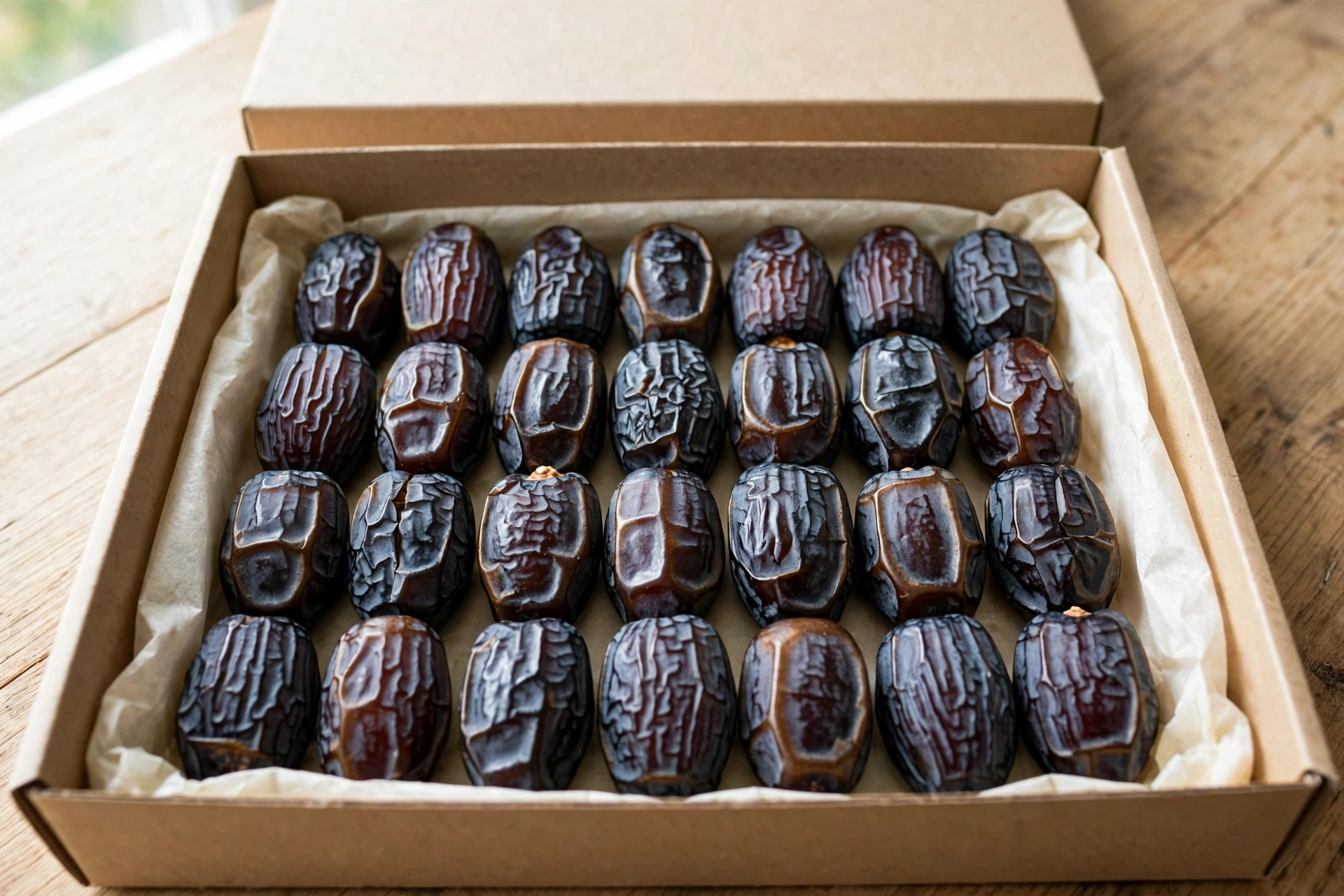
Anbara, also from Madinah, is the scarcity gift. Saudi Arabia’s national reference describes it as one of the kingdom’s rare palm yields: planting frequently fails, offshoots are expensive, and a mature palm yields no more than about 70 kg a year against roughly 250 kg for Barhi. The fruit is large and dark red with a pronounced aroma. Superior grade starts at 13 g per date.
Sagai, from the Riyadh region, is the most visually distinctive gift date: thick, roughly rectangular fruit with a pale firm tip and a dark soft base, giving it a two-tone look and an unusual crisp-then-soft bite. Superior grade starts at 14 g per date, about 35 dates per 500 g.
Piarom, from Hormozgan in Iran, is the non-Arabian premium: large, long, thin skinned, dark, semi-dry, with distinct toffee and chocolate notes. It commands some of the highest prices of any Iranian date.
Best value
The answer: Safawi from Madinah, and Iraqi or Iranian soft dates in bulk.
Value means flavour per unit of money, and it is where the premium names lose badly.
At a single Madinah retailer on 30 October 2026, these were the listed prices per kilogram, all inclusive of 15 percent Saudi VAT:
| Variety | 1 kg listed price | Approximate USD per kg |
|---|---|---|
| Safawi | SAR 32 | about USD 8.50 |
| Sukkari, luxury | SAR 40 | about USD 10.70 |
| Mabroom | SAR 60 | about USD 16 |
| Anbara | SAR 70 | about USD 18.70 |
| Ajwa, fourth class | SAR 56 | about USD 15 |
| Ajwa Quba | SAR 89 | about USD 23.70 |
| Ajwa, first class Alia | SAR 130 | about USD 34.70 |
Bulk shifts it further. Safawi in a 12 kg carton was SAR 264, or SAR 22 per kilogram, about USD 6.
Safawi is the standout. Soft, deep black, properly caramel-sweet, from the same region as Ajwa, at roughly a quarter to a third of the Ajwa price. In South Asia it is sold under the market name Kalmi: see Kalmi dates.
Khudri is the other volume value variety, semi-dry with a rich raisin-like flavour that suits both eating and baking: Khudri dates.
Sayer, Halawy and Zahidi are the cheapest useful dates in global trade. Nobody gifts them, and that is the point.
One caution on value. A price that is dramatically below the source-market rate is a reason for suspicion rather than celebration. A kilogram of “Ajwa” at a price close to ordinary dark dates is most likely a variety substitution, which is covered in the Ajwa dates price guide.
Most historically significant
The answer: Iraq for the industry, Egypt and Mesopotamia for the fruit itself, Madinah for the cultural weight.
Dates have been cultivated from Mesopotamia to prehistoric Egypt. Archaeological evidence of date cultivation in Arabia goes back to the sixth millennium BCE, with eastern Arabian evidence dated between roughly 5530 and 5320 calBC, and cultivation at Mehrgarh in the Indus region is dated to around 7000 BCE. The ancient Egyptians made date wine. The fruit is mentioned more than 50 times in the Bible and 20 times in the Quran, and the date palm is one of the Seven Species traditionally associated with the Land of Israel.
Iraq has the strongest claim on the modern industry. Barhi originated near Basra, and Zahidi, Halawy, Khadrawy, Dayri and Sayer are all Iraqi or Iraqi-associated cultivars that still underpin large parts of world production and processing. The varietal diversity is remarkable: a 1923 survey described about 370 date varieties in Iraq alone. The American date industry was effectively built on Iraqi material. Paul Popenoe and his brother collected roughly 9,000 palm offshoots from southern Iraq and Baghdad, introducing Barhi to the United States in 1913, and Californian plantings drawn from Algeria, Tunisia, Egypt and Iraq between 1890 and 1922 laid the foundation of the industry there.
Madinah carries the cultural weight rather than the agronomic history, through Ajwa and its place in Islamic tradition.
Iraq’s current standing illustrates how much of this is politics rather than horticulture. Once the dominant force in world dates, Iraq produced about 0.6 million tonnes in 2024, sixth globally, after decades of war, sanctions and the destruction of plantations.
Largest production: what the data says
The answer: Saudi Arabia and Egypt, effectively tied, at about 1.9 and 1.8 million tonnes.
Global production reached 9.9 million tonnes in 2024, according to FAOSTAT.
- Data year
- 2024
- UN FAO, Statistics Division (FAOSTAT), dates production quantity
| Rank by volume | Country | 2024 production (million tonnes) | Mainly known for |
|---|---|---|---|
| 1 | Saudi Arabia | 1.9 | Ajwa, Sukkari, Khalas, Safawi, Sagai, Khudri, Mabroom |
| 2 | Egypt | 1.8 | Zaghloul, Hayany, Siwi, mostly consumed fresh at home |
| 3 | Algeria | 1.3 | Deglet Nour, Thoory |
| 4 | Iran | 1.2 | Mazafati, Piarom, Sayer, Zahidi, Rabbi |
| 5 | Pakistan | 0.7 | Aseel, much of it processed into dry dates |
| 6 | Iraq | 0.6 | Zahidi, Halawy, Khadrawy, Barhi, Sayer |
| World | 9.9 |
Source: UN Food and Agriculture Organization, Statistics Division, FAOSTAT, dates production quantity 2024. The top four countries account for 63 percent of world output.

A few notes on reading that table honestly.
Egypt and Saudi Arabia swap places depending on the data year and the source. Earlier estimates using 2022 trade-database figures put Egypt first at nearly 18 percent of world output with Saudi Arabia just behind at about 17 percent. FAOSTAT’s 2024 figures have Saudi Arabia marginally ahead. Treat them as effectively tied and be suspicious of any page that states one of them as a settled fact without a year attached.
Saudi national figures and FAO figures differ. Saudi Arabia’s General Authority for Statistics reported about 1,923 thousand tonnes for 2024, a 1 percent rise on 2023, from more than 37.6 million palms of which over 32 million are fruit bearing. Saudi Arabia’s own national reference quoted 1.6 million tonnes as of 2023. Different collection methods produce different numbers for the same crop.
Volume and export value are different competitions. Tunisia produces only about 2 percent of world dates but has held over half the value of EU date imports, because it concentrates on one high-value export cultivar. Israel is described as one of the world’s largest exporters on the strength of Medjool, with 2022 Medjool exports estimated at USD 330 million. Egypt’s enormous crop barely registers in Western retail because most of it is eaten fresh domestically.
Smaller producers matter more than their rank suggests. Oman produced 396,775 tonnes in 2024, of which Khalas was about 15 percent, Naghal 12 percent and Fardh 9 percent. The United Arab Emirates accounts for roughly 6 percent of world production and is the main source of premium Khalas. The United States grows dates on only about 5,600 acres in California, more than 95 percent of US production, almost entirely Deglet Noor and Medjool.
So which country has the best dates?
If you want one answer, here it is, with the reasoning attached.
For the widest range of genuinely distinct high-quality varieties: Saudi Arabia. Around 300 named varieties across 34 to 37 million palms, and it is the only country producing a top-tier variety in each category: Ajwa for significance, Sukkari and Khalas for eating, Anbara and Sagai for gifting, Safawi and Khudri for value.
For the single best eating date: Morocco and Israel, through Medjool.
For the best cooking date: Algeria and Tunisia, through Deglet Nour.
For the most interesting dates most people never taste: Iran and Iraq, through Mazafati, Piarom, and Barhi at khalal.
What should not drive the decision is production volume, brand marketing or a seller’s ranking. Buy for the job you want the date to do, and taste across at least one soft, one semi-dry and one dry variety before deciding you have a favourite. The classification that makes those three categories meaningful is set out in other date varieties.
Frequently asked questions
Which is the most expensive date in the world?
Several varieties compete for the title and the claim is usually made without evidence. In Saudi retail, first class Ajwa was listed at SAR 130 per kilogram on 30 October 2026, well above Sukkari, Mabroom and Anbara at the same seller. Internationally, premium Ajwa and Iranian Piarom both reach USD 30 to 40 per kilogram. Rare single-estate lots can exceed that, but those prices are not representative of a variety.
Are Ajwa dates the best dates?
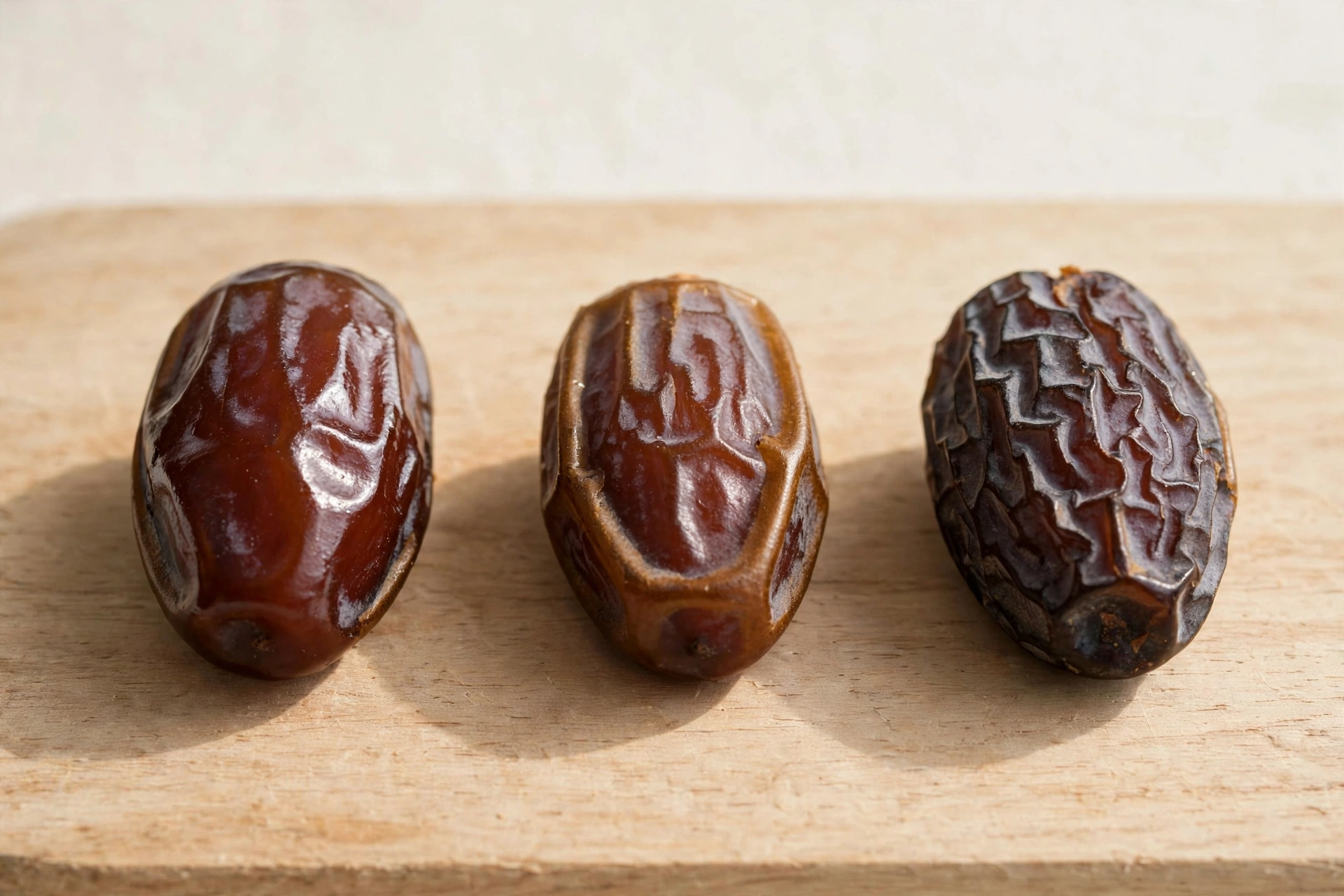
They are the most significant, which is not the same thing. Ajwa is mild rather than sweet and relatively firm, and many people who try it expecting an intense premium date find it understated. If you want the religious and cultural association, nothing substitutes for it. If you want the most pleasurable date to eat, you may prefer Medjool, Sukkari or Mazafati.
Which country exports the most dates?
Export leadership depends on whether you measure volume or value, and the two give different answers. Tunisia has historically dominated EU import value with Deglet Nour despite a small crop, Israel leads on Medjool value, and Iran and Iraq move large volumes of lower-priced fruit. Production rank and export rank do not match: Egypt is at or near the top for production and well down the list for exports.
Are Saudi dates better than Egyptian dates?
They are different markets rather than different quality tiers. Saudi production is oriented towards named premium varieties for domestic sale, gifting and export. Egyptian production is enormous and mostly consumed fresh at home, including varieties like Zaghloul that are eaten crunchy at the khalal stage and would not survive export. Egypt is not producing a worse date, it is producing a date for a different purpose.
Is a more expensive date actually better?
Only for the things price tracks: size, cosmetic uniformity, scarcity and prestige. Grade in particular is a cosmetic and size judgement, not a nutritional one. If the dates are going into a paste, a smoothie or a batter, paying premium grade prices buys appearance you are about to destroy.
How do I taste dates properly to find what I like?
Buy small quantities of three dates from different classes, for example a Medjool for soft, a Deglet Noor for semi-dry and a Thoory or Zahidi for dry, and eat them at room temperature, plain, in that order. Most people discover their preference is about texture rather than sweetness, which is not what they expected to find.
Sources
- UN Food and Agriculture Organization, Statistics Division, FAOSTAT, dates production quantity 2024 (world 9.9 million tonnes; Saudi Arabia 1.9, Egypt 1.8, Algeria 1.3, Iran 1.2, Pakistan 0.7, Iraq 0.6; top four 63 percent of output)
- General Authority for Statistics, Saudi Arabia, 2024 Agricultural Statistics publication (1,923 thousand tonnes, up 1 percent on 2023; 37.6 million palms, over 32 million fruit bearing)
- National Centre for Statistics and Information, Oman, 2024 date production (396,775 tonnes; Khalas 15 percent, Naghal 12 percent, Fardh 9 percent)
- FAO, The World Market for Dates working paper (Tunisia 48 percent of EU supply volume and 55 percent of EU import value against about 2 percent of world production; Algeria, Iran, Israel, US and Pakistan EU supply positions)
- FAO, Date Production and Protection, composition chapter (soft, semi-dry and dry classification; invert sugar type; Deglet Noor sucrose exception; Iraq variety count of about 370 from Dowson, 1923)
- Al-Khayri, J. M., Jain, S. M. and Johnson, D. V. (eds.), Date Palm Genetic Resources and Utilization, Springer, 2015 (cultivar origins and descriptions for Medjool, Deglet Noor, Barhi, Zahidi, Thoory, Mazafati, Piarom, Sayer, Halawy, Khadrawy, Dayri, Safawi, Sukkari, Khalas)
- Saudipedia (Saudi national reference), list of date varieties in Saudi Arabia plus the Ajwa, Barhi, Khalas, Sagai and Anbara entries (about 300 varieties, 34 million palms, 17 percent of world output; Madinah province 4.5 million palms, 70 varieties, about 800,000 Ajwa palms; Anbara yield of up to about 70 kg per palm against about 250 kg for Barhi; superior grade minimum weights)
- University of California Agriculture and Natural Resources, date varieties in California (Swingle’s Deglet Noor introduction in 1900 and Medjool in 1927; Medjool’s likely Tafilalt origin; about 5,600 acres and over 95 percent of US production)
- Specialty Produce, Barhi date reference (Popenoe brothers’ 1913 introduction and roughly 9,000 offshoots collected in southern Iraq and Baghdad; khalal eating characteristics)
- Wikipedia, Date palm, Deglet Nour and List of date cultivars, used as index pages to the FAOSTAT table, Munier’s history of Deglet Nour and the Al-Khayri et al. cultivar descriptions, including archaeological dating for Arabia, Mehrgarh and the Levant
- Fruit weight reference for Ajwa: Lipids in Health and Disease, 2019, date variety texture and fruit weight table (11.41 g average)
- Al Jazeera, Ramadan date production and trade reporting, 2024 and 2025, citing Tridge (2022 world total about 10 million tonnes; Egypt nearly 18 percent, Saudi Arabia about 17 percent, Algeria about 13 percent; Israeli Medjool exports USD 330 million in 2022)
- FreshPlaza reporting on the TasteAtlas 2025 best-rated dates ranking, January 2026 (top-rated entry was a producer’s organic Medjool from Boudnib, eastern Morocco, scoring 4.8 out of 5)
- Munwra Dates Store (Madinah) listings read on 30 October 2026: Safawi 1 kg SAR 32 and 12 kg SAR 264, Sukkari luxury 1 kg SAR 40, Mabroom 1 kg SAR 60, Anbara 1 kg SAR 70, Ajwa fourth class SAR 56, Ajwa Quba SAR 89, Ajwa first class Alia SAR 130. SAR is pegged at 3.75 to USD 1; Saudi retail prices include 15 percent VAT
Where to go next

Amira Noor writes about Ajwa dates, their origin in Madinah, nutrition and heritage, with clear, practical guides for readers.